
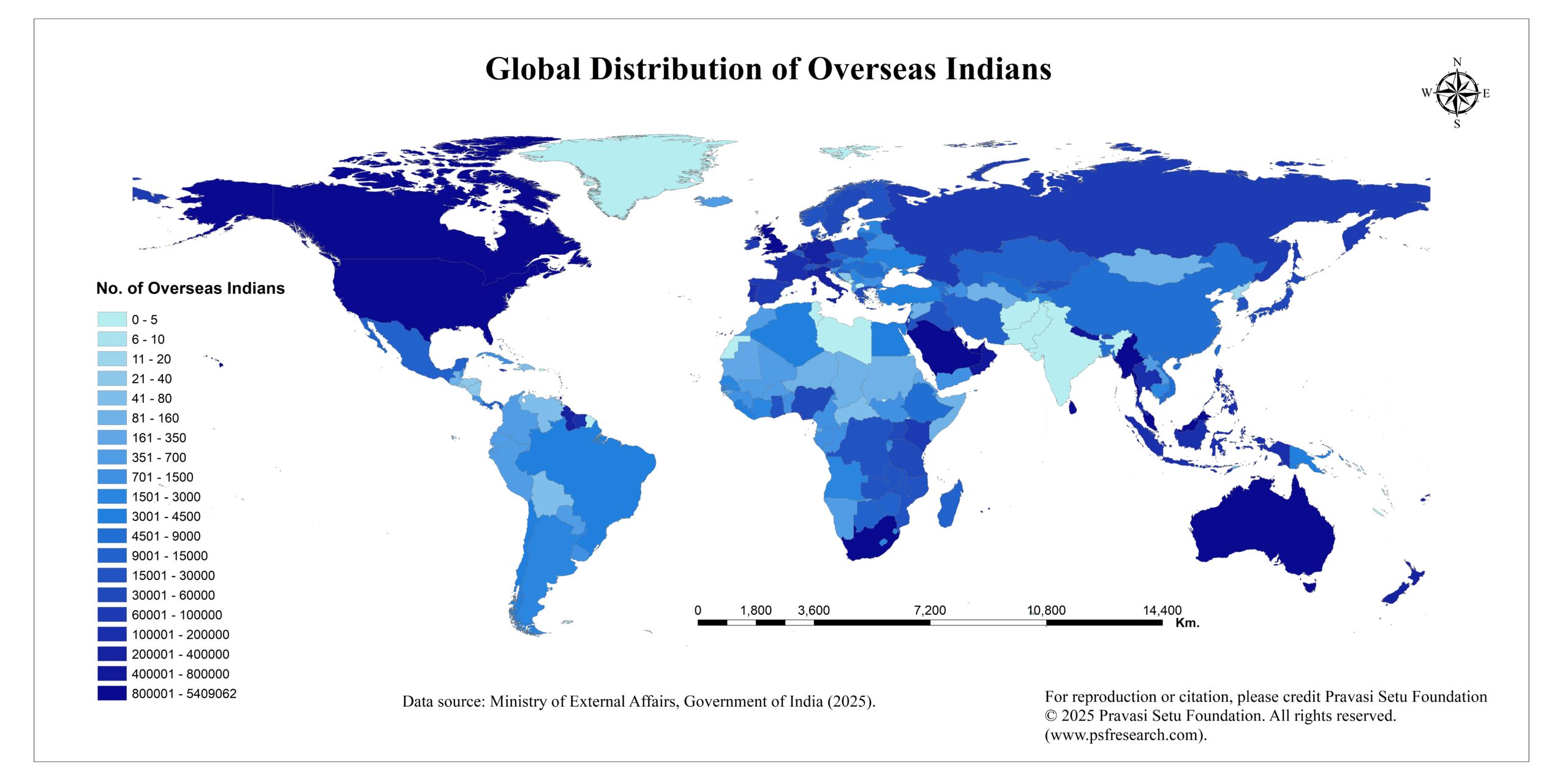
India’s relationship with its diaspora, which is most widespread across the world, has oscillated through ups and downs. In the post-Independence era, the Indian government’s policies towards the Indian diaspora were limited to cultural and humanitarian contacts; hence, overseas Indians were considered the forgotten children of the motherland India (Lal et al., 2006, p. 84). The shift in the diaspora policy can be observed in the 21st century, with the Indian government forging socio-economic and political connections with its long-lost powerful community. This change can be largely credited to the economic reforms undertaken by the Indian government in the 1990s. The liberalised economy opened up the Indian markets for the diasporic community for investment and trade. The Overseas Indians who were till then accused of “brain-drain” were now recognised as a source of “brain-circulation” (meaning the return migration that started from the 1990s, wherein skilled Indian diaspora came back with their knowledge to serve India), thus helping India in its growth and development. (B. Rashmi & S. Smriti, 2021)
Famously called as the world’s largest diaspora population, India boasts a total of 35.4 million people who reside outside the country for various purposes. Serving as a major source of foreign remittances to India, this valuable population not only boosts our economy but also represents the nation at various levels and, therefore, is a precious asset to this country. Indian diaspora is spread across the world with key hubs including the USA, UAE, Malaysia and Canada. The diaspora population is roughly demarcated into two categories, comprising the Non-Resident Indians (NRIs) and the Persons of Indian Origin (PIOs). Making the most of our diaspora in every space and sector is seen as an expansion of India’s soft power. They have a significant impact on the globalisation of the economy of India and also proliferate the rich Indian culture. They also have an incredible political impact, with some of them holding key positions in the legislatures of various countries. Despite all these achievements and the undeniable significance of the Indian diaspora, the policy development since independence, with respect to this, has been slightly slow-paced, leading to a certain form of disconnect between the homeland and the diaspora. This kind of disconnect leads to a lot of untapped potential and thus requires adequate policy intervention to enhance the relationship between India and its highly valuable diaspora across the globe.
Background and Context:
- Significance of the Singhvi Committee Report:
The groundwork in this space was started in September 2000, under the aegis of Dr L M Singhvi, wherein a high-level committee on the Indian diaspora was set up under his chairmanship. It was tasked with the preparation of a comprehensive report on the Indian diaspora, informing the Indian public of the achievements of the Indian Diaspora, sensitising it to their problems and their expectations from their mother country, proposing a new policy framework for creating a more conducive environment in India to leverage these invaluable human resources. The report contained the detailed conclusions and recommendations of the Committee on the entire gamut of the expectations, needs and requirements of the government’s agenda for the Indian Diaspora.
The key recommendations of the Singhvi report (which was submitted on January 8, 2002) discussed various topics and are briefed below as follows:
- Dual Citizenship: Recommended amending the Citizenship Act to allow dual citizenship for PIOs in certain countries, thus culminating in the Overseas Citizenship of India (OCI) Scheme.
- Institutional Framework: Proposed the creation of a dedicated body to handle diaspora affairs, leading to the creation of the Ministry of Overseas Indian Affairs.
- Pravasi Bharatiya Divas: Advised the acknowledgement of the contributions of the diaspora, leading to the observance of 9th January as Pravasi Bharatiya Divas every year.
- Economic & Social Engagement: Encouraged leveraging the diaspora for investments in education, health, and science & technology.
- Strengthening Connectivity: Initiating projects like the Know India Programme and Tracing the Roots Scheme for the younger diaspora to connect with their roots.
- Support Services: Suggested improving airport facilities, creating Pravasi Bharatiya Bhavan, and providing better grievance redressal for diaspora members.
Dr L. M. Singhvi very aptly quoted the following;
“The Indian Diaspora is a rainbow, and if I may say so, my head soars with a fond aspiration, and my heart leaps with boundless joy when I behold the rainbow of India and Indians over the globe. I also behold and hope for the globalisation of India in the right perspective and Indianisation of the globe in the right proportion, with our Indian Diaspora as the catalyst for cross-fertilisation. This congregation and this auspicious beginning will, I hope, build a global Diaspora network of bridges or what was called in Indian antiquity, Setubandhanam.” (S. Kamala, 2017)
The committee had noted: “This is the first time that Bharat engaged every segment of her diverse diaspora in an extensive consultation and interface”. In addition, the committee noted that “The opening up of Bharat’s economy in the post-1990 led to a dramatic change in the regime’s approach towards diaspora communities”. The committee strongly believed that now (2000s) was the time to involve the Bhartiya diaspora, in multifarious ways, in the economic rejuvenation of Bharat and revive their sense of belonging with Bharat”. (M. Rohit, 2024)
The observations and conclusions of the Committee helped in laying the foundation stone for a sound framework of policy approach for a mutually beneficial and incremental interaction between Bharat and her Diaspora. In India and its Diaspora, there is today a greater awareness, a deeper engagement and renewed enthusiasm and optimism for the new thresholds of opportunities to relate to India. (M. Rohit, 2024)
- Policy Developments under Atal Bihari Vajpayee’s Government:
- PM Atal Bihari Vajpayee created an institutional mechanism, such as the Office of Chief Commissioner (NRIs) under the aegis of the Ministry of External Affairs (MEA) in 1999. However, the NRI/PIO Division, headed by an officer of the rank of an Additional Secretary in the Ministry of External Affairs in the 2000s, was responsible for looking comprehensively at diaspora issues.
- The first policy to reach out to the Bhartiya diaspora began in 2003 when Atal Bihari Vajpayee initiated a celebration of ‘Pravasi Bhartiya Divas’ on the 9th of January, which marks the day when Mahatma Gandhi returned to Bharat from South Africa. The government decided to celebrate it annually by holding events that bestowed awards on prominent members of the Bhartiya diaspora.
- In post-LPG times, the leadership aptly recognised the significance of the diaspora community for Bharat’s economic growth. Thus, they started building bonds with them by developing various policies to connect the diaspora community of every corner of the globe; since then, it has remained an essential agenda of successive governments.
- Developing various foundational infrastructures to connect the diaspora with their homeland led to the evolving ‘Diaspora diplomacy’ as a critical component within the ambit of the foreign policy of Bharat.
- Introduced the PIO Card Scheme in 1998, a major initiative designed to ease travel and residency restrictions for people of Indian origin, allowing them to visit India without a visa. The foundational work of the OCI Scheme of providing a quasi-dual citizenship framework was initiated as a means of offering lifelong visa-free travel and economic rights.
- Strengthened the economic engagement and investment, post-nuclear tests, to counter economic sanctions by launching the Resurgent India Bonds (1998) and the Millennium Deposit Scheme (1999). These were supported by diaspora, raising millions of dollars.
PM Vajpayee is widely credited as a diaspora champion who rebuilt the links with those who had left their homeland. He reshaped India’s outreach, treating the diaspora as a strategic asset rather than merely as passive expatriates.
Policy continuity & changes:
Post-Vajpayee government, India’s diaspora policy has shifted from passive engagement to active leveraging, transforming overseas Indians into strategic assets and soft power ambassadors. One of the major achievements of diasporic involvement was their lobbying to push the India-US Civil-Nuclear agreement through the US Congress in 2008, which ended India’s decades-long nuclear isolation in 2007 under Dr Manmohan Singh’s government. The increasing political influence of the Indian diaspora in the US and the political support given by them to pursue the nuclear deal were of great value for India. While the policy continued to emphasise economic engagements pioneered under the Vajpayee government, the later Governments, especially the Modi government, amplified this into diaspora diplomacy aimed at strengthening bilateral relations, attracting technology, and promoting cultural influence.
- Aspects of policy continuity:
- Institutional framework: The foundation led by the Vajpayee government, based on the LM Singhvi Committee report, has continued, with Pravasi Bharatiya Divas staying as the landmark event for the Indian diaspora.
- Economic focus: The focus on encouraging remittances and investments remains intact.
- Strengthening ties with Western diaspora: Attracting the prosperous Indian community based in the US, UK, and Canada for technology transfer and lobbying remains robust.
The objective of the current government’s foreign policy with respect to the Indian diaspora can be understood through a mix of strategic, economic, cultural and political goals. Since taking office in 2014, PM Modi has emphasised the importance of the Indian diaspora as a key pillar of India’s global engagement (P.Manas & M. Bindushree, 2025, p.2). The breakdown of objectives is as follows:
- Strengthening India’s global influence through the diaspora, soft power diplomacy and public engagement.
- Economic diplomacy and investment, promoting FDI and economic ties, startups and innovation.
- Political and strategic support for building political alliances in international forums.
- Cultural and civilisation links for reviving cultural identity.
- Consular and welfare services for protecting Indian citizens abroad.
- Visible changes in diaspora policy that are based on the above objectives:
- Merger of classifications of PIO into the OCI card scheme. It strengthened the combined scheme by providing more lifelong privileges and streamlining the process of engagement.
- Aggressive engagement: The approach has moved towards more proactive and high-profile outreach seeking their active involvement through mass public events abroad. (example, events like Howdy Modi!)
- Soft power and branding: Under the current government, the diaspora is utilised to promote India’s image globally and facilitate initiatives like ‘Make in India’ and ‘Digital India’, treating them as key contributors to soft power.
- Crisis response: The government has enhanced the responsiveness of the ministry to provide protection and evacuation services to diaspora members in crises. (example in Yemen, Iraq, and during the COVID-19 pandemic)
Transitions in diaspora engagement strategy in various sectors:
- Economic transition: The strategy has changed from encouraging simple remittances to harnessing high-value capital and intellectual property. Diaspora members, especially from Silicon Valley, have started investing in 110-plus Unicorn companies, thus inducing startup maturation. The government is leveraging Indian-origin CXOs to encourage global firms to set up R&D and high-end engineering hubs in India, that is, Global Capability Centres. NRI deposit schemes saw investments nearly double to $7.8 billion in early 2024, supported by simplified FDI norms and OCI cards that facilitate property ownership and banking.
- Cultural transition: From preservation to soft power, the engagement has moved beyond simple heritage preservation to actively employing the diaspora as ambassadors of Indian culture and soft power. Initiatives like Pravasi Bharatiya Divas and the Know India Programme target the diaspora has institutionalized cultural diplomacy. India’s cultural footprint has been amplified through the promotion of Yoga, Ayurveda, and festivals like Diwali by the Indian diaspora, leading to globalization of Indian culture. The ‘Chalo India’ program aims to promote tourism via the diaspora by encouraging them to urge their non-Indian friends to visit India, turning the diaspora into brand ambassadors.
- Strategic transition: The VAIBHAV Fellowship and VAJRA schemes are bringing top-tier diaspora are bringing top-tier diaspora researchers for collaborative, cross-border innovation in frontier areas like AI, quantum computing, and semiconductors. The government has proactively used its diplomatic missions (MADAD portal, e-Migrate) to ensure the safety of Indian workers, demonstrating a robust capability to evacuate thousands from conflict zones. The government has facilitated advisory roles for tech leaders from the Indian diaspora in the India Semiconductor Mission advisory board.
Apart from these transitions, expatriate academics and wealthy alumni are fundamentallyrestructuring India’s higher education landscape by infusing global pedagogical standards and massive financial endowments. Trailblazing institutions like Ashoka University and Plaksha University were substantially bankrolled by diaspora entrepreneurs seeking to replicate Ivy League research models in India. Furthermore, diaspora academics have been crucial in advising the regulatory frameworks that recently allowed foreign universities, like Deakin, to establish campuses in GIFT City.
Non-resident medical professionals are systematically elevating India’s healthcare capacity through sustained mentorship, telemedicine frameworks, and targeted infrastructure investments. Groups like the American Association of Physicians of Indian Origin (AAPI) frequently run specialised training clinics and donate advanced diagnostic equipment to underfunded rural Indian hospitals. During recent public health crises, these robust networks rapidly mobilised specialised task forces and facilitated the immediate transfer of critical respiratory technologies to India.
Critical evaluation of policy effectiveness and implementation gaps:
While there is an incredible transition in diaspora policies across various governments, right from the 2000s till now, the policy effectiveness still seems to lag. Especially in times as uncertain as these, where wars and sudden unrest seem to happen quite frequently, the safety net for our diaspora population doesn’t seem quite as strong. Although we do conduct speedy evacuations when needed, it doesn’t ensure any job security or means of livelihood once the diaspora population returns from crisis-stricken areas. Also, the engagement with the diaspora has been inconsistent, with the absence of dual citizenship being one of the major long-standing issues.
As much as we strive to bridge the gap, some concerns persist. Some of them have been listed as follows:
- Lack of centralised database: This significantly hampers the Indian government’s ability to provide essential services like effective welfare, emergency assistance, and policy engagement. While platforms like MADAD and e-Migrate exist, they are fragmented and do not provide a distinct, unified picture of the diaspora’s distribution, skills, or specific locations. Key aspects of the data gap include:
- Voluntary registrations with Indian embassies and missions lead to massive gaps in tracking the exact number of the diaspora population.
- Invisible diaspora, i.e., illegal migration, makes it extremely tricky to maintain an accurate database.
- Inefficiencies and too much scattering of data amongst multiple ministries make it difficult to obtain real-time information on migrants.
- Blue-collar workers, particularly in the Gulf countries, are vulnerable to fluctuating labour markets and poor conditions of accommodation in the host nation. The 2024 fire incident in Kuwait killed almost 50 migrant workers, of whom 46 were Indian. Lack of an integrated database makes it difficult to track the vulnerable diaspora population in crises like these.
- Absence of dual citizenship: While the OCI card acts as a gateway to various opportunities for the diaspora population, it cannot be a replacement for dual citizenship. It restricts the civil and political rights of the diaspora population. The gaps lie in the fact that high-net-worth individuals and senior researchers frequently cite the lack of dual citizenship as the primary barrier preventing their permanent relocation or establishment of deep-rooted infrastructure in India. Unlike nations like Ireland or Israel, India’s strict single-citizenship policy forces the $730-billion-earning diaspora to ultimately align their long-term sovereign loyalties elsewhere. A critical gap that needs to be highlighted is that, despite having legal provisions, the requirement to be physically present to vote undermines the political right of most of the expatriates to participate in elections.
- Bureaucratic red tape: Bureaucratic paralysis has been one of the defining gaps, especially in R&D collaborations. Outdated intellectual property frameworks and rigid academic hierarchies stifle the transfer of frontier technology and scientific brain circulation. Slow procurement, administrative apathy, and unclear patent-sharing laws bog down the ambitions of enthusiastic diaspora researchers who want to contribute to India’s deep-tech innovations. The VAIBHAV fellowship suffers from execution delays due to slow inter-ministerial approvals. Expatriate researchers in Western universities find it difficult to seamlessly integrate Indian datasets into collaborative global models due to restrictive domestic data localisation laws.
- Strict regulations under the Foreign Contribution (Regulation) Act (FCRA) have significantly impacted the ability of the Indian diaspora to contribute to philanthropy. These strict rules have created a lot of paperwork and red tape, which has limited the capacity of grassroots organisations to receive foreign donations. This has hindered the potential for meaningful social impact through diaspora-funded initiatives, especially in fields like health and education. Many NGOs have lost their licenses, which has disrupted critical projects aimed at improving rural communities. For example, in 2025, notable diaspora networks saw a major decline in their ability to fund climate resilience efforts in rural areas due to these strict compliance requirements.
- Complex tax rules and multiple regulatory frameworks discourage non-resident Indians from making long-term investments or starting businesses in India. The lack of clear guidelines for repatriating funds and overlapping tax authorities creates significant obstacles. Recent analysis shows that even with some easing, compliance with the Foreign Exchange Management Act (FEMA) still causes delays in funding for diaspora-backed startups compared to funds from within India. Additionally, changes in the Tax Collected at Source (TCS) system and discussions on inheritance taxes create uncertainty for the 35 million members of the diaspora, making long-term financial planning difficult.
- Diplomatic tensions and geopolitical issues have also affected the unity of the diaspora. These conflicts have caused divisions within diaspora communities, which can undermine their role as a valuable source of soft power. When relations with key Western countries suffer, the diaspora often becomes a target, which can hinder diplomatic efforts and economic partnerships. For instance, the strained relations between India and Canada led to visa suspensions and a halt in trade negotiations, which directly affected diaspora-led businesses and academic exchanges. Similarly, tensions with the US have led to increased scrutiny on Indian expatriates, prompting some to maintain a distance from political activities supporting India to avoid local backlash.
Possible Policy Solutions for a better diaspora engagement:
To effectively implement policies that transform the diaspora into a strategic development asset, collaboration among different stakeholders is essential. This includes governments in host countries and India, the diaspora itself, the bureaucracy, institutions focused on diaspora issues, and families of diaspora members in India. Based on the identified gaps in implementation, possible policy solutions can be outlined to support long-term engagement with the diaspora:
1) A unified digital platform should be developed to digitally map and engage with the global Indian talent pool. This platform should facilitate real-time matching between specialised expatriate skills and domestic needs, streamline cross-border mentorship and intellectual property sharing, and reduce administrative barriers. While there are ongoing efforts to integrate foreign missions with the Global Passport Seva, more complete systems are needed, especially in states like Kerala and Punjab that are exploring structured emigration tracking.
2) Expanding the benefits of the Overseas Citizens of India (OCI) status is crucial. Although full dual citizenship is not constitutionally allowed, enhancing specific investment opportunities or easing business operations could help. Allowing OCI holders to participate in local government and Panchayat activities could help leverage their expertise. Proposed dual citizenship arrangements with strategic partner nations, while avoiding sensitive or political roles, could also be considered.
3) A graded regulatory clearance mechanism should be introduced for verified diaspora networks. This mechanism would allow fast-track approvals and support outcome-based facilitation, helping to maintain critical social impact investments. This would assist in the smooth transfer of diaspora wealth into sectors like healthcare and rural welfare.
4) The Finance Ministry should establish sovereign-backed co-investment funds that match diaspora investments in early-stage startups. This would reduce the risks of frontier investments by offering government guarantees to diaspora angel investors. By harmonising foreign exchange regulations and creating a faster taxation clearance process, the government can remove financial barriers that deter transnational capital.
5) Educational regulators should introduce a fast-track framework enabling diaspora academics to hold endowed, dual-affiliation faculty positions at top Indian universities. These roles should allow complete freedom in curriculum design, grant management, and cross-border research without requiring physical presence. This approach would help retain global talent and improve educational standards by integrating non-resident scholars into academic institutions. It would also ensure the success of fellowships like VAIBHAV effectively on the ground
While these policy solutions show a path towards making more robust and inclusive policies towards the Indian diaspora, more genuine intent and strong will are required to convert the diaspora population into a strategic asset. As we move speedily towards our goal of ‘Vikasit Bharat’, we need a more deep-seated institutional engagement with this vast population. By dismantling regulatory barriers and fostering high-value R&D corridors, the state can convert emotional affinity into a sustainable pipeline of technology, capital, and global influence. Treating overseas Indians as a distributed national asset rather than mere emigrants will provide the necessary macroeconomic ballast and innovative edge for 21st-century growth. Ultimately, the diaspora’s role as a force multiplier in deep tech and diplomacy will define India’s trajectory as a leading global power. As Prime Minister Modi has rightly said, ‘Let us view our diaspora not only in terms of ‘Sankhya’ (number/quantity) but let us see it as ‘Shakti’ (power/strength)’, we must see to it that we transform this statement into reality very soon.
Bibliography:
- Ministry of External Affairs, Government of India, In a major initiative, the Government of India had set up a High-Level Committee on the Indian Diaspora, in September 2000 under the Chairmanship of Dr L M Singhvi, MP, January 8, 2002.
- Lal, B. V., Reeves, P., & Rai, R. (Eds.), The Encyclopedia of the Indian Diaspora. Singapore: Editions Didier Millet, 2006.
- Kamala Singhvi, Archives of contemporary India, Ashoka University, 2017.
- Rohit Mule, Evolution of ‘Diaspora’ as an essential factor in Bharat’s foreign policy of the 21st century, September 11, 2024. Pg no. 202.
- Dr Rashmi Bhure, Ms Smriti Singh, Diaspora a key in strengthening India-US relations under the Modi government, Fins India, October 15, 2021.
- Manas Ranjan Pati, Dr Bindhushree Mishra, Rethinking Modi’s Vision on Indian Diaspora, International Journal for Multidisciplinary Research (IJFMR), May-June 2025, Pg no. 2.
- Lok Sabha Documents, Committee on External Affairs, Twenty-fifth report, December 2023, Pg no. 7.
- Disha IAS, Transforming India’s diaspora into a strategic national asset, April 3, 2026

Leave a Reply