

Introduction
The international migration flows have significantly led to the formation of the global diaspora population which serves as a bridge between the societies by enhancing strategic connections and has emerged as an essential component in the globalization process by bringing people together from different national, socio-economic, political, and cultural backgrounds. According to the UN, the number of international migrants comprises ~ 304 million people globally which represents 3.7% of the world’s population. Today, foreign relations signify interconnectedness between populations of various countries. In recent years, where governments have become increasingly people-centered, one of the leading agents of diplomacy is the people themselves. This has made the diaspora an effective diplomatic agent. According to the UNDESA International Migration Stock 2024, the Indian diaspora (~18 million) stands as the largest diaspora in the world with its noteworthy policy initiatives towards diaspora engagement, often making headlines as a lesson for other country’s diaspora engagement strategy. Similarly, it is required to look beyond, for analyzing the structural gaps and reforms required for building a more effective diaspora relationship with changing times. For this, the diaspora engagement policies of other top diaspora countries such as Mexico (~ 11.6 million) and China (~ 11.7 million) can provide comparative insights in understanding the critical areas of development for stronger ties with diaspora people. These two countries provide different approaches for the diaspora governance and engagement model.
This paper evaluates the diaspora engagement programs of China and Mexico with the institutional mechanisms and policy frameworks, tools of engagement and comparative analysis across countries so that important lessons can be examined for strengthening India’s diaspora policy framework and programs related to it.
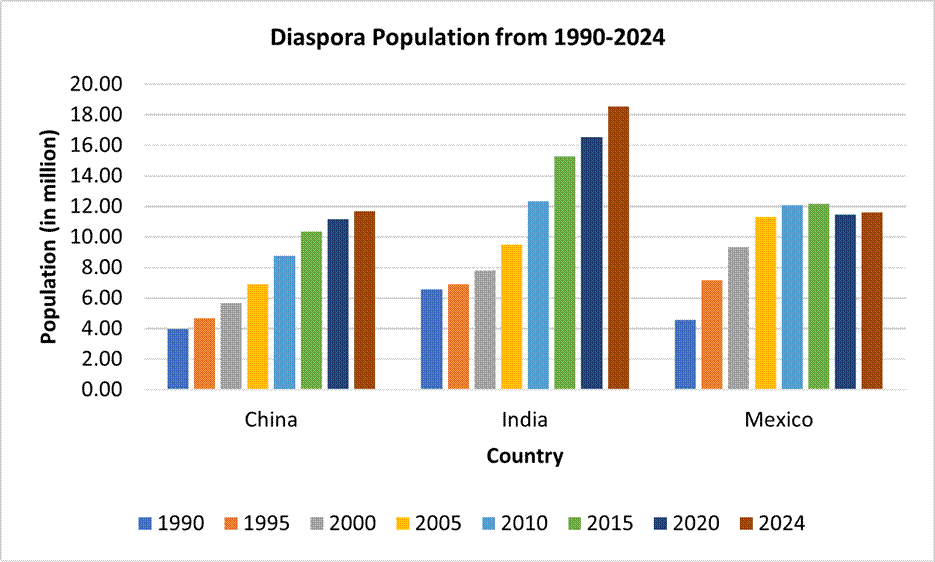
Source: UN DESA International Migration Stock (2024)
Overview of India’s diaspora policies
India is a pioneer in recognizing the importance and valuable contributions of its community abroad. The Government of India has put in place the necessary institutional support for NRIs and OCIs to maximize their global success in countries of destination, while embracing the diversity of contributions to their communities of origin. Important initiatives such as the Overseas Citizenship of India (OCI) Card Scheme provides lifelong visa-free travel to India for Persons of Indian Origin (PIOs), allowing them to live, work, own property, and invest in India without restrictions. Pravasi Bharatiya Divas (PBD) is a flagship event for the Indian diaspora. It is hosted every two years on January 9th to mark the contributions of the Indian community abroad in the development of India. During the convention, selected overseas Indians are honored with the prestigious Pravasi Bharatiya Samman Award to recognize their contributions to various fields both in India and abroad. Other initiatives such as the Know India Program and Tracing the Roots help the younger generation to understand their cultural roots and maintain their relation with their country. Along with cultural engagement, the government has introduced welfare measures like the Indian Community Welfare Fund (ICWF), the MADAD portal, and the e-Migrate system to support and protect Indians living and working abroad (Fatima 2026, 4667-4670).
In recent years, India has also tried to involve the diaspora more actively in economic development through investment opportunities, business partnerships, and knowledge sharing. These initiatives reflect India’s broader effort to build long-term and meaningful relationships with its diaspora communities across the world.
China and its diaspora strategy
China has one of the most influential diasporas in the world. Since the mid-19th century, there was significant outbound migration as a result of European imperial powers opening up Chinese port cities, and Chinese labor was exported to plantations and mines in the Caribbean, North America, Southeast Asia etc. China provides an ideal lens to investigate the roles of diasporas in homeland geopolitics.
How China engaged with its diaspora people?
The history of China’s diaspora engagement is way similar with that of India where post-independence, the governments of both these countries disassociated itself with their overseas people. It was only during the late 1970s when China opened its borders for outward migration after the policies of reform and openness, which resulted in an increased pace of migration since the 1990s (Carbonnier 2011, 181-196). Since the late 1970s, China’s economic growth has been largely supported by overseas Chinese communities living in the Asia-Pacific region. The government then largely relied on the investments from overseas people. To encourage this support, the Chinese government introduced policies and laws to institutionalize the diaspora’s legal privileges in terms of social welfare and economic well-being. As a result, China saw rapid economic development. The overseas Chinese communities helped in expansion of Chinese investment abroad by turning it into a FDI source-country which led to the changes in patterns of diaspora engagement. The diaspora business networks strengthened in connecting China with global markets. These business networks serve for more strategic purposes such as, the Chinese Chamber of Commerce in many countries often acts as a link on behalf of the Chinese government by cultivating relationships with high-ranking officials in host countries as well as with business communities (Adamson and Han 2024, 476-493).
Diaspora and its approaches in China
Many scholars find that the relationship between the state and diaspora people is based on two approaches. The first one is the state-centered approach, where the government tries to maintain its influence over people living abroad which is like an effort to extend powers beyond territorial borders. The second approach considers diasporas to be actors in their own right, with their increasing role implying a decline in the power of nation-states. It focuses on the idea of ‘transnationalism’ where migrants continue to maintain strong social, economic, and cultural ties with their host country as well as the country of their origin.
The role of the state remains highly debated in research on contemporary China. Before economic reforms, most of the studies focused majorly on the controlled nature of the state. However, after the reform period; the state-society paradigm was viewed as a ‘balanced alliance’ between state and society and acknowledges the impact of social dynamics on the state, while the globalization paradigm recognizes the influence of global dynamics (Liu and Dongen 2016, 806-807).
The overseas Chinese policy apparatus: the ‘Five Overseas Chinese Structures’
The transnational aspect and the interaction between public and private actors can be seen from the system for ‘overseas Chinese work’ (Qiaowu Gongzuo). It consists of five interrelated governmental and semi-governmental institutions operating at national and local levels (Liu and Dongen 2016, 809). These five institutions are:
- The State Council Overseas Chinese Affairs Office (OCAO) ‘Guowuyuan qiaowu bangongshi’ or ‘Qiaoban’ – It is the most powerful government agency which deals with the coordination of policy formulations with regard to overseas Chinese as well as monitoring their implementation. It also seeks to advance the protection of the rights and interests of the overseas people. The OCAO engages in political work, such as promoting the unity between China and the Chinese overseas, and advancing reunification with Taiwan and also develops cultural exchange and Chinese language education programs.
- The China Zhigong Party ‘Zhongguo zhigongdang’ – It consists mostly of returned overseas Chinese and family dependents with its role in advancement of multi-party cooperation and political consultation, in which strengthening ties with Chinese overseas organizations occupies a central role. The party attracts overseas capital and strengthens ties with organizations in over 40 countries.
- The Overseas Chinese Affairs Committee of the National People’s Congress (NPC) ‘Quanguo renmin daibiao dahui huaqiao weiyuanhui’ – It investigates and deliberates legislative proposals by the presidium or the Standing Committee of the NPC and puts forward new legislative proposals. It deliberates and reports on regulations, resolutions, orders and directives of the State Council, its ministries, committees and local governments.
- The Hong Kong, Macau, Taiwan Compatriots and Overseas Chinese Affairs Committee of the CPPCC (Chinese People’s Political Consultative Conference) ‘Quanguo zhengxie gang’aotaiqiao weiyuanhui’ – It has a consultative function such as political consultation, democratic supervision and participation in the administration of state affairs. The Committee brings together organizations of returned overseas Chinese and Chinese overseas outside of mainland China, which again reflects the transnational aspect of diaspora policy.
- The All-China Federation of Returned Overseas Chinese (ACFROC) ‘Zhonghua quanguo guiguo huaqiao lianhehui or quanguo qiaolian’ – It is ‘a people’s organization’ that functions as a bridge between Party and government and the returned overseas Chinese and Chinese overseas. It maintains ties with diaspora communities through cultural exchanges, business networks, and friendship associations, working to mobilize overseas Chinese support for Beijing’s economic development and geopolitical objectives.
The shared objective of this apparatus of overseas Chinese affairs is to establish direct links with the overseas Chinese all over the world and to guarantee the Chinese state’s closeness to them. These institutions operate at several levels from national to local and work together with the Ministry of Foreign Affairs and other ministries to formulate and implement policies towards the Chinese overseas. In addition, China has an overseas expert advisory committee of the overseas Chinese affairs office composed of prominent scientists, scholars and entrepreneurs from various countries who contribute to China’s modernization by giving policy recommendations and feedback on its policies towards overseas people.
Different dimensions of diaspora engagement
During the early reform era, policies towards Chinese overseas were closely and intimately tied up with the goal of economic development, with the Special Economic Zones (SEZs) strategically located in the traditional emigration areas of Guangdong and Fujian. During the second stage of reform in the 1990s, the focus shifted from rehabilitation and the granting of social, political and economic benefits to returnees and dependents during the 1980s to a more active policy of liaising with the ‘new migrants’.
Diaspora in increasing economic power
Since 2000, the Chinese government changed the SEZ model to knowledge-intensive development models for building hi-tech industrial development parks, science, technology, engineering and mathematics (STEM) laboratories, and other research and development (R&D) facilities to attract new generations of diasporic Chinese to invest in China. This helped in bringing foreign investments in various cities in China with additional financial facilities granted to the overseas people. These efforts were further developed by Xi Jinping since 2012, who promoted the idea of “Chinese Dream” which provided a foundation for the efforts in China’s diaspora engagement. The overseas people were the hi-tech investors and technopreneurs from the US, Japan and other advanced Western countries (Liu and Dongen 2016, 816).
Diaspora towards knowledge and technology in ‘brain circulation’
The overseas people serve China through the process of ‘brain circulation’ where many students and scholars returned to China from abroad and are playing a crucial role in introducing advanced technologies as well as management and administration skills (Schafer 2019, 36). Several programs such as the ‘Changjiang’ Scholars program or the 100 Talents program offer high salaries and research funds for overseas Chinese. Similarly, the 1,000 Talents and 10,000 Talents program offer high-level academic positions to senior Chinese scholars (Agarwal 2017). Through these initiatives, the government effectively positioned the “Going Out and Inviting In” strategy.
Diaspora as political assets
The Chinese diaspora has increasingly come to be regarded as an important medium for China’s international image campaign. The overseas people communicate China’s ideas to the outside world and spread its propaganda messages. Instances such as supporting China’s Tibet policy in 2008, protest against Dalai Lama during his stay in Vienna in 2012, cooperation between Chinese Students Association and Chinese Embassy for demonstrations and protests in other countries with the aim of bolstering China’s international image as a peace-loving country etc (Schafer 2019, 36-37).
Diaspora as soft power towards cultural promotion
The Chinese government relies heavily on a cultural approach to spread a sense of national identity among Chinese abroad. It deeply emphasizes its 5,000 years of history, with its language, writing system, philosophy, and art forming the core of its civilizational identity. These cultural attributes are prominently featured in its public diplomacy campaigns overseas. Initiatives such as “Roots-Seeking” programs for overseas youth promote Chinese language and culture abroad, “Global Civilization Initiative” argues that the future of all countries are closely and increasingly connected, “Tianxia” (all under heaven) for actively promoting its civilizational politics etc. The Chinese diaspora is not only tasked with the active promotion of China’s success on the global stage but are also expected to be agents of Chinese civilization in the rest of the world (Adamson and Han 2024, 485-486).
The Chinese Foreign Ministry established the Emergency Call Center of Global Consular Protection and Service, 24 hour-hotline serving overseas Chinese citizens and enterprises in rescuing and evacuating various Chinese nationals across the world (Agarwal 2017). The Chinese overseas are not just passive recipients of a state policy, but they are actors in their own right who benefit from cooperation with the Chinese state.
Mexico and its diaspora strategy
Mexico is one of the most advanced countries in diaspora engagement and it has gradually developed strong policies to maintain connections with its diaspora, especially the large Mexican population living in the United States. Mexican policymaking regarding migration has historically gone through different stages. In the early 20th century, the policies were aimed at discouraging migration and then the policy of negotiation was followed during and after the Second World War. In the 1970s and 1980s there was a laissez-faire approach which was followed by a damage control policy in the 1990s. Since the 1990s, the policies were aimed at overcoming the historic lack of trust between Mexico and its emigrants. Instead of a policy, Mexico has a diaspora framework, which is found in a collection of different official efforts, including laws, norms and institutions (Engstrom 2015).
Mexico’s diaspora engagement efforts
The Mexican government has a very comprehensive approach to its diaspora, both at federal and state level, as well as putting forward legislation to address return migration and transit migrants.
Offices at the sub-ministerial level have diversified their portfolios by adopting initiatives that facilitate their diasporas’ integration into host-country societies and participation in development activities at home. The Institute of Mexicans Abroad (IME) “Instituto de los Mexicanos en el Exterior” concentrates its efforts on the contributions made by Mexicans abroad; both in their localities and in their communities of origin through activities regarding both remittances and community development. It encourages diaspora organizations to join the consultative framework. The IME has formalized a long-standing Mexican government policy to gain the trust and support of an increasingly influential expatriate population who live mainly in the United States. The IME’s website also provides information about remittances to Mexico.
The Vote Abroad campaign through the National Electoral Institute “Instituto Nacional Electoral”, Mexico promotes and encourages the diaspora to vote and has developed some campaigns in order to facilitate the registration and voting of Mexicans abroad; even a website has been enabled for this purpose. Other such initiatives are mentioned below (Montemayor 2012).
Financial Initiatives
The Padrino Program is geared toward successful Mexican-American businesspeople, who are encouraged to invest in one or more of the over 1,000 projects identified by the Presidential Office for Mexicans Abroad in consultation with the local communities.
The Western Union 4+1 program is to augment the support for productive projects generated by Sedesol’s 3×1 program by adding a fourth contribution (up to a limit of USD 25,000) to the three matching contributions offered by municipal, state, and federal governments in Mexico to the collective investment made by a Mexican hometown associations to a productive project.
The 1×1 Program is created to match individual migrants’ investment funds for business projects with government money (up to USD 25,000). The loan is repayable within three years and carries no interest. The unique feature of the 1×1 program is that repayment is not made in cash to the government but rather in the form of a contribution to a social investment through the remittance based 3×1 program. Thus, the program supports both individual business investment by small entrepreneurs and collective community investment.
The Mexican Talent Network is an example of a means for local business leaders and professionals to meet one another and discuss potential business and investment opportunities in the homeland.
The Financial Education Week is a campaign run by the Mexican government that offers Mexicans in the US information and services to strengthen their financial literacy and enhance financial inclusion, through strategic alliances with actors in Mexico and the United States. It offers orientation workshops on access to financial services, business development and basic skills for personal and family finance management.
Social Development Initiatives
Tres por Uno (3×1) investment matching program is a public program in which every $1 contributed by diaspora associations is matched by the federal and state governments. This money is gathered in a fund that is then used to invest in local development, with investment decisions made by local residents and contributing emigrants. From the government perspective, this allows them to provide public goods with partial funding from privates residing abroad, whilst the local communities play an active role in the investment decisions.
Through the IME and in close collaboration with the Ministry of Health and the support of the Mexican consular network, the Ministry of Foreign Affairs has implemented several health initiatives to facilitate the access of Mexican migrants to primary and preventive health services, in addition to providing information, education and advice on health issues.
The Paisano program was started as a response to problems diaspora members faced when visiting Mexico. It is primarily an information service directed at the Mexican Diaspora and includes a training element for civil servants and a follow-up service for complaints and reports of abuses of civil rights.
Consular Services
The Mexican consular network plays an important role in strengthening the development and progress of the Mexican communities in which the community itself participates through its leaders, clubs and federations, Mexican migrant organizations, as well as local institutions and organizations. Ventanilla de Salud offers information health services through 51 outlets based at the consular offices to provide information and education related health services. The Mexican Government promoted the issuing of their Matricula Consular among its diaspora. It is an identification card issued by the government through consular offices to confirm that the carrier is a Mexican national. The consular identification card has become an important vehicle for Mexican migrants to obtain drivers licenses and open bank accounts etc.
Mexican diaspora engagement efforts have been institutionalized and strengthened gradually, contributing to facilitated and enabled ways of channeling different types of diaspora contributions to Mexico. Today Mexico focuses on the welfare of both migrants in Mexico as well as with their diaspora abroad, by focusing on facilitating and managing migration to and from Mexico, by giving priority to national security, protection, and respect of human rights (Engstrom 2015).
Comparative Overview of Diaspora Engagement Model
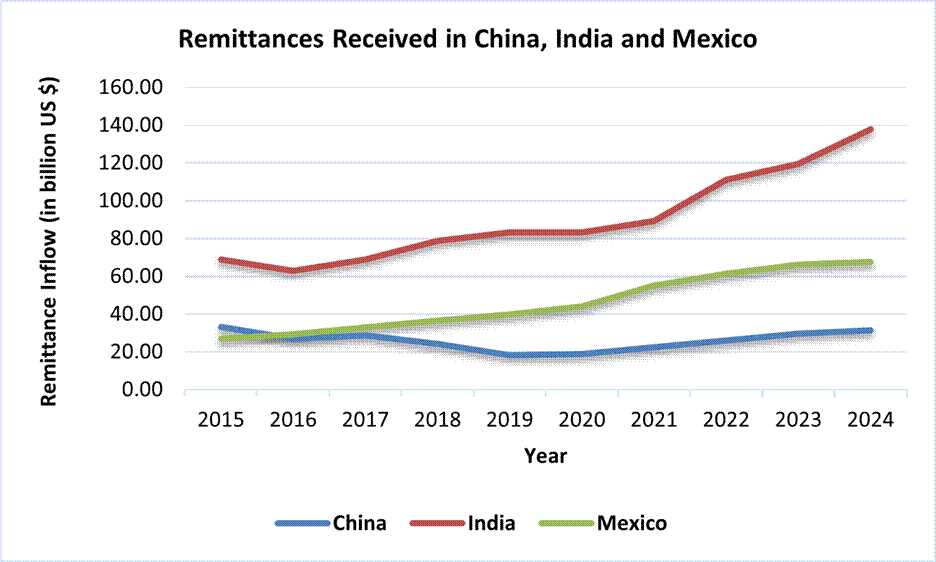
Source: World Bank Databank – Migration and Remittances (2024)
| Key Aspect | India | China | Mexico |
| Estimated Diaspora Population (UNDESA 2024) | ~18 million | ~ 11.7 million | ~ 11.6 million |
| Major Destination Regions | US, UK, Canada, Gulf | Southeast Asia, US, Canada | Majorly US |
| Policy Focus | Cultural ties, investment and soft power | Economic modernization, technology transfer | Migrant welfare, community development, remittances |
| Key Institutions | Ministry of External Affairs | Overseas Chinese Affairs Office | Institute for Mexicans Abroad |
| Major Engagement Tools | OCI, Pravasi Bharatiya Divas, e-migrate | Talent recruitment programs, diaspora networks | Consular outreach, 3×1 Program |
| Economic Contribution | High remittance and investment | Investment and business networks | Remittance and local development |
| Key Strength | Global skilled diaspora influence | Strong business and investment linkages | Strong migrant welfare and local development participation |
What are the key lessons for India?
The Indian government has done a commendable job towards its diaspora community which serves as an example to other countries. In order to work towards building a more robust policy towards its overseas people, the programs and initiatives from both China and Mexico can be taken as a lesson. There exist certain gaps in India’s program and policy initiatives which need to be addressed.
Lessons from China
Agarwal (2017) has highlighted in her study that in today’s globalized world, diaspora can function as an asset of utmost value. India has the largest remittance inflow but unlike China, the dividends have not been utilized properly. There are challenges such as poor infrastructure, red tape, labor market regulations, etc., that need to be taken care of, which prevents a PIO or NRI from investing in India. Indian initiatives such as ‘Know India’ are not extensive like in China considering the number of intakes for such programs. The employment opportunities to the overseas Indians have its problems in comparison to the Chinese ‘1,000 talents’ program. China has an integrated set of institutional apparatus working at different levels, interconnected with its political structure, and helping to formulate policies for the Chinese diaspora but India faces the challenge of overburdened and understaffed Overseas Indian Affairs department in the Ministry of External Affairs leading to a lack of much needed specific intellectual expertise. Further, more Indian states should come up with its diaspora initiatives. Although the focus of the Chinese and Indian governments differs, both recognize their respective diaspora not just as sources of economic remittances but also of social remittances in the form of access to markets, knowledge, foreign capital, expertise, ideas and best practices. This will help India to ramp up its efforts to reap the full potential of its diaspora.
Lessons from Mexico
Over the years, Mexico has developed a more community-based and welfare-oriented approach towards its diaspora. Mexico’s consular support helped many migrants access banking services and cheaper remittance transfer systems, which significantly increased remittance inflows to the country. The ‘3×1 program’ offered a more structured and institutionalized way to transform collective remittances into community projects. India needs to encourage the local bodies and state governments to develop more structured diaspora policies. Mexico provides voting rights to its citizens living abroad. Although India allows its NRIs to vote, the process remains difficult with a lot of paper work and often requires physical presence. A major strength of Mexico’s policy approach is its attention to ordinary migrant workers, not only wealthy professionals or investors. India needs to provide greater attention to its low-skilled migrants and adopt more balanced policy initiatives. For India, adopting a more welfare-oriented and participatory diaspora framework could strengthen both national development and long-term ties with overseas Indians (Engstrom 2015).
Policy Recommendations
- India should make diaspora engagement more development-oriented by encouraging diaspora people to engage not only through remittances, but also through technology, innovation, and investment.
- Greater efforts should be made to involve the diaspora in local development projects, especially in migration-prone states.
- Welfare and protection of migrant workers particularly in Gulf countries must be given more attention through stronger legal support, safe working conditions, and quick consular services.
- There should be expansion of the use of digital platforms to provide easier access to investment opportunities, networking, and cultural engagement for overseas Indians.
- There is a need for better coordination between the central government, state governments, and diaspora organizations to make diaspora policies more effective.
Conclusion
The diaspora programs of China and Mexico highlight the existing gaps in Indian diaspora initiatives. As India continues to emerge a major global power, its diaspora will remain as a crucial link with the global world. The way forward lies in building more inclusive and long-term policy frameworks which will not only strengthen India’s relationship with its diaspora but will also enhance India’s global presence with strong developmental connections.
References
Adamson, Fiona B., and Enze Han. 2024. “Diasporic geopolitics, rising powers, and the future of international order.” Review of International Studies 50, no. 3 (May): 476-493. 10.1017/S0260210524000123. https://www.cambridge.org/core/journals/review-of-international-studies/article/diasporic-geopolitics-rising-powers-and-the-future-of-international-order/A8D62FDBC6195729138E90662B6C824D
Agarwal, Gauri. 2017. “Comparing Indian and Chinese Engagement with their Diaspora.” Institute of Chinese Studies 44 (April). https://www.icsin.org/uploads/2017/05/12/79170556f0718143783ce8d80f142f84.pdf.
Carbonnier, Gills. 2011. International Development Policy: Energy and Development. N.p.: Palgrave Macmillan. 10.1057/9780230314016. https://link.springer.com/chapter/10.1007/978-0-230-31401-6_10
Engstrom, Sara K. 2015. “An Analysis of Mexico’s Diaspora Engagement Efforts.” Aalbord University. https://projekter.aau.dk/projekter/files/224355268/Diaspora_Engagement_SaraKittenEngstr_m.pdf.
Fatima, Zeba. 2026. “Indian Diaspora: Meaning, Significance and Various Policies of Government of India towards It.” International Journal of Research and Innovation in Social Science 10, no. 1 (January): 4664-4676. 10.47772/IJRISS. https://rsisinternational.org/journals/ijriss/uploads/vol10-iss1-pg4664-4676-202602_pdf.pdf
Liu, Hong, and Els v. Dongen. 2016. “China’s Diaspora Policies as a New Mode of Transnational Governance.” Journal of Contemporary China 25 (102): 805-821. 10.1080/10670564.2016.1184894. https://dr.ntu.edu.sg/server/api/core/bitstreams/975ab591-67f1-4b06-a73f-67a38cb5f810/content
Montemayor, Eduardo R. 2012. “Diaspora Direct Investment Policy Options for Development.” nter-American Development Bank. https://publications.iadb.org/en/publications/english/viewer/Diaspora-Direct-Investment-Policy-Options-for-Development.pdf.
Schafer, Carsten. 2019. ““The body overseas, but the heart remains in China”? – China’s diaspora politics and its implications.” Border Crossing 9, no. 1 (January): 29-42. 10.33182/ bc.v9i1.606. https://bordercrossing.uk/bc/article/download/606/1661/9301

Leave a Reply