Abstract
This research examines the historical evolution, socio-economic transformation, and strategic role of the Indian diaspora in the United States by challenging conventional understandings of migration as merely a demographic process. The study explores how Indian migration has resulted in the formation of a transnational community that significantly contributes to innovation ecosystems, corporate leadership, cultural institutions, and policy engagements. Using a historical and analytical method, the article focuses on Indian-origin professionals who have been instrumental in the creation and expansion of knowledge networks, entrepreneurship, and technological advancement while they have also preserved their cultural identities and institutional relations. The study highlights identities have become more complex, community representation still lags, and the perception of diaspora influence has been constantly challenged. The study argues that the Indian diaspora has emerged as an important bridge between India and the United States, strengthening bilateral relations through economic, intellectual, and political channels. The paper demonstrates how migration can evolve into a source of global influence and strategic partnerships.
Keywords: Diaspora Leadership; Indian Diaspora; Innovation and Knowledge Networks; Cultural Identity; India–U.S. Strategic Relations etc.
Introduction
Migration is not only a demographic movement but also a mechanism through which knowledge, institutions, and political influence travel across borders. The Indian diaspora, being one of the major migrant communities, has been the focus of few studies recently because of its extraordinary socio-economic achievements, educational progress, and growing impact in politics, business, science, and public policy. With over five million people of Indian origin living in the U.S., Indian Americans are among the fastest-growing, highly educated, and economically successful immigrant communities in the country. Their path shows how skilled migration can go beyond the simple addition to the labor force and transform into a major factor in knowledge creation, leadership in institutions, cultural diplomacy, and cooperation among states (Pew Research Center 2024; Migration Policy Institute 2023).
The trajectory of the Indian diaspora in the U.S. mirrors a wider change in global migration trends. Whereas earlier migration was subject to racial discrimination and restrictive immigration laws, the Immigration and Nationality Act of 1965 dramatically changed migration patterns by putting emphasis on family reunification and immigration of skilled workers. Since then, successive waves of highly skilled professionals, entrepreneurs, researchers, and students have been able to build a strong presence in sectors like technology, healthcare, higher education, finance, scientific research, and public administration. All these changes have made the Indian diaspora not only a successful immigrant community but also an influential participant in the American economic, social, and political realms. (Reimers 1983; Marinari 2014; Capps et al. 2024).
Although a large number of research studies look at Indian migration from different perspectives, most of the existing work looks at demographic changes, economic mobility, or transnational identity separately. In contrast, there are only a few studies that offer a comprehensive understanding of how historical migration processes, socio-economic advancement, innovation, institutional leadership, cultural continuity, and strategic engagement together make the Indian diaspora in the United States a major force today. The present paper aims to fill the above gap by employing an interdisciplinary method that locates the diaspora not only in the sphere of migration and diaspora studies but also in the context of public policy and international relations.
The paper uses a diversity of sources, including scholarly articles, official government documents, and research reports by top institutions, to study the Indian diaspora in the United States from several angles, such as its history, demographics, socio-economic changes, innovation, culture, and strategic importance. Besides tracing the community’s contribution to India and U.S. strategic relations, it also identifies the challenges that could influence its future development. The paper maintains that the Indian diaspora has transcended the immigration framework and transformed into a strategic community that is making a simultaneous contribution to economic competitiveness, scientific innovation, democratic participation, and bilateral cooperation. In this way, it shows the diasporic human capital as a long-lasting connecting link between two of the world’s largest democracies.
Historical Evolution of Indian Migration to the United States
The history of Indian migration to the United States reflects broader changes in American immigration policy, global labor markets, and transnational mobility. From a small community of agricultural laborers in the early twentieth century to one of the most influential immigrant groups in contemporary America, the Indian diaspora has passed through periods of exclusion, accommodation, and opportunity.
The first significant wave of Indian migration occurred in the late nineteenth and early twentieth centuries, when predominantly Sikh peasants from Punjab arrived on the Pacific Coast seeking economic opportunities. Many settled in California, Oregon, and Washington, where they worked in agriculture, lumber mills, and railway construction. Their arrival, however, coincided with rising anti-Asian sentiment in the United States. Indian migrants faced racial hostility and legal discrimination, reflected in incidents such as the Bellingham riots of 1907 and broader anti-Asian campaigns (Hess 1969, 61–62; Pillai 2020, 1–2).
Federal immigration policy reinforced these exclusionary attitudes. The Immigration Act of 1917 established the Asiatic Barred Zone, effectively restricting immigration from most parts of Asia, including India (Hess 1969, 64). The legal position of Indians worsened further following the Supreme Court’s decision in United States v. Bhagat Singh Thind (1923).[1] Thind argued that Indians were scientifically classified as Caucasian and therefore eligible for naturalization. The Court, however, ruled that Indians did not qualify as “white persons” in the common understanding of the term. The decision deprived many Indian immigrants of citizenship rights and deepened their exclusion from American civic life (Hess 1969, 65; Hutton 2022, 41–42). Consequently, Indian migration remained limited for nearly two decades.
A significant turning point emerged during and after the Second World War. Changing geopolitical realities, India’s growing international importance, and lobbying efforts by Indian American activists such as J. J. Singh contributed to a reconsideration of exclusionary policies. The Luce–Celler Act of 1946 restored naturalization rights to Indian immigrants and introduced a small annual immigration quota for India (Shah 2014, 4). Although numerically modest, the legislation marked the first formal recognition of Indians as participants in American civic life. Migration levels nevertheless remained relatively low because quota systems continued to favor European immigration (Daniels 1986, 159–160).
The most transformative development in the history of Indian migration came with the Immigration and Nationality Act of 1965, commonly known as the Hart–Celler Act. By abolishing the national-origins quota system and introducing preferences based on family reunification and occupational skills, the legislation fundamentally altered the composition of American immigration (Marinari 2014, 219–221; Reimers 1983, 9–10). Although lawmakers did not fully anticipate its demographic consequences, the reform created unprecedented opportunities for highly educated migrants from Asia, particularly India (Reimers 1983, 10–11).
Table 1. Major Phases in the Historical Evolution of Indian Migration to the United States
| Migration Phase | Period | Key Characteristics | Major Legislative/Political Developments |
| Early Labor Migration | 1890s–1917 | Predominantly Punjabi Sikh migrants employed in agriculture, lumber, and railway construction on the Pacific Coast | Initial migration wave; emergence of anti-Asian sentiment |
| Exclusion and Restricted Citizenship | 1917–1946 | Severe limitations on immigration and naturalization; racial exclusion of Indian migrants | Immigration Act of 1917 (Asiatic Barred Zone); United States v. Bhagat Singh Thind (1923) |
| Limited Inclusion and Legal Recognition | 1946–1965 | Restoration of naturalization rights and modest reopening of migration channels | Luce–Celler Act (1946) |
| Skilled Migration and Professional Expansion | 1965–1990s | Large-scale migration of physicians, engineers, scientists, academics, and students | Immigration and Nationality Act (Hart–Celler Act) of 1965 |
| Globalized and Transnational Diaspora | 1990s–Present | Growth of technology professionals, entrepreneurs, and transnational networks; increasing socio-economic influence | Globalization and expansion of high-skilled migration pathways |
Source: Compiled by the author based on Hess (1969); Daniels (1986); Shah (2014); Reimers (1983); Marinari (2014); Liu (1992); and Varma (2007).
Following 1965, Indian migration entered a new phase characterized by professionals, scientists, engineers, physicians, and students. The United States’ demand for skilled labor coincided with India’s expanding higher education system, generating a substantial flow of talent to American universities, research institutions, and technology industries. Studies show that Asian professional and technical immigration increased dramatically after 1965, with Indian migrants emerging as one of the most significant contributors to this trend (Liu 1992, 673–674). By the 1970s and 1980s, Indian physicians, engineers, and scientists had become integral to sectors experiencing labor shortages and rapid innovation (Kanjanapan 1995, 7–8; Gulati 1990, 196–197).
This post-1965 migration wave transformed the nature of the Indian diaspora. Earlier migrants were largely agricultural laborers facing exclusion and marginalization; later migrants arrived with educational credentials, professional expertise, and transnational networks. As a result, Indian migration evolved from a story of racial exclusion to one increasingly associated with skilled mobility and global knowledge exchange. By the end of the twentieth century, Indian Americans had become one of the most highly educated immigrant communities in the United States, laying the foundation for their growing influence in technology, business, academia, and public life (Varma 2007, 540–541; Chanda and Srinivasan 2006, 215–218).
Migration Patterns and Demographic Transformation
Since the late twentieth century, the Indian diaspora in the U.S. has been completely transformed not only by the growth in migration numbers but also through a major change in the characteristics, skills, and migration patterns of the migrants. In contrast to early migrant streams which were mainly laborers in the agricultural sector, the post-1965 migration has been dominated by highly skilled professionals, international students, entrepreneurs, and family-sponsored migrants. Such a demographic change has dramatically altered the socio-economic profile of Indian Americans and served as a platform for their increasing economic and public life prominence in the country (Reimers 1983, 9-11; Capps et al. 2024).
The 1965 Immigration and Nationality Act laid down a legislative scheme that promoted immigration via both family reunification and work-based channels. Over time, these two mutually supportive streams not only allowed for population increase but also helped build cross-generational community ties. As per the U.S. Census Bureau and Pew Research Center, the Indian-origin population has grown from a relatively small immigrant group to one of the fastest-growing populations of Asian origin in the United States, with a population exceeding 4.8 million people by 2023 (Pew Research Center 2024; U.S. Census Bureau 2023).
Figure 1. Growth of the Indian-Origin Population in the United States (2000–2023)
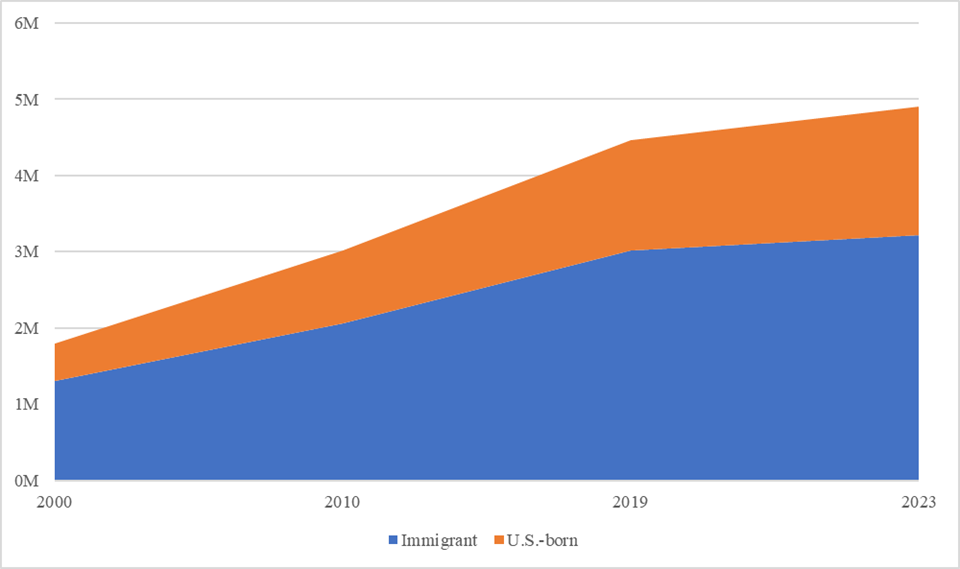
Source: Prepared by the author based on Pew Research Center (2024), Indian Population in the U.S. (2000–2023).
Indian Americans are geographically mostly found in big metropolitan and innovation-oriented states such as California, Texas, New Jersey, New York, and Illinois. These states not only provide sophisticated labor markets but also have some of the best universities, technology hubs, and strong supporting community networks that together offer new migrants several advantages. That is why migration has been increasingly influenced by chain-migration factors wherein earlier migrant communities help new migrants through various supporting mechanisms such as social, professional and institutional (Capps et al. 2024; U.S. Census Bureau 2023).
At the same time, migration channels have undergone major changes. Employment-based migrations especially via the H-1B visa program[2] have largely characterized Indian mobility to the United States. Recent data shared by the USCIS suggest that those born in India made up nearly 70% of all approved H-1B applications during the Fiscal Year 2025, underlining India’s leading position in the U.S. system for high-skilled immigration (U.S. Citizenship and Immigration Services 2026, 2). Also, the majority of those granted visas held at least a bachelor’s degree, and individuals with master’s degrees came out as the largest group, thereby highlighting the highly skilled character of this migration stream (U.S. Citizenship and Immigration Services 2026, 3). At the same time as the professional migration, India has also become the largest provider of international students in the United States, thereby continuing a steady influx of highly qualified human resource into American universities, research institutions, and innovation sectors (Institute of International Education 2025).
Socio-Economic Mobility and Sectoral Presence
The upward socio-economic mobility of Indian immigrants in the U.S. is undoubtedly one of the most remarkable characteristics of the contemporary Indian diaspora. Earlier immigrant groups’ entry into the low-skilled labor markets was typical of their initial experience in America, whereas the migration of Indians post-1965 has been largely of highly educated professionals who came through skill-based immigration channels. This selective migration pattern gave Indian immigrants the opportunity to use their educational qualifications for long-term economic success, and, as a result, they have become one of the most affluent and professionally established ethnic communities in the United States (Khadria 2006, 84-87; Varghese 2011, 6-8).
At the center of Indian Americans’ upward mobility is education. They achieve among the highest levels of educational attainment, with a significantly bigger share of them holding bachelor’s and postgraduate degrees than the general U.S. population. This educational lead is the result of a combination of India’s broadened higher education system and the need for highly skilled professionals created by the changes in U.S. immigration policy after 1965. Consequently, educational wealth has resulted in occupational movement, higher incomes, and professional progress over the long run in various industries (Pew Research Center 2024; Migration Policy Institute 2022).
The occupational pattern of the diaspora also illustrates these educational advantages. Professionals of Indian origin are over-represented in science, technology, engineering, mathematics (STEM), healthcare, finance, higher education, and scientific research. The U.S. Citizenship and Immigration Services states that in Fiscal Year 2025, Indian nationals made up almost 70 percent of the approved H-1B specialty occupation beneficiaries, with computer-related occupations constituting the largest employment category under the program (U.S. Citizenship and Immigration Services 2026). Research through scholarly publications also confirms that Indian-born scientists and engineers have become essential contributors to the United States’ industrial innovation, research and development, and technological competitiveness (Varma 2010, 395-401; Hanson and Liu 2018).
Table 2. Socio-Economic Profile and Sectoral Presence of Indian Americans in the United States
| Indicator | Key Evidence | Major Sectoral Outcome |
| Educational attainment | Indian Americans have among the highest rates of bachelor’s and postgraduate degree attainment in the United States. | Strong human capital and professional competitiveness. |
| Skilled migration | Indian nationals accounted for 69.9% of approved H-1B beneficiaries in FY2025. | Dominance in high-skilled and knowledge-intensive occupations. |
| Occupational concentration | High representation in STEM, information technology, engineering, medicine, finance, higher education, and scientific research. | Leadership in innovation-driven sectors of the U.S. economy. |
| Economic status | Among the highest median household incomes across U.S. ethnic groups. | Sustained upward socio-economic mobility and financial stability. |
| Entrepreneurship | Strong presence among technology entrepreneurs, start-up founders, and corporate executives. | Expansion of innovation, investment, and transnational business networks. |
| Healthcare contribution | Significant representation among physicians, medical specialists, and biomedical researchers. | Strengthened contribution to the U.S. healthcare and research systems. |
Source: Prepared by the author using data from Pew Research Center (2024); U.S. Citizenship and Immigration Services (2026); Migration Policy Institute (2022); Saxenian (2000); Varma and Varma (2009); Hart et al. (2007).
Economic success has accompanied this concentration in knowledge-intensive occupations. Indian Americans consistently rank among the highest-income ethnic communities in the United States, reflecting their strong presence in professional, managerial, and technical careers. Their achievements extend beyond individual economic success, illustrating a broader pattern of structural integration into the American labor market. Rather than remaining concentrated within narrowly defined ethnic economic niches, Indian immigrants have secured influential positions across mainstream institutions, reinforcing long-term socio-economic mobility and intergenerational advancement (Pew Research Center 2024; Migration Policy Institute 2022).
Entrepreneurship has further expanded the community’s economic influence. Indian entrepreneurs have played a significant role in establishing technology firms, promoting innovation, and strengthening transnational business networks linking the United States and India. Research on Silicon Valley highlights how these entrepreneurs facilitated knowledge transfer, investment, and cross-border collaboration, transforming the conventional narrative of “brain drain” into one of “brain circulation” and global innovation networks (Saxenian 2000, 253–255; Varma and Varma 2009, 160–164).
The healthcare field is an additional instance of such a wide professional representation. Indian-origin doctors, scientists, and medical experts play a significant part in the U.S. healthcare workforce, offering both highly specialized medical services and healthcare provision in geographically and economically disadvantaged areas (Hart et al. 2007, 473, 476).
These accomplishments together prove that the socio-economic advancement of the Indian diaspora has been diversified by the factors of educational capital, professional expertise, and entrepreneurial vibrancy. Such a broad presence across sectors has not only enhanced the economic standing of the community but also produced the institutional trustworthiness, leadership connections, and public recognition which in turn have helped its growing civic participation and political influence in the American society.
Innovation, Leadership & Policy Influence
The dramatic growth of the Indian diaspora in the United States is not only mirrored in its demographic and economic growth but also in its increasing impact on innovation, leadership in major institutions, and public policy. In recent decades, Indian Americans have become major players in the U.S. knowledge economy, filling critical roles in technology, start-ups, higher education, research, and the public sector. This evolution shows how skilled migration can bring about sustained developmental benefits to both host and origin countries by way of innovation, enhancing global competitiveness, and intensifying transnational cooperation (Kerr and Kerr 2020; Varma and Sabharwal 2018).
One of the hallmarks of the Indian diaspora’s achievement has been its input to knowledge-intensive and innovation-led sectors. Scientists, engineers, and entrepreneurs of Indian descent have significantly contributed to the advancement of research, development of new technologies, and high-value production in sectors including information technology, artificial intelligence, biotechnology, healthcare, and advanced manufacturing. Studies have shown that immigrant professionals are responsible for a very high proportion of patenting, scientific discovery, and new enterprise creation, and at the same time, their professional networks across countries facilitate the flow of knowledge, capital, and technological skills between the United States and India (Almeida, Phene, and Li 2015; Kerr 2008; Burchardi et al. 2021). As a result, the Indian diaspora has grown into a core part of America’s innovation machinery rather than just a source of skilled labor.
Entrepreneurship is one more significant aspect of this impact. The heavy presence of Indian professionals in top technology centers such as Silicon Valley has led to the establishment of many high-growth companies and startup ventures. These companies have not only generated jobs but also hastened the spread of technology and strengthened cross-border business relationships. Instead of a one-way flow of talent, the Indian diaspora is increasingly functioning through knowledge circulation[3], which means that the movement of professional skills, investment, and innovation in the US and India is continuous. In fact, such transnational networks have greatly enlarged the scope for joint research, technology transfer, and entrepreneurial collaborations (Saxenian 2002; Wadhwa 2007; Varma and Sabharwal 2018).
The Indian American community has also attained influential leadership positions across multinational corporations, universities, research institutions, and public organizations. The fact that their numbers have been rising in the executive ranks is consistent with the ascending significance of technical knowledge, international exposure, and multi-cultural skills. In addition to being instrumental in shaping the organizational strategies and technology development, these leaders also increase India’s presence in worldwide networks of innovation and further the image of the Indian diaspora as a conduit between two of the world’s most prominent democratic economies (Cappelli et al. 2010; Indiaspora 2024).
Indian Americans have even influenced the policy area. Indian American groups like Indiaspora and the U.S.-India Political Action Committee (USINPAC) have enhanced the level of civic participation and also helped in raising policy awareness towards skilled immigration, innovation, entrepreneurship, education, and U.S.-India strategic cooperation. At the same time, research shows that Indian Americans have become a well-organized and powerful group in the ongoing discourse on technology partnerships, democratic governance, and bilateral relations. This is an indication of their transformation from an immigrant community to an institutionally recognized stakeholder in American public life (Carnegie Endowment for International Peace 2021; Brookings Institution 2023; Center for Strategic and International Studies 2024).
Table 3. Innovation, Leadership and Policy Influence of the Indian Diaspora in the United States
| Dimension | Major Contributions | Supporting Evidence |
| Innovation | Significant contributions to research, patents, artificial intelligence, biotechnology, semiconductors, and information technology | Almeida, Phene, and Li (2015); Kerr (2008); Burchardi et al. (2021) |
| Entrepreneurship | Establishment of high-growth technology firms and startups, particularly in Silicon Valley and other innovation clusters | Wadhwa (2007); Saxenian (2002) |
| Corporate Leadership | Leadership in multinational corporations, research institutions, and global technology firms | Cappelli et al. (2010); Indiaspora (2024) |
| Knowledge Networks | Promotion of transnational research collaboration, technology transfer, and brain circulation between India and the United States | Varma and Sabharwal (2018); Bolay and Tejada (2014) |
| Policy Influence | Growing engagement in immigration reform, innovation policy, entrepreneurship, education, and U.S.–India strategic cooperation | Carnegie Endowment (2021); Brookings Institution (2023); Center for Strategic and International Studies (2024); Carnegie Endowment for International Peace 2024 |
Source: Prepared by the author based on Almeida, Phene, and Li (2015); Saxenian (2002); Wadhwa (2007); Kerr (2008); Cappelli et al. (2010); Bolay and Tejada (2014); Varma and Sabharwal (2018); Burchardi et al. (2021); Kerr and Kerr (2020); Indiaspora (2024); Carnegie Endowment for International Peace (2021); Brookings Institution (2023); Center for Strategic and International Studies (2024); and U.S.-India Political Action Committee (2024).
The Indian diaspora as a whole suggests that the role of skilled migration in a society is much more than just the factor of labor market participation. Through innovation, entrepreneurship, assuming top institutional roles, and making policy contributions, Indian Americans, on the one hand, have played a major part in making the United States a more vibrant economy, and at the same time, on the other hand, they have also facilitated strengthening work in science, technology sharing, and strategic cooperation between the US and India. Their story is one of the best examples of how diasporic human capital can bring about mutually beneficial effects for both the host society and the country of origin.
Cultural Identity and Institutional Presence
The remarkable achievements of the Indian diaspora in the United States have been accompanied by their keen interest in keeping cultural identity alive, by a strong network of different types of institutions, mainly religious, cultural, educational, and professional ones. Instead of just completely adopting American ways, Indian Americans have continued to give importance to their language, religion, and culture by their way of life while they have become part of the social and institutional setup of the US. This double act of taking in the larger community and at the same time keeping one’s own identity has turned out to be one of the major features of the journey of the community (Kurien 2007; Pew Research Center 2024).
A large part of the religious and community organizations have been instrumental in the whole process of the preservation of the cultural identity. Hindu temples, Sikh gurudwaras, mosques, churches, Jain temples, and several regional cultural organizations are not simply seen as places for prayer and worship but are also utilized as hubs for cultural education, language classes, and youth involvement as well as community welfare. These organizations are a living example of the experimentation of new ways by the Indian diaspora of maintaining cultural continuity with their motherland within the American environment. By constituting strong ties with the heritage, people are, in turn, encouraged to identify with the community, and thus the belongingness to the community is enhanced. As Kurien (2007) points out, in fact, such organizations have been a major element in the establishment and growth of Indian cultural and religious life in the United States by facilitating the adjustment of Hindu, Sikh, etc. traditions to a multicultural democratic milieu.
Besides preserving their communities, Indian cultural institutions have also played a major role in promoting India’s soft power in the U.S. The increasing trends of yoga, Ayurveda, Indian food, traditional arts, Bollywood movies, and big festivals like Diwali and Holi have made Indian culture more prominent in American mainstream culture. At the same time, groups like Indiaspora have deepened community relations through philanthropy, leadership training, and civic engagement, marking a shift from mere cultural preservation to broader institutional involvement. New survey data also reveal that Indian Americans are not only emotionally and culturally connected with India but also socially integrated and actively participating in civic life in the U.S. (Pew Research Center 2024; Carnegie Endowment for International Peace 2025).
The strengthening of Indian diaspora institutions demonstrates that maintaining cultural identity and social integration are not opposing paths. On the contrary, the establishment of Indian American community institutions has opened a way to respect one’s roots while being a part of American diversity. In fact, Indian cultural identity has shifted from being an individual’s ethnic attribute to a community asset that helps in uniting the community, supporting the passing down of traditions from one generation to another, and promoting India’s cultural influence and soft power in the U.S.
Contemporary Challenges and Emerging Debates
The Indian diaspora in the United States, despite its significant socio-economic milestones and rising influence in the institutional domain, still experiences a series of structural, social, and political challenges that determine its path forward. One of the biggest issues is related to the U.S. immigration system. It heavily relies on employment-based visas, for example, the H-1B visa program, and at the same time, the backlog in employment-based permanent residency applications remains an ongoing problem. Such limitations not only put highly skilled workers under stress due to the unpredictability factor but also might end the long-standing position of the U.S. as a magnet for top-notch global talent. With the worldwide competition for skilled workers becoming tougher, resolving immigration policies stands out as a crucial subject for maintaining highly innovative economic growth (Migration Policy Institute 2023; Kerr and Kerr 2020).
On the other hand, besides the immigration issues, the Indian American community is still confronting identity, representation, and social inclusion issues on which there are lively discussions. To be sure, the image of Indian Americans as a “model minority” has for the most part hindered the community’s inner diversities to be brought to the scene, and differences concerning religion, caste, region, gender, and socioeconomic status have been disregarded. On top of that, according to research done through surveys, discrimination, racial prejudice, and biases due to identity are still problems that certain parts of the diaspora face even though their educational level and economic prosperity are on the rise. Such facts demonstrate that achieving upward social mobility through economic success doesn’t necessarily resolve the larger issues of fairness, representation, and having a sense of belonging in a multicultural setting (Carnegie Endowment for International Peace 2021; Pew Research Center 2024).
Meanwhile, the worldwide changes forecast new and great opportunities for the diaspora. In fact, the quick growth of the sectors of artificial intelligence, semiconductor manufacturing, biotechnology, digital governance, and the most advanced scientific research has enhanced the strategic role of the top Indian professionals. In addition, the enhancement of the U.S.-India strategic partnership has uncovered new pathways for cooperation in the areas of innovation, higher education, critical technologies, and research partnerships. These changes set the Indian diaspora up as a key link that ties together economic competitiveness, technological cooperation, and democratic engagement in both countries (Center for Strategic and International Studies 2024; Brookings Institution 2023).
In the end, how important the Indian diaspora will be in the future goes beyond continuing immigration only. It is also about the capacity of policymakers, institutions, and community organizations to break down structural barriers and, at the same time, cultivate inclusive representation and ongoing innovation. As changes of population, technology, and geopolitics keep on redrawing the map of global migration, the Indian diaspora is expected to continue being a strong player in enhancing bilateral relations, developing knowledge-based economies, and facilitating transnational cooperation between India and the United States.
India–U.S. Strategic Relations
The rise of the Indian diaspora as a major force has transformed it into a key element of the modern India-U.S. strategic partnership. Besides their economic and technological roles, members of the diaspora act as a conduit between the political, scientific, educational, and commercial sectors of both democracies. Widespread involvement in government, academia, industry, and civil society has allowed the Indian American community to contribute to bilateral relations by enabling exchanges of ideas, investments, innovations, and dialogues on policies. As a result, the diaspora has turned from mere migrant groups into a significant strategic resource that supports one of the most important bilateral relationships in the world (Carnegie Endowment for International Peace 2024; Pew Research Center 2024).
Among other factors, technology partnership has become the mainstay of this relationship. The reliance on the expertise of highly skilled Indian professionals who have reached highly skilled levels and who are engaged in American institutions of higher learning, research centers, and technology companies has grown to a great extent in recent joint efforts in fields like artificial intelligence, semiconductors, quantum technologies, biotechnology, telecommunications, and advanced manufacturing. At the same time, schemes for collaboration such as the Initiative on Critical and Emerging Technology (iCET)[4] and a range of scientific collaborations have been the main driving forces behind joint research, innovation, and capacity building between the two countries. These changes highlight the fact that the Indian diaspora offers more than just skilled human capital; it acts as the driver of technological collaboration and strategic resilience that can be sustained over the long term (Center for Strategic and International Studies 2024; National Science Foundation 2024).
The diaspora has also been a major player in public diplomacy and policy work. Indian American groups, businesspeople, scholars, and policy analysts are regularly involved in trade, education, defense, climate governance, and Indo-Pacific security talks. These associations help foster communication among governments, universities, businesses, and civil society, thus enhancing mutual trust and presenting more avenues for bilateral cooperation. Their increased formal presence indicates the rising awareness that diaspora communities can act as major non-state players in pushing foreign policy goals and democratic partnerships (Brookings Institution 2023; Indiaspora 2024).
Future perspectives: The importance of the Indian diaspora in strategic terms will probably grow as the two countries will join forces more and more in areas such as emerging technologies, resilient supply chains, higher education, and scientific innovation. Keeping the ball rolling, however, will mean support for talent mobility, research interaction, and a welcoming immigration system for skilled professionals. Against this background, the Indian diaspora is not just a culturally vibrant community; it is a key strategic link that contributes to the economy, enables technological breakthroughs, and opens avenues for democratic partnership, thus reinforcing the long-standing alliance of the two countries, India and the U.S.
Conclusion
The history of Indian migration to the United States is by far the most remarkable instance of how skilled migration has evolved to become a source of long-term socio-economic, institutional, and strategic influence. Initially a small and marginalized group of immigrants largely held back by racist immigration laws, today Indian Americans constitute one of the most well-educated, economically prosperous, and professionally influential ethnic groups in the United States. Their story is a great case study in how human capital, when combined with sound policy frameworks, educational opportunities, and transnational networks, can lead to far-reaching impacts well beyond mere economic assimilation.
The present study points out that the real power of the Indian diaspora today rests not simply on its numeric and financial clout but also on its widening role in areas such as innovation, scientific research, start-ups, institutional leadership, cultural perpetuation, and public policy. At the same time, the diaspora has evolved into a highly efficient strategic conduit linking India and the United States through technology partnerships, knowledge exchange, research collaboration, and democratic engagement. All these facets together underscore how diaspora communities are becoming key non-state actors capable of fostering bilateral cooperation in a world that is more interconnected than ever before.
At the same time, the realization of the Indian diaspora’s full potential will require overcoming modern-day hurdles such as restrictive immigration policies, securing a fair representation, and adapting to new global trends in talent mobility. To keep this going, there must be sustained efforts in the areas of education, building innovation ecosystems, establishing research partnerships, and formulating inclusive immigration policies that allow skilled professionals to move freely.
Migrants who have left their homelands in search of better livelihoods have often been stereotyped as mere numbers or even burdens to the receiving societies. On the contrary, the unfolding saga of the Indian diaspora clearly reveals that migration is an ongoing conduit not only for people but also for knowledge, creativity, institutional strengthening, and global cooperation. Given that the strategic partnership between India and the United States is expected to be further strengthened, the Indian diaspora will likely remain an important contributor behind joint prosperity, democratic collaboration, and global technological leadership in this century.
Bibliography
Almeida, Paul, Anupama Phene, and Sali Li. 2015. “The Influence of Ethnic Community Knowledge on Indian Inventor Innovativeness.” Organization Science 26 (1): 198–217. https://doi.org/10.1287/orsc.2014.0931.
Burchardi, Konrad B., Thomas Chaney, Tarek A. Hassan, Lisa Tarquinio, and Stephen J. Terry. 2021. “Immigration, Innovation, and Growth.” NBER Working Paper No. 27075. Cambridge, MA: National Bureau of Economic Research. https://www.nber.org/papers/w27075.
Cappelli, Peter, Harbir Singh, Jitendra V. Singh, and Michael Useem. 2010. “Leadership Lessons from India.” Harvard Business Review 88 (3): 90–97. https://hbr.org/2010/03/leadership-lessons-from-india.
Capps, Randy, Kristen McCabe, and Jeanne Batalova. 2024. Indian Immigrants in the United States. Washington, DC: Migration Policy Institute. https://www.migrationpolicy.org/article/indian-immigrants-united-states.
Indiaspora. 2024. Impact Report: Community Impact by Indiaspora. Washington, DC: Indiaspora. https://indiaspora.org/impact/impact-report/.
Kerr, William R. 2008. “Ethnic Scientific Communities and International Technology Diffusion.” The Review of Economics and Statistics 90 (3): 518–537. https://doi.org/10.1162/rest.90.3.518.
Kerr, Sari Pekkala, and William R. Kerr. 2020. “Immigrant Entrepreneurship in America: Evidence from the Survey of Business Owners.” Journal of Labor Economics 38 (S1): S3–S44. https://doi.org/10.1086/705163.
Kurien, Prema A. 2007. A Place at the Multicultural Table: The Development of an American Hinduism. New Brunswick, NJ: Rutgers University Press.
Marinari, Maddalena. 2014. Unwanted: Italian and Jewish Mobilization against Restrictive Immigration Laws, 1882–1965. Chapel Hill: University of North Carolina Press.
Migration Policy Institute. 2023. Indian Immigrants in the United States. Washington, DC: Migration Policy Institute. https://www.migrationpolicy.org.
Pew Research Center. 2024. Indian Americans: A Survey Data Snapshot. Washington, DC: Pew Research Center. https://www.pewresearch.org.
Reimers, David M. 1983. An Unintended Reform: Immigration Policy in the United States and the Demographic Consequences. Westport, CT: Greenwood Press.
Saxenian, AnnaLee. 2002. “Transnational Communities and the Evolution of Global Production Networks.” Global Networks 2 (1): 27–44. https://doi.org/10.1111/1471-0374.00027.
Tejada Guerrero, Gabriela, Metka Hercog, Christiane Kuptsch, and Jean-Claude Bolay. 2014. “The Link with a Home Country: A Comparative Analysis of Host Country Environments for Diaspora Engagement.” In Global Diasporas and Development: Socio-economic, Cultural and Policy Perspectives, 39–68. Cham: Springer.
U.S. Census Bureau. 2023. American Community Survey Data. Washington, DC: U.S. Census Bureau. https://www.census.gov/programs-surveys/acs.
U.S. Citizenship and Immigration Services. 2024. Characteristics of H-1B Specialty Occupation Workers. Washington, DC: U.S. Department of Homeland Security. https://www.uscis.gov.
Varma, Roli. 2007. “Indian Scientists and Engineers in the United States: Their Role in the Knowledge Economy.” Current Science 93 (4): 456–462.
Varma, Roli, and Meghna Sabharwal. 2018. “Transnational Research Collaboration and the Indian Diaspora.” Science, Technology & Society 23 (2): 1–20.
Varma, Roli, and Zeeshan Noor. 2021. “Ethnic Organizations and Adaptation: A Case Study of Indian Immigrant Engineers in the U.S.” Perspectives on Global Development and Technology 20 (3): 317–335.
Wadhwa, Vivek, AnnaLee Saxenian, Ben Rissing, and Gary Gereffi. 2007. America’s New Immigrant Entrepreneurs. Durham, NC: Duke University.
[1] Andrew J. Hutton, An Immigrant’s Tale: The Indian Citizenship Act of 1923 and the United States v. Bhagat Singh Thind Case (New York: Routledge, 2022), 41–42.
[2] U.S. Citizenship and Immigration Services, Characteristics of H-1B Specialty Occupation Workers: Fiscal Year 2025 Annual Report to Congress (Washington, DC: U.S. Department of Homeland Security, 2026), 2–3.
[3] AnnaLee Saxenian, The New Argonauts: Regional Advantage in a Global Economy (Cambridge, MA: Harvard University Press, 2006), 35–42.
[4] Center for Strategic and International Studies, Sustaining Momentum in U.S.–India Technology Ties (Washington, DC: CSIS, 2024).

Leave a Reply