
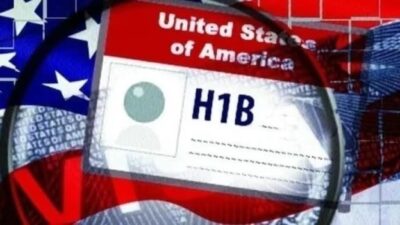
On September 19, 2025, by the Presidential Proclamation, the Trump administration imposed a new annual fee of $100,000 per H-1B visa application. This initiative, part of Project FireWall, aims to prevent the abuse of H-1B visas, effective September 21, 2025, resulting in a surge of roughly 2,111.1% from the current highest fee levels of $4,500.
The H-1B Visas Program
H-1B visa, a non-immigrant work visa that allows U.S. employers to hire foreign workers temporarily in speciality occupations that require specialised knowledge, particularly in fields like IT, engineering, mathematics, medicine, finance, and more, having at least a bachelor’s degree or its equivalent. Because the number of applications exceeds the annual cap, the program uses a lottery system. It has a validity of 3 years with an extendable term of an additional 3 years, making the total duration of the program six years.
The Project Fire Wall Initiative
The Project Fire Wall, a major enforcement initiative of the US Department of Labour, launched on September 19, 2025, centred on cracking down on abuses of the H-1B visa program. The program is specifically designed to monitor, detect, and address cases where employers might attempt to exploit the system. The program aims to protect the rights, wages, and job opportunities of highly skilled domestic and foreign workers, holding employers accountable through stringent investigations, penalties, and debarment from the visa program if any violations are found.
The program aligns with the Trump Administration’s “America First” agenda, focused on protecting American jobs, especially in high-skilled sectors like Technology. It coincided with President Donald Trump signing an executive order imposing a $100,000 annual fee on H-1B visa petitions, representing a coordinated effort to reform the program. The broader vision lies in reinforcing the economic dominance of the USA by prioritising American workers in the job market and restoring integrity to employment-based immigration programs.
Impact on Indian IT Companies and Professionals
According to US Citizenship and Immigration Services (USCIS) data for the fiscal year of 2024, Indian professionals globally comprised 71% of all H-1B recipients, while China stood second at 11.7%. Historically, Indians have been the primary beneficiaries of the H-1B visa program, as the U.S. technology sector has depended heavily on Indian engineers for specialisations in software, analytics, and IT services.
The Indian IT services firms win contracts from US businesses and need to send their staff onsite to manage projects, requiring frequent and reliable access to H-1B Visas. According to the US Citizenship and Immigration Services data for the period of April to September, TCS received 5,274 H-1B visas, Infosys 8,140 and Wipro 1,634, a dominant share compared to applicants from other countries or sectors.
Impact of the H-1B Fee Hike
The increase of H-1B visa fee from $4500- $8000 per applicant to $ 100,000 has significantly led to the rise in cost burden, making it nearly impossible for companies, particularly mid-sized IT firms and startups, to sustain previous levels of H-1B deployment.
In addition to cost burden there is a comparative disadvantage for the Indian companies as they file most of the H-1B petitions thereby facing greater exposure to the cost escalation than their US or European multinational counterparts having fewer H-1B needs.
Strategic Shift by Indian IT Companies
The significant increase in scrutiny and procedural hurdles amid the tougher US rules and higher visa fees has led to change in approach of Indian Multinationals such as TCS, Infosys, Mahindra, WIPRO, etc.
According to a report by Money Control, these companies have reduced their dependency on H-1B visas, from 50-70% of their US workforce using H-1B visas to now only about 20-50%. Now, over half of the US employees, particularly at TCS and Infosys, are local Americans (citizens or Green Card holders). This protects US companies from sudden government policy changes and regulatory shocks, enabling them to conduct their operations smoothly in the long run. Through this, the Indian companies have responded to US concerns about foreign workers and support the trend of global companies building local teams to operate.
Impact on the Indian Diaspora
The H-1B fee hike compounds the existing financial pressures on the Indian Diaspora. Along with higher visa costs, they simultaneously face remittance taxes. The Reserve Bank of India’s survey of March 2024 shows that Indian-origin individuals in the US sent approximately $32 billion to India in 2023-24, representing 27.7% of India’s total remittances received in 2023-24. Recently under the One Big Beautiful Bill Act( H.R.1) approved by Congress, a 3.5% excise tax was imposed on outbound remittances by foreign workers, which could cost the Indian diaspora an additional $1.12 billion annually based on the 2023-24 remittance levels of $32 billion.
The community of Indian immigrants particularly on the H-1B visas face the direct impact of this fee hike, not the existing H-1B holders inside the USA but those on travel or temporary leave. They are facing re-entry challenges unless their employer files a new H-1B petition including the $100,000 fee. This creates uncertainty and potential disruption for those needing international travel or job transitions, the Indian government has warned of “likely humanitarian consequences” specifically noting disruptions for families of H-1B workers.
The rise in fee is expected to severely reduce the number of H-1B visa applications targeting Indian tech workers, who make up about 71% of H-1B recipients (according to USCIS data of 2024) limiting access and raising costs for Indian professionals hoping to enter the US labour market through visa sponsorship.
Experts warn this cost escalation and tighter visa access could lead firms to offshore more work to countries like India rather than bringing Indian workers onsite in the USA due to increased labour costs undermining America’s competitive advantage in cutting-edge technology sectors. It may also reduce onsite innovation collaboration and slow knowledge transfer as Indian professionals provide crucial brainpower for the US economy impacting its leadership in AI and other frontier technologies.
As the visa pathway becomes more restrictive, stronger emotional and professional connections to India may develop, complicating the traditional sense of integration and belonging in America. This dynamic creates a complex space where the diaspora balances maintaining cultural roots while negotiating their place within American society.
Diaspora Diplomacy
The new $ 100,000 H-1B visa fee (₹88 lakh at present exchange rate of about ₹88 per dollar) has deeply unsettled many in the Indian diaspora, especially young professionals who came to the US chasing the American Dream through education and tech jobs. For families, the new fee and restrictions create anxiety about job stability, potential layoffs, travel hassles, and even forced returns to India.
At the same time, this shift pushes the diaspora into a new role not only as community members but also as political advocates and lobbyists. No longer just bridges between India and the US, they now must actively contest policies that threaten their livelihoods and families. This politicization shapes new advocacy priorities focused on immigration rights and protections.
The congressional representation of the Indian American community reached historic 1% matching their proportion of the US population. These representatives have been instrumental in strengthening US-India relations and advocating for the community’s interests.
Strategic and Geopolitical Dimension
The restrictive policies create opportunities for India’s “reverse brain gain” phenomenon, where skilled professionals return to contribute to India’s knowledge economy. This could strengthen India’s “Atmanirbhar Bharat” (self-reliant India) initiative and boost domestic innovation ecosystems, particularly in technology and research sectors. Many returning Indian professionals bring international experience, global networks, and access to venture capital, potentially boosting India’s startup ecosystem. The policy inadvertently supports India’s innovation goals by forcing talent repatriation.
The steep hike in the H-1B visa fee to $100,000 poses a significant new stress point in India-US relations, already strained by recent trade disputes and tariffs. The policy marks a departure from the traditionally warm, mutually beneficial engagement to a more transactional and contested phase, challenging the future trajectory of this strategic partnership.

Leave a Reply