
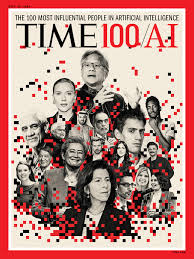
On 28th August, TIME magazine published the third edition of its TIME100 AI, an annual list recognising the most influential people in artificial intelligence. First launched in 2023—shortly after OpenAI’s release of ChatGPT—the list highlights a critical truth: the future of AI will not be determined by machines, but by people. Innovators, researchers, entrepreneurs, policymakers, and cultural figures are the real forces shaping how AI evolves, and TIME100 AI showcases those individuals who are defining this journey.
Artificial Intelligence (AI) has rapidly emerged as one of the most powerful forces in modern history. Few technologies have scaled as quickly: between October 2022 and April 2025, ChatGPT users alone rose from zero to 800 million, while revenues crossed US$4 billion, making it the fastest “overnight success” story in the tech sector (BOND Report). AI is transforming economic structures, business models, and user behaviour worldwide. With such momentum, the critical question arises: who truly influences AI’s direction? The TIME100 AI list seeks to answer that, focusing not on algorithms but on the people behind them.
How TIME Chose the 2025 TIME100 AI
In an article by Sam Jacobs, Editor-in-Chief of TIME, the methodology behind this year’s list was explained. Two key factors stood out:
- The Talent War: Companies are fiercely competing to attract the best AI minds, offering pay packages that sometimes reach hundreds of millions of dollars. This illustrates that influence in AI extends beyond products—it lies equally in the researchers and innovators shaping the field.
- Massive Investment: AI spending is growing nearly four times faster than the global economy. Experts even compare today’s AI investments to historic projects—estimating it could be 25 times larger than the Manhattan Project when adjusted for inflation.
These forces—talent and capital—are reshaping AI’s trajectory, and TIME100 AI recognises those guiding this transformation.
(Source: Times Magazine)
India’s Strong Presence in Artificial Intelligence
India’s role in AI is both deep and fast-growing, driven by two powerful streams: Indian-origin innovators abroad and trailblazers within India.
On the global stage, leaders like Sundar Pichai (Google CEO) and Satya Nadella (Microsoft CEO) are directing the future of AI at the world’s largest tech companies. Nadella, for example, has projected that AI could add $500 billion to India’s GDP by 2025, with Microsoft investing heavily in India, including new data centres in Hyderabad (AP News).
At home, India’s AI revolution is gaining remarkable momentum. According to Nasscom, the number of Generative AI startups grew from 66 in early 2023 to over 240 by mid-2024—a stunning 260% increase. Even more significantly, 75% of these startups were already generating revenue, compared to just 22% the year before. Since 2023, they have attracted over $750 million in funding, making India the sixth-largest GenAI ecosystem globally (The Economic Times).
The broader startup ecosystem is thriving as well. As of July 2025, India has 180,000+ registered startups under the Startup India program, with 121 unicorns and 159,000+ recognised ventures—making it the third-largest startup ecosystem in the world.
Looking ahead, a Nasscom–BCG report projects India’s AI market to grow to $17 billion by 2027, with a robust 25–35% annual growth rate. Already, more than 420,000 professionals are working in AI-related roles, placing India among the world’s most AI-skilled nations.
Indian-Origin AI Leaders Abroad
Arvind Narayanan & Sayash Kapoor
Arvind Narayanan, a professor of computer science at Princeton University and Director of its Centre for Information Technology Policy, earned his B.Tech at IIT Madras and Ph.D. at the University of Texas (2009). Known for groundbreaking work on data privacy, web transparency, and AI ethics, he has revealed how technology often manipulates users and reinforces stereotypes. His honours include the Presidential Early Career Award for Scientists and Engineers (PECASE).
Sayash Kapoor, his Ph.D. student at Princeton and an IIT Kanpur alumnus, focuses on the societal impacts of AI. His research has won awards at ACM FAccT and CSCW, addressing predictive AI’s pitfalls and the reproducibility crisis in AI research.
Together, they co-authored AI Snake Oil (Princeton University Press, 2024), a widely acclaimed book demystifying AI hype, and run the AI Snake Oil newsletter, a trusted resource for policymakers and journalists. Their influence extends into teaching, policy, and global AI governance, securing them spots on TIME100 AI.
Ravi Kumar S.
Born in Odisha, Ravi Kumar S. is the CEO of Cognizant and a leading figure in enterprise AI. Under his leadership, Cognizant committed $1 billion toward AI transformation and launched the Synapse skilling initiative, training nearly 1 million people in AI. His initiatives include the world’s largest AI hackathon (53,000 participants, 30,000 prototypes) and the Bluebolt program, which encouraged employees to submit over 500,000 AI ideas. Recognised globally, Ravi Kumar serves on several high-level AI committees and won the Pravasi Bharatiya Samman Award (2025).
Maithra Raghu
A former Google Brain researcher and Ph.D. in computer science from Cornell University, Raghu focused on understanding neural networks and AI-human collaboration in healthcare. Inspired by her personal injury, she explored AI tools to assist doctors in diagnosis. In 2022, she co-founded Samaya AI, now building finance-specific AI tools with $43.5M in funding. Named in Forbes’ 30 Under 30 and now on TIME100 AI, she champions trustworthy, domain-specific AI.
Navrina Singh
Founder & CEO of Credo AI, Singh drives responsible AI adoption by helping enterprises measure and manage risks like bias, security, and compliance. With degrees from India, Wisconsin, and USC, and experience at Microsoft and Qualcomm, she has emerged as a global voice for ethical AI. Singh also serves on the U.S. National AI Advisory Committee and the U.N. AI Advisory Board, positioning her at the centre of global AI governance.
Priya Donti
An MIT professor and co-founder of Climate Change AI, Donti develops AI solutions for renewable energy integration. With a Ph.D. from Carnegie Mellon, she has won the ACM SIGEnergy Doctoral Dissertation Award, MIT Innovators Under 35, and the Schmidt AI2050 Fellowship. Her work ensures AI is harnessed to address climate change responsibly.
Other Global Icons
- Anima Anandkumar (Caltech & NVIDIA):
An alumna of IIT Madras (B.Tech) and Cornell University (PhD), is a leading AI researcher and pioneer in neural operators, a breakthrough technology that allows AI to simulate complex physical systems millions of times faster than traditional methods. She serves as a Bren Professor at Caltech and directs Machine Learning Research at NVIDIA, bridging cutting-edge research with practical applications.
Her work powers advancements in areas like weather forecasting, nuclear fusion, and infection-resistant medical device design, earning her the 2025 TIME100 AI Impact Award. Anandkumar exemplifies how Indian-origin scientists are driving global AI innovation with tangible societal impact.
- Arvind Krishna (IBM CEO):
An alumnus of IIT Kanpur and University of Illinois Urbana-Champaign (PhD), he is the Chairman and CEO of IBM, leading the company’s global AI and hybrid cloud initiatives. He has played a key role in driving enterprise-scale AI adoption while emphasising ethical and responsible deployment.
Under Krishna’s leadership, IBM continues to innovate in AI research, quantum computing, and hybrid-cloud solutions, positioning the company—and Indian-origin leadership—at the forefront of global AI development.
- Ashish Vaswani (Essential AI):
An alumnus of BIT Mesra and USC (PhD), is the co-creator of the Transformer architecture, the foundational technology behind modern large language models like GPT and BERT. His work revolutionised natural language processing, enabling AI systems to understand and generate human-like text at an unprecedented scale.
Currently leading Essential AI, Vaswani continues to advance scalable AI tools and open research initiatives, shaping the future of AI while highlighting the global impact of Indian-origin innovators in cutting-edge technology.
- Svetha Venkatesh (Deakin University):
An Indian-Australian computer scientist is an Alfred Deakin Professor and Co-Director of the Applied Artificial Intelligence Institute (AAII) at Deakin University. She has developed impactful AI tools for healthcare, security, and autism therapy, translating research into real-world solutions that improve lives.
Through startups like iCetana (security AI) and Toby Playpad (autism therapy app), Venkatesh demonstrates how AI can address societal challenges, while her contributions to pattern recognition and multimedia analytics have earned her global recognition, including the ARC Laureate Fellowship and the Pearcey Medal.
- Himanshu Gupta (ClimateAI):
An alumnus of IIT Kharagpur and Stanford University, he is the co-founder and CEO of ClimateAI, a climate-tech firm that combines AI with climate models to help agriculture and supply chains adapt to changing environmental conditions.
His work enables data-driven decision-making for farmers and businesses, mitigating climate risks and optimising resources. Gupta’s contributions highlight how Indian-origin innovators are using AI to tackle global sustainability challenges.
Indian AI Trailblazers at Home
- Mitesh M. Khapra (IIT Madras):
A professor at IIT Madras is the co-founder of AI4Bharat, an open-source initiative dedicated to building AI tools for India’s 22 official languages. His work ensures that cutting-edge technology reaches people in their native tongues, breaking barriers of accessibility in a linguistically diverse nation.
Through AI4Bharat, Khapra plays a key role in supporting the Government of India’s Bhashini mission, which aims to create inclusive digital ecosystems in regional languages. His efforts highlight how AI can be used not only for global breakthroughs but also for bridging cultural and linguistic divides at home.
- Abhishek Singh (IAS, MeitY):
An IAS officer is leading India’s AI revolution as the CEO of the IndiaAI Mission under MeitY. He is driving a $1.2 billion national initiative aimed at building world-class compute infrastructure, empowering startups, and fostering innovation.
Under his leadership, India is rolling out 30+ AI applications across healthcare, agriculture, and governance—bringing technology closer to the everyday lives of citizens. Singh’s work reflects India’s ambition to not just adopt AI but to lead in its responsible and inclusive development.
- Kakul Srivastava (Splice CEO):
Born in India and raised with a passion for creativity, Kakul Srivastava is the CEO of Splice, a leading platform that blends music creation with cutting-edge AI tools. With a background in product innovation, including key roles at Adobe and GitHub, she has consistently focused on building tools that empower communities.
At Splice, she champions the use of AI not to replace artists, but to enhance human creativity, helping musicians explore new sounds and ideas. Her leadership represents how Indian-origin innovators are shaping AI in ways that celebrate culture and human imagination rather than overshadow it.
- Aravind Srinivas (Perplexity AI CEO):
An alumnus of IIT Madras and UC Berkeley, Aravind Srinivas co-founded Perplexity AI in 2022 with the vision of transforming search through conversational AI. Within just three years, Perplexity reached a valuation of $18 billion, serving 30M+ active users worldwide.
Rooted in his Indian background, Srinivas has worked to make AI more accessible at scale—most notably through a partnership with Airtel, offering free Pro access to 360M Indians. His journey highlights how Indian talent is leading the way in building global, impactful AI platforms.
The Impact of Indian Contributions
1. Global Impact: Shaping Research and Big Tech
Indians now account for 12% of AI researchers globally (TechGig). Innovators like Vaswani (Transformers), Anandkumar (neural operators), and Srinivas (Perplexity) are central to global AI breakthroughs.
(Source: Times magazine, Generative AI Startups Growth: Generative AI Startups Growth)
2. National Impact: Solving India’s Challenges
- Generative AI startups grew 260% in a year, raising $750M.
- 75% of startups are already revenue-generating.
- 420,000+ AI professionals in India today.
- AI market projected at $17B by 2027.
(Source: Economics Times)
These solutions are powering healthcare diagnostics, agricultural forecasting, and multilingual AI services, such as Krutrim LLM, bringing AI to over a billion Indians.
3. Cultural Impact: Inspiring Future Generations
Indian-origin leaders like Kapoor, Narayanan, and Singh represent ethical AI leadership on the global stage. Their visibility inspires Indian youth, while government programs like Karnataka’s ₹1,000 crore LEAP initiative further strengthen AI education and innovation pipelines.
Conclusion
Indian contributions to AI are reshaping the world across three dimensions: global leadership, national innovation, and cultural inspiration. From pioneers at global tech giants like Google, Microsoft, NVIDIA, and IBM, to homegrown initiatives addressing healthcare, climate change, and education, India has emerged as a critical hub of AI talent and innovation.
TIME100 AI’s recognition of Indian-origin and India-based leaders highlights not just technical brilliance, but also the ethical and socially impactful applications of AI. Their journeys inspire future generations, proving that innovation knows no borders. With an expanding ecosystem, supportive policies, and unmatched talent, India is not only adopting AI but actively shaping its future—locally, globally, and culturally.

Leave a Reply