
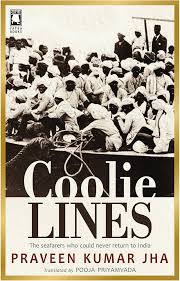
Coolie Lines by Praveen Kumar Jha, translated from Hindi by Pooja Priyamvada, is a profoundly moving and meticulously researched account of one of the most overlooked chapters in Indian labour history. The book tells the story of thousands of Indian workers who were transported across the Indian Ocean as indentured laborers during the nineteenth and early twentieth centuries. These men and women were sent to colonial plantations and settlements under contracts they neither fully understood nor freely accepted. Many of them never returned to India, and their stories have remained largely invisible in both academic scholarship and public memory. Through a combination of archival research, oral histories, and narrative reconstruction, Jha brings these forgotten lives into focus, offering readers a window into a brutal system that shaped the modern world.
Historical Context and Scope
The book begins in 1826, when the first ship carrying Indian laborers set sail for Réunion Island. This moment, Jha argues, marked the beginning of a long and brutal system of labor extraction that effectively replaced slavery with indenture while retaining many of its most exploitative features. The workers, called “coolies,” were not merely laborers in the economic sense. They were racially marked and treated as disposable bodies, managed and controlled through a combination of deceptive contracts, physical violence, surveillance, and geographic isolation. By focusing on the lived experiences of these workers rather than just the administrative records of the colonial state, Coolie Lines shifts the narrative away from bureaucratic documentation and instead places human suffering, endurance, and fragmented belonging at the center of the story.
The book is organized geographically rather than chronologically, a structural choice that mirrors the dislocation and displacement experienced by the workers themselves. Jha traces labor routes from India to Mauritius, Réunion, South Africa, the Caribbean, Fiji, and parts of South America. Each chapter combines archival fragments, travel accounts, and reflections drawn from descendants of indentured laborers. The result is not a linear, straightforward history but a layered and textured narrative that captures both continuity and rupture in the lives shaped by the indenture system. This spatial framework allows the reader to see how the same patterns of exploitation were replicated across different geographies, creating a global labour regime that served the interests of colonial capital.
Methodology and Research Approach
One of the book’s greatest strengths lies in its innovative research methodology. Jha does not rely solely on official colonial archives, which often reduced labourers to statistics, numbers, and contractual obligations. Instead, he reads against the grain of these documents and supplements them with letters, ship records, court cases, folk memories, and linguistic traces that survive in diasporic communities today. This approach allows the book to recover voices that were systematically erased from the historical record. The emphasis on girmit ancestors—descendants of indentured workers—is particularly significant. It connects historical labour migration to contemporary questions of identity, culture, and memory within the Indian diaspora, showing that the legacy of indenture is not confined to the past but continues to shape lives and communities today.
By drawing on multiple sources and perspectives, Jha constructs a narrative that is both historically rigorous and emotionally resonant. He gives agency to people who were treated as mere instruments of colonial profit, allowing their humanity to emerge from the fragments of evidence that remain. This method also challenges traditional historical writing, which has often privileged official documents over personal testimonies and oral traditions. In doing so, Coolie Lines participates in a broader movement within postcolonial scholarship to decolonise historical narratives and centre marginalised voices.
Writing Style and Accessibility
The narrative style of Coolie Lines is accessible and reflective, avoiding heavy theoretical jargon while remaining intellectually engaged. Jha writes with clarity and restraint, neither sensationalising the suffering he describes nor minimising its gravity. The prose is measured and respectful, creating space for readers to reflect on the weight of what they are learning. Yet despite its accessible language, the book is deeply engaged with essential debates in labour history, migration studies, and postcolonial theory. Jha demonstrates how indenture functioned as a global labour regime that enabled the British Empire to expand economically and territorially while maintaining a façade of legality and consent.
Contracts were signed, but consent was manufactured through deception, coercion, and desperation. Wages were promised, but exploitation was normalised through a system of debt bondage and punitive surveillance. Workers were technically “free” in the legal sense, yet they were bound by debt, isolation, and the threat of punishment. In this way, Coolie Lines contributes to a broader understanding of how capitalism and colonialism worked hand in hand to create modern labour systems that continue to shape global economic inequalities today.
The Quality of Translation
The translation by Pooja Priyamvada deserves special recognition. Translating a work so deeply rooted in historical context, emotional nuance, and cultural specificity is an extraordinarily demanding task. The English version largely preserves the tone, rhythm, and gravity of the original Hindi text. The language is clear, measured, and respectful of the subject matter. Cultural references, idioms, and linguistic nuances are handled with care, allowing non-Hindi readers to engage with the text without losing its rootedness in Indian history and experience. While a few passages retain a slightly literal quality that suggests the translation process, this does not significantly affect the book’s overall readability or impact. Priyamvada has managed to create a text that feels both faithful to the original and accessible to an English-reading audience, which is no small achievement.
Everyday Life Under Indenture
One of the most compelling aspects of Coolie Lines is its attention to the everyday lives of indentured workers. Jha does not treat labour history as merely an economic or demographic matter. Instead, he describes the workers’ food habits, religious practices, forms of resistance, and emotional survival strategies. These details humanise a system that is often discussed only in abstract terms. The observation that the same food traditions persist in villages separated by oceans is particularly poignant. It reinforces the idea that migration did not erase cultural memory, even when it fractured families, broke social bonds, and disrupted identities. Food, language, ritual, and memory became ways for displaced communities to maintain a connection to a homeland they could never return to.
Jha treats diaspora not as a distant or completed outcome of migration but as an ongoing social condition shaped by labour and loss. This perspective is crucial for understanding contemporary diasporic identities. The descendants of indentured workers carry with them the historical weight of displacement, and their cultural practices are shaped by both memory and absence. By documenting these everyday practices, Jha shows that history is not just something that happened in the past—it is lived and felt in the present.
Accountability and Historical Justice
At the same time, Coolie Lines does not romanticise suffering or treat the past as something to be simply remembered with nostalgia. Jha is careful to identify the agents responsible for creating and sustaining the indenture system. Colonial authorities, plantation owners, recruiters, and the British Empire itself are shown not as distant historical entities but as active participants in organised injustice. The book raises difficult questions about accountability, compensation, and historical responsibility. The observation that many labourers never received justice, recognition, or reparations gives the narrative a sharp contemporary relevance, especially in ongoing debates around colonial memory, reparations, and historical redress.
Jha’s work joins a growing body of scholarship and activism that demands acknowledgement of colonial crimes and their lasting effects. By documenting the lives of those who were exploited and forgotten, he makes a robust case for why historical memory matters—not just as an academic exercise but as a moral and political necessity.
Limitations and Areas for Further Exploration
Despite its many strengths, Coolie Lines has some limitations. Readers looking for a more explicit and sustained engagement with existing academic literature on indenture may find the book less theoretically framed than expected. While this makes the text accessible to a broader audience, including general readers and students, it may limit its use for scholars seeking a direct dialogue with current debates in labor history, migration studies, or postcolonial theory. A more robust engagement with secondary literature could have strengthened the book’s contribution to academic scholarship.
Additionally, the book could have benefited from a clearer and more reflective concluding chapter. While the individual chapters are rich and compelling, the book ends somewhat abruptly without a synthesis of its findings or a sustained reflection on what the indenture system means for present-day labor migration and precarity. Given the book’s emphasis on continuity between past and present forms of exploitation, a concluding section that draws these connections more explicitly would have strengthened the overall argument and left readers with a clearer sense of the book’s broader significance.
Significance and Contribution
Despite these minor concerns, Coolie Lines makes a significant and much-needed contribution to both labor history and migration studies. It successfully bridges the gap between academic research and public history, offering a narrative that is both deeply informative and ethically grounded. The book is particularly relevant for scholars and students of labor studies, history, sociology, and diaspora studies. It will also appeal to general readers interested in colonial history, the global Indian diaspora, and the long-term effects of imperialism on contemporary society.
In a world where contemporary labor migration continues to be marked by vulnerability, debt, and dispossession, Coolie Lines reminds us that these patterns have deep historical roots. The exploitative structures that governed indentured labor have not disappeared—they have simply taken new forms. By recovering the stories of those who crossed oceans under coercion and never returned, Jha not only documents a forgotten past but also challenges readers to rethink how labor, mobility, and dignity are structured in the modern world. His work is a call to remember, to acknowledge, and to act.
Final Recommendation
Coolie Lines is an essential and deeply humane work that deserves wide readership. It is highly recommended for anyone seeking to understand the human cost of colonial labor systems and the lasting impact of indentured migration on the Indian diaspora. The book is indispensable for students and scholars of history, migration, and labor studies, and it is equally valuable for general readers who want to engage with this overlooked chapter of Indian and global history. Praveen Kumar Jha has given voice to the voiceless, and in doing so, he has made an important contribution to our understanding of the past and its continuing influence on the present.

Leave a Reply