
Abstract
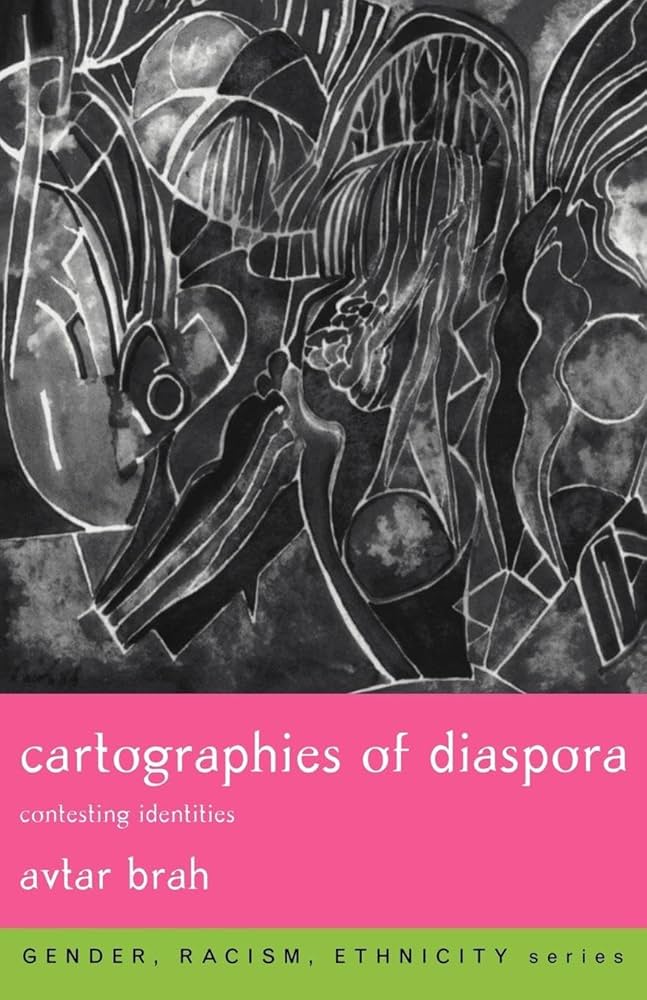
Cartographies of Diaspora: Contesting Identities, by Avtar Brah, is a seminal publication in diaspora research that rejects essentialist and narrow perspectives on migration, identity, and belonging. Instead of recognising the diaspora as a homogeneous group associated with a single homeland, Brah imagines it as a contested social space shaped by relations of power, gender, race, class, and colonial experiences. This review examines the book’s argumentative points, particularly the concepts of diaspora space, home, and the politics of location. It highlights feminist and postcolonial interventions by Brah, as well as the experiences of women and everyday identity negotiations in diasporic situations. The book is also situated within the broader context of migration and belonging, and its role in the study of diaspora is examined, along with its additional usefulness in contemporary descriptions of migration. Although the review has identified some limitations (including the fact that it is only really empirical in the case of South Asian diasporas in Britain), it still concludes that Cartographies of Diaspora is also a vital text that researchers in the area of migration, identity, and politics of belonging in a globalised world will find helpful.
Introduction
Cartographies of Diaspora: Contesting Identities, by Avtar Brah, is among the most popular and significant publications in diaspora studies. The book was initially published in 1996 but it has influenced the way in which scholars perceive the concept of diaspora not just as physical scatter but rather as a multifaceted social, cultural, and political status. Instead of viewing diaspora as a stable identity that is bound to a homeland, Brah views it as a process that is lived and influenced by the forces of power, memory, gender, race, and class.
The book appeared at a time when the field of migration studies was shifting beyond economic accounts of migration and beginning to address issues of identity and belonging. The importance of Brah’s intervention lay in its questioning of both nationalist and essentialist interpretations of culture. She claimed that diasporic identities are not transferred as such between one location and another but that they are actively created in day-to-day activities, struggles, and negotiations.
This review examines the central thesis of Cartographies of Diaspora, its conceptual value, and its implications for the study of diaspora, particularly through the lens of the Global South and postcolonialism. It also highlights the book’s shortcomings and their implications for current discussions on migration, identity, and belonging.
Diaspora as a Conceptual and Political Space
One of the book’s central contributions lies in Brah’s redefinition of the concept of diaspora. She moves away from the idea of diaspora as a homogeneous community bound by a shared origin or nostalgia for return. Instead, she conceptualizes diaspora as a space marked by difference, contestation, and unequal power relations.
Brah introduces the idea of “diaspora space” to capture the social terrain where migrants, non-migrants, and host populations interact. This space includes not only those who move but also those who stay, and histories of colonialism, racism, labour relations, and gender hierarchies shape it. Diaspora space, therefore, is not just about migrants; it is about how societies are transformed through migration.
This formulation is crucial because it challenges the tendency to isolate migrants as separate cultural groups. Brah shows that identities are produced relationally, through encounters between different communities. Diaspora becomes a lens through which to examine broader social processes, rather than a narrow category of people.
Home, Belonging, and the Politics of Location
A key theme of the book is the idea of “home”. Brah makes a careful distinction between “home” as a lived experience and “homeland” as an imagined or symbolic space. For many in the diaspora, home is not a single place but a set of emotional attachments, memories, and everyday practices.
Brah argues that the longing for home need not imply a desire to return to one’s homeland. Instead, it often reflects a search for security, dignity, and recognition in contexts where migrants face exclusion and racism. Home, in this sense, is deeply political.
The concept of “politics of location” is central to this discussion. Brah emphasises that experiences of diaspora differ based on gender, class, caste, race, and generation. A middle-class professional migrant and a working-class migrant woman do not experience belonging in the same way, even if they share a national origin.
By foregrounding these differences, the book resists romanticised accounts of diaspora. It shows that diaspora is not a unified experience but a fragmented and often unequal one.
Gender and Diaspora: A Feminist Intervention
One of the most critical strengths of Cartographies of Diaspora is its feminist approach. Brah critiques mainstream migration and diaspora studies for treating gender as secondary or ignoring it altogether. She demonstrates how women’s experiences of migration are shaped by both patriarchy and racism.
Drawing on the experiences of South Asian women in Britain, Brah reflects on the interactions among cultural norms, family structures, and labour markets that shape women’s lives. She demonstrates that women do not passively preserve tradition, but rather negotiate, oppose, and construct cultural expectations.
This feminist perspective also destabilises nationalist discourses that regard women as objects of cultural purity. Brah states that this kind of narrative tends to police women’s bodies and behaviour as a means of maintaining identity. These pressures may be even stronger for the diaspora.
Focusing on gender, the book expands the scope of diaspora studies and emphasises the necessity of intersectional analysis.
Race, Racism, and Postcolonial Contexts
Brah situates diaspora firmly within histories of colonialism and racialisation. She shows how migration from former colonies to imperial centres cannot be understood without acknowledging colonial power relations.
In the British context, South Asian diasporas are shaped by racial hierarchies that mark them as outsiders, regardless of citizenship or length of residence. Brah analyses how racism operates not only through overt discrimination but also through everyday practices and institutional structures.
Notably, she also critiques multiculturalism when it treats culture as static and overlooks the role of power. Celebrating diversity without addressing inequality, she argues, risks reinforcing existing hierarchies.
This critique remains relevant today, as debates on migration often oscillate between exclusion and superficial inclusion, without addressing the structural injustices that underlie them.
Contribution to Diaspora Studies
Cartographies of Diaspora made several lasting contributions to the field of diaspora studies. First, it provided a theoretical framework that moved beyond binary thinking, such as the distinction between home and host, or tradition and modernity. Second, it systematically integrated feminist and postcolonial perspectives into diaspora studies.
The book also influenced later work on transnationalism, identity, and belonging. Concepts such as diaspora space and the politics of location continue to be widely used across various disciplines, including sociology, anthropology, cultural studies, and development studies.
For scholars working on the Global South, Brah’s work is particularly valuable because it resists Eurocentric assumptions and foregrounds colonial histories. It encourages scholars to think critically about how power shapes mobility and identity.
Limitations and Critiques
While the book remains influential, it is not without limitations. One critique is that its empirical focus is mainly on South Asian diasporas in Britain. Although Brah does not claim universal applicability, readers working on other regions may find the scope limited.
Another weakness is that the language of the theories is dense in certain parts of the book. Although the ideas are potent, they may be difficult for readers unfamiliar with feminist or postcolonial theory to unravel. This could restrict access for practitioners or students new to the field of diaspora studies.
Lastly, the book is not as much involved with state policies and legal systems. Migration scholars or those with an interest in citizenship policy may be required to corroborate Brah’s analysis with an institution-oriented work.
Nevertheless, these shortcomings do not diminish the book’s overall contribution. Instead, they are a product of their own intellectual preoccupation and historicism.
Contemporary Relevance
Despite being published more than two decades ago, Cartographies of Diaspora remains highly relevant. In an era of increasing migration, rising nationalism, and debates over belonging, Brah’s insights offer essential tools for analysis.
The book helps explain why migrants remain excluded even after they have become economically integrated. It also illuminates the emotional and cultural aspects of migration, which are often overlooked in policy debates.
Intersectionality is of importance to modern scholars and practitioners. The current state of migration demands that gender, class, caste, and race be considered together to form the experiences of mobility and exclusion.
Conclusion
Cartographies of Diaspora: Contesting Identities by Avtar Brah is an informative book that has reinvented the study of diaspora. The book goes beyond the simplified accounts on migration and identity by conceptualising diaspora as a relational and contested space. It employs a feminist and postcolonial approach, offering a nuanced understanding of belonging, power, and difference.
The book has some drawbacks, though its theoretical contributions are essential. It has remained an inspiration to scholars across all fields and can offer insights to anyone who wants to understand the dynamics of a globalised diaspora.
Cartographies of Diaspora is a valuable and satisfying resource for anyone interested in migration, identity, and the politics of belonging.

Leave a Reply