
Abstract
This paper offers a comparative historical review of the Indian diaspora in Guyana and Suriname within the pre-2005 period. To me, the Indian diaspora of South America should not be seen as a recent migrant phenomenon but the long-term result of nineteenth-and early twentieth-century indentured labour, post-indenture settlement, and trackable community formation. Using archival records, census data, official reports, and historical scholarship, the research examines demographic consolidation, settlement patterns, socio-cultural contributions, and political incorporation. The analysis reveals that the two diasporas, despite having a common origin in the plantation labour, took two different institutional paths: in Guyana, the demographic majority led to intensified ethnicized competition for power, while in Suriname, the Hindustani community members were able to gain entry through coalition, accommodation, and plural governance. The paper finally states that the Indian diaspora was a major element in the formation of modern plural societies in both countries.
Keywords: Guyana; political incorporation; Suriname; indentured labour; Indian diaspora; comparative history; South America, etc.
Introduction
Modern migration frameworks alone won’t give us a proper understanding of the history of the Indian diaspora in South America. In fact, for Guyana and Suriname, the Indian settlements were most significantly established through the indentured labour system.[1] of the 19th and early 20th centuries, a system that arose following the abolition of slavery in plantation economies of the Caribbean and northern South America (Fokken, 2018; Nationaal Archief n.d.). Instead of viewing the Indian presence in these societies as simply a recent demographic change, this paper regards the Indo-Guyanese and Hindustani-Surinamese communities as the outcome of a prolonged historical process involving colonial labour extraction, settlement, cultural adaptation, and intergenerational community formation (Fokken, 2018).
During the last decades of the 19th and the first decades of the 20th century, British India became one of the chief sources of indentured labourers for the plantation colonies, which, after the abolition of slavery, faced an acute labour shortage. The utilisation of this system in British Guiana resulted in the creation of one of the largest Indian migrant communities in the Region; official records and archival research reveal that about 238,979 Indians were brought into the colony under the indenture system (UNESCO Memory of the World 2011; Solowsky, 2013). As late as the beginning of the 21st century, this heritage was still very much apparent in the country’s demographic profile. The 2002 Guyana National Census Report identified 326,277 people of East Indian descent, who made up 43.43 per cent of the total population of 751,223, thereby making them the largest ethnic group in the country (CARICOM Secretariat, 2009).
In Suriname, the Dutch colonial plantation economy produced a parallel, yet different, path. “The Dutch National Archives and top historical scholars reveal that from 1873 to 1916, over 34, 000 Hindustani immigrants from British India were brought to Suriname as indentured labourers (Nationaal Archief n.d.; Fokken 2018).” The continuing impact of this migration history is clearly reflected in official demographic figures as well. “The 2004 census of Suriname, as mentioned by the Permanent Mission of the Republic of Suriname to the United Nations, showed the total population at 492, 829, of which the Hindustani (East Indian) communities made up 27 per cent (Permanent Mission of the Republic of Suriname to the United Nations n.d.).”
The paper proposes that a comparative study of Guyana and Suriname allows one to focus on the historical development of the Indian diaspora in South America.[2] This diaspora would be different from the post-2005 student mobility, professional migration, and new transnational circuits. Although both societies experienced plantation systems and Indian workers’ immigration, they were two different imperial systems British in Guyana and Dutch in Suriname. These differences resulted in various settlement patterns, return migration, cultural preservation, language retention, and political participation (Fokken 2018; Choenni 2025). Therefore, this comparative framework enables discussing beyond demographics and opening up the analysis to how similar migration patterns led to different historical results.
Therefore, the paper really zooms in on Indo-Guyanese and Hindustani-Surinamese diaspora prior to 2005 only, leaving aside the recent migration of mostly students and professionals. Moreover, these two groups are portrayed as being part of the larger narrative of labour migration, post-indentured settlement, and socio-cultural consolidation over time. In fact, by using archival records, census figures, and historiographies as its centerpieces, the paper aims to reveal that India’s diaspora in South America is not simply a migration story but rather a main chapter in the growth of modern plural societies in Guyana and Suriname (Fokken, 2018; UNESCO Memory of the World 2011).
Historical Evolution of the Indian Diaspora in Guyana and Suriname
The story of Indian migration to Guyana and Suriname is part of the bigger historical change in the Caribbean when slavery was abolished, and indentured labour was introduced. In the two colonies, after slavery was abolished, there was a severe labour shortage in plantation agriculture, especially in the sugar sector. This situation led the colonial authorities and private planters to look for a new, disciplined labour force in British India. In British Guiana, the arrival of Indian indentured migrants began in 1838, making it the earliest major site of Indian indenture in the Caribbean; between 1838 and 1917, approximately 240,000 Indians were transported there, primarily for plantation labour (Prasad and Jha 2016, pp. 235-36). In Suriname, then a Dutch colony, the system began later but followed a comparable logic. The first major ship associated with organised migration, the Lalla Rookh, arrived in 1873,[3] Moreover, between 1873 and 1916 more than 34,000 Indian indentured labourers were brought to Suriname under the Dutch colonial regime (Choenni 2025, p. 1; Ramdayal, Maat, and Van Andel 2021, 1-2). Rather than treating these migrations as merely a labour transfer, they should be understood as the foundational phase of a durable social formation that would later produce two of the most significant Indian-descended populations in the Caribbean and northern South America.
Although the structural logic of indenture was similar in both colonies, the long-term trajectories of the two diasporas diverged in important ways. In British Guiana, the system was larger in scale and more deeply tied to the sugar economy. At the same time, in Suriname the smaller size of the migration stream produced a more tightly documented and highly traceable community history. In Suriname, historical data indicate that indenture was probably practised not only during the labour contract period. Because the changes for re-indenture, repatriation, and permanent settlement were made very often until the beginning of the 20th century, “the historical period could even be 1873-1921 (Kraaij 2022, 39).” The Surinamese scholarly work also shows that many ex-indentured labourers did not return to their homeland but rather settled and the colonial government even assisted this by offering land grants, hardly any cash compensation, and access to agricultural plots instead of return passage. One of the detailed stories states that the permanent settlers in Suriname could be given about 1.5-2 hectares of Crown land and 100 guilders, which were the incentives to change from plantation labour to small-scale farming (Choenni 2025, 106). This fact deeply influenced the Surinamese Indian experience: the post-indenture population was not simply the leftover labouring class but rather a newly developing agrarian society becoming more and more socially rooted. In Guyana also, the descendants of indentured labourers to a great extent became independent of the plantation, but due to the larger demographic scale and higher degree of their incorporation into plantation, ethnic competition and social mobility occurred in somewhat different ways.
A significant turning point in the history of these two colonies was the shift of the indentured laborers to permanent settlement. Ending the period of indenture, however, did not mean that the diaspora ceased to be formed, but rather that it was the start of the community consolidation. “In Suriname, it is pointed out by researchers that an increasing number of ex-laborers stayed in the colony, bought land, reconstituted their family relations, and founded religious, cultural, and farming institutions that helped stabilize the collective life after the upheavals of migration and plantation discipline (Fokken 2018; Choenni 2025, 106).” This development was very important as it shows why the Indian community in Suriname not only became demographically visible but also socially resilient. Interestingly, in Guyana, the Indo-Guyanese people transitioned from the cruel plantation system to a wider social environment where culture, religion, kinship, and rural areas were essential to the collective survival. “The extent of this history became evident in the demographic level by the late 20th and early 21st centuries: according to Guyana’s 2002 Census, East Indians made up 43.43% of the country’s total population, therefore, they were still the largest ethnic group (CARICOM Secretariat 2009).” Even as of 2012, though somewhat diminished due to migration and other demographic changes, East Indians still constituted 39.8% (297, 493 persons) of the population and continued to be the largest ethnic community.[4] The past indenture system is also seen in the ongoing importance of the Hindostani population in Suriname as well as in the continued presence of their farming, language, and religious traditions, even though later migration and modernization have changed their forms to some extent (Ramdayal, Maat, and Van Andel 2021, 1-3). So the Indian diaspora’s historical changes in Guyana and Suriname should be understood not as merely a chapter about indenture being closed, but rather as a lengthy passage from forced colonial labor towards being adapted, rooted, and politically influential diasporic community formation.
Demographic Profile and Settlement Patterns
The demographic profile of the Indian diaspora in Guyana and Suriname shows that the descendants of indentured laborers became long-standing communities, which historically anchored themselves, rather than being just temporary labor populations. In fact, the demographic prominence of Indian-origin societies in both countries is mostly due the fact that they live in the coastal and agriculturally fertile areas which were developed by the plantation economy. This, therefore, leads to an analysis of the two interconnected aspects: firstly, the demographic importance of the Indo-Guyanese and the Hindustani-Surinamese populations in the national population structures; secondly, the settlement patterns through which these communities, over time, became territorially consolidated. If these two aspects are read together, it will be seen that the Indian diaspora in South America has survived not just through migration but also long-term settlement, reproduction, and regional concentration.
Table 1. Demographic Profile and Settlement Patterns of the Indian Diaspora in Guyana and Suriname
| Country | Census Year | Total Population | Indian-Origin Population | Share of Total Population | Principal Historical Settlement Zone | Broad Settlement Pattern | Evidence Type |
| Guyana | 2002 | 751,223 | 326,277 East Indians | 43.43% | Coastal plantation belt of former British Guiana | Strong concentration in the major coastal population regions, especially Regions 2, 3, 4, 5, and 6; broad continuity between plantation geography and later village and agricultural settlement. | Direct official census evidence |
| Suriname | 2004 | 492,829 | Hindustani population reported as 27% of total population | 27% | Coastal plantation districts of former Dutch Guiana | Historically concentrated in coastal agrarian districts and later expanded into the Paramaribo-Wanica zone | Official national-level population anchor + cautious demographic proxy + historical settlement scholarship |
Source: Author’s compilation based on Bureau of Statistics, National Census Report 2002, Guyana; Suriname-2004 Census Evaluation; Permanent Mission of the Republic of Suriname to the United Nations, “Country Facts”; and Suriname Country Experience Report.[5]
The Indian diaspora’s demographic profile in Guyana can be precisely defined thanks to the 2002 National Census Report which contains direct ethnic data. According to the census, there are 326, 277 East Indian people in the country out of a total population of 751, 223, meaning that East Indians made up 43.43 percent of the national population and were the largest ethnic group in Guyana (Bureau of Statistics 2009, 26).[6] This is a crucial piece of evidence as it indicates that the Indo-Guyanese community was not a marginal migrant minority but a major demographic element of modern Guyana. Besides, the same census shows that the country’s population was still predominantly living along the narrow coastal belt, whereas huge parts of the interior were largely unpopulated (Bureau of Statistics 2009, 49-50). “Region 4 alone had about 41.3 percent of the country’s population in 2002, whereas Regions 3, 5, and 6 also represented main areas of population concentration (Bureau of Statistics 2009, 50).” Historically, this corresponds with the geography of plantation labor: Indians in British Guiana were initially recruited for the coastal sugar areas, and many after working as indentured laborers stayed in the very same regions where land availability, drainage systems, transport routes, rice cultivation, and village settlement facilitated long-term consolidation. The Indo-Guyanese case therefore shows a strong continuity between the geography of indenture and the geography of demographic permanence.
In Suriname, the demographic profile must be handled more cautiously, but it is still clearly significant. The most secure demographic anchor for Suriname in this section is the official total population figure of 492,829 recorded in the 2004 census, as reported in the Suriname census evaluation materials. In addition, the research base for this paper uses the officially cited national figure that Hindustanis constituted 27 percent of the population in the early twenty-first century (Suriname-2004 Census Evaluation n.d.; Permanent Mission of the Republic of Suriname to the United Nations n.d.). Given the absence of a directly quoted ethnicity table in the present source base, the Hindustani population is best retained here in percentage form rather than converted into a derived absolute figure. Even in this cautious form, however, the evidence clearly indicates that Hindustani-Surinamese communities remained one of the most demographically important groups in the country.
The Surinamese settlement pattern is best reconstructed through historical continuity rather than through a single district-wise ethnic table. After contract labour ended, many former Indian labourers became small cultivators and settled in specific coastal and peri-coastal zones. “According to the Suriname Country Experience Report, a large number of Indians settled along the roads surrounding Paramaribo; others settled in Nickerie and Saramacca; and a few went to areas south of Paramaribo, which today corresponds to Wanica (Suriname Country Experience Report n.d., 319).” It is significant because it directly connects post-indenture settlement with later regional population structure. Instead of suggesting a widespread, diasporic presence, it rather points to a specific territorial pattern: agricultural settlement in the most productive districts and gradual expansion into the Paramaribo metropolitan zone. Moreover, these later shifts to urban and peri-urban areas did not diminish the historical role of the rural districts. In other words, Guyana could be considered a stronger example of direct, census-visible ethnic concentration confined to the coastal belt, while Suriname shows a pattern of investment in agrarian district settlement with a more controlled expansion along the Paramaribo-Wanica axis than that of Guyana.
However, demographic and spatial concentration at the same time also laid the social foundation for achieving something more than just continuity in quantities. Settling together closely in villages, agricultural districts, and kinship-based localities was a great help not only in maintaining family relations but also community institutions and inherited cultural practices. In this sense, demographic concentration went beyond a question of population size and geography as it also contributed towards kinship ties, inherited cultural practices and forms of collective attachments that later became central to community identity. This broader social significance will be explored in greater detail in the next section.
Looking at all the facts from Guyana and Suriname, they back up one main idea here: the Indian diaspora in South America made a big historical impact because they not only were a big group of people, but also they managed to live in one place very strongly. “We see this clearly in Guyana where, without even doing very complicated mathematics, the census shows that in 2002, East Indians made up 43.43 percent of the total population of the country and at the same time, they were mostly living in the main coastal areas, where most people are also living (Bureau of Statistics 2009, 26, 49-50).” In Suriname, the official total 2004 population combined with the 27 percent Hindustani portion and the studied residential areas of Nickerie, Saramacca, and Paramaribo-Wanica corridor indicate that Hindustani-Surinamese indeed communities grew to be a very important part of the country’s social structure over time. Thus, the main takeaway here is that in both these countries, the Indian diaspora should be viewed not as a small leftover from migration but as a demographically and spatially significant part of the historical development of the modern plural societies.
Economic, Social, and Cultural Contributions
Economic Contributions
The Indian diaspora in Guyana and Suriname made enduring economic contributions that extended well beyond the colonial plantation system. In Guyana, the descendants of Indian migrants remained closely tied to agriculture, first through sugar and later through rice cultivation, thereby helping to sustain a durable smallholder and village-based agrarian economy after indenture (Deonarain-Gear 2025; Gillette and Sakai 2020, 25-26). Their long-term economic significance is reinforced by official demographic evidence: the 2002 National Census Report recorded 326,277 persons of East Indian origin out of a total population of 751,223, meaning that East Indians constituted 43.43 percent of the national population and formed the country’s largest ethnic group (Caribbean Community [CARICOM] Secretariat 2009, 26).[7] This demographic scale helps explain why Indo-Guyanese participation in agriculture, petty trade, and rural commercial life became structurally important to the national economy.
A second dimension of economic contribution lies in migration-development linkages. In a government-linked study focusing on Guyana’s engagement with its diaspora, it is pointed out that remittances became greater than foreign direct investment after the new millennium; the study’s figure on official monetary flows clearly cites World Bank (2017) and UNCTAD (2017) data. Furthermore, the same study highlights the Government of Guyana’s launching of the Guyana Diaspora Project in 2013 with the collaboration of IOM, a strong indication that diaspora capital, skills, and investment are development resources which have been formally recognized by the government. Meanwhile, in Suriname, the economic contribution of the Indian diaspora can be understood best in terms of post-indenture settlement and small-scale cultivation.[8] Historical researches reveal the fact that many working-class laborers did not return to their countries but often chose to live in a way that depended on the land from the labour on the plantation to the small farming by means of land-based agreements (Kraaij 2022, 39-42; Choenni 2025, 106). This way of life was also supported by the fact that rice cultivation practices, initially carried out by the first generation of migrants, were preserved by the following ones among the Hindustani communities (Ramdayal, Maat, and van Andel 2021, 1-3). On a policy level, the Suriname Migration Profile, drafted by the International Organization for Migration (IOM), states that migration and diaspora matters had made their way even into the formal development discourse in Suriname (International Organization for Migration [IOM] 2015).
Social Contributions
Besides fostering social progress, the Indian diaspora also transformed labour migration into lasting community presence. A case in point is the transition of the Indian migrants in Guyana from working on the plantations to living in villages and engaging in agricultural activities. This not only led to the strengthening of family ties, religious centers, and other forms of social organization but also facilitated Indo-Guyanese people in living their lives in ways that were independent of the plantation system while setting up stable family, religious, and local structures (Deonarain-Gear 2025). Interestingly, this same official examination which records East Indians as the biggest ethnic group in 2002 also points out that this community continues to be at the very heart of the social life of present-day Guyana (Caribbean Community [CARICOM] Secretariat 2009, 26).
The case of Suriname shows that the Indian communities there have experienced a similar pattern of being socially rooted over a very long period of time. According to historical and settlement records, several Indian-origin communities have settled themselves firmly in Nickerie, Saramacca, and areas connected to the broader Paramaribo-Wanica corridor, thus establishing demographic and social continuity (Fokken 2018, 219-20). The Permanent Mission of the Republic of Suriname to the United Nations, in its country profile, also depicts Suriname as a multi-ethnic society where the Hindustani communities are still a part of the national social fabric (Permanent Mission of the Republic of Suriname to the United Nations n.d.).
Cultural Contributions
The Indian diaspora had a significant role in the cultural development of both countries by maintaining and reinterpreting various religious, linguistic, and ritual traditions. The public presence of Hindu and Muslim celebrations, along with festivals like Diwali and Phagwah in Guyana, indicate that the use of Indian-origin cultural elements went beyond the private ethnic sphere and indeed became part of the national symbolic culture (Solowsky 2013). The cultural imprint of the Indian diaspora in Suriname was quite unique as new diasporic forms were created rather than simply preserved. The most prominent example is Sarnami[9], a language that developed in Suriname out of North Indian language influences, showing that the Indian community in Suriname was not only culturally strong but also culturally creative in a specifically South American environment (Fokken 2018). Overall, the Indian diaspora in Guyana and Suriname did not just exist after indenture; it was a major force in shaping the economic bases, social structures, and cultural identities of both communities (Prasad and Jha 2016, 235-36; Ramdayal, Maat, and van Andel 2021, 1-3).
Political and Comparative Analysis
Ethnicity, Representation, and State Power: The political incorporation of the Indian diaspora in Guyana and Suriname took different but still structurally related paths even though their origins were similar in indenture, settlement, and demographic consolidation. In Guyana, the Indian diaspora became a community that was not only large in number but also electorally decisive. However, this demographic strength alone did not guarantee them stable political security. Actually, from the 1961 general election onwards, voting behaviors “became largely divided along ethnic lines,” according to Khemraj, who points out that it was a system of strategic ethnic voting where people support co-ethnic elites to gain access to state-linked economic advantages (Khemraj 2016, 326). Under such circumstances, the political power of Indo-Guyanese attained both a central position and a source of challenge, as electoral competitions were increasingly viewed as contests for control of the state, while access to governmental power was largely perceived in communal rather than purely ideological terms.
This structural problem was identified later even in governance-oriented international dialogue. A 2005 UNDESA/UNDP-linked reflection on the Guyana case explicitly considered the conflict in terms of inclusion and exclusion, describing the tension as one between a “winner takes all” model and a “consensual paradigm” of governance.[10] This framing implies that the main issue was not ethnic diversity itself but rather the institutional means through which ethnicity was brought into the fold of state power. For the Indian diaspora before 2005, therefore, political centrality in Guyana carried a paradox: demographic and electoral weight increased representation, but also intensified communal polarization and made the struggle for state legitimacy more volatile (Khemraj 2016, 326-28).
Comparative Political Outcomes in Guyana and Suriname: Suriname developed a different, though not non-ethnic, political pattern. Hindustanis similarly became a major social and political force, but their incorporation was mediated less through ethnic bipolarity than through negotiated coalition-building. Choenni’s analysis of political adaptation in Suriname is decisive here: by the mid-twentieth century, Hindustanis had become a politically mature community, yet their rise was channelled through what Choenni terms verbroederingspolitiek, or the politics of ethnic fraternity associated with cooperation between the VHP and NPS rather than immediate zero-sum confrontation (Choenni, “Ethnicity and Politics,” 416). This did not eliminate ethnic voting; rather, it institutionalized a more accommodationist mode of ethnic politics in which coexistence was maintained through elite bargaining.
Veenendaal’s research on Suriname’s multiethnic democracy provides further evidence of this interpretation. According to him, although coalition formation in Suriname is frequently pragmatic and opaque, it still leads to recurrent power-sharing among parties representing different ethnic communities, mainly because being excluded from the government would also mean the exclusion of specific groups from access to state resources (Veenendaal 2020, 76-77). Hence, the political system in Suriname continued to be highly ethnic, nevertheless, it gave rise to a more stable structure of negotiated inclusion as compared to the starkly bipolar model of Guyana.
Official data makes this difference even more obvious. For instance, the Suriname General Bureau of Statistics’ technical review of the Population and Housing Census 2004 included a Post Enumeration Survey which was then used to verify the enumerations of the count. They also cross-verified the results with several government databases like SOZAVO, SZF, CEBUMA, Ministry of Education, and Electricity Company of Suriname (GBS 2006, 15-16, 20-23).[11] In a scenario where the political importance of racial-demographic balance was so high, this kind of administrative checking was significant because it showed that the government has the ability to not only measure but also manage the diversity of the population in a very systematic and institutional way.
So, prior to 2005, population sizes were not really the main factor through which the Indian diaspora’s political power in Guyana and Suriname was determined. The main factor was rather the logic according to which the government operated. In Guyana, demographic dominance worsened ethnic rivalry; in Suriname, it had to be done through alliances. So the main difference was really in the way the institutions were set up: in Guyana, political power could be more easily consolidated as a result of ethnic competition, whereas in Suriname coalitions and negotiated inclusion were the main ways of political mediation.
Contemporary Demographic and Socio-Economic Position
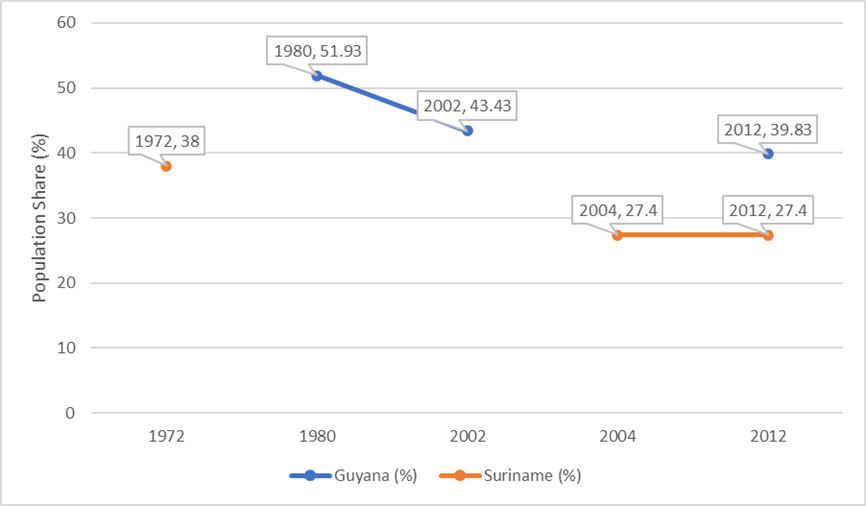
The present-day status of the Indian diaspora in both Guyana and Suriname shows the following: a shared demographic resilience story but two very different adaptation paths in the late twenties and early twenty-first centuries. In Guyana, the East Indian remained the country’s largest single ethnic group in the early 2000s, yet their overall share declined from 326, 277 persons (43.43%) in 2002 to 297, 493 persons (39.83%) in 2012, which means that numerical predominance was there but became less absolute over time (CARICOM Secretariat 2009, 26; Bureau of Statistics, Guyana 2012). On the other hand, in Suriname, the Hindustani population showed greater proportional stability within a more explicitly plural social order: it represented 135, 117 persons (27.4%) in 2004 and 148, 443 persons (27.4%) in 2012, which means not a demographic decline in percentage terms, but the consolidation of a lasting plurality within a multi-ethnic national structure (Hassankhan, Bipat, and Abdoel 2016, 2). Such a contrast is quite a change analytically. Before 2005, the electorally and demographically the Indians in Guyana remained the most dominant, whereas the Hindustanis in Suriname, although less dominant, were in a position institutionally so that the community was one of several. Notably, the survival of similar demographic power from one generation to another also shows that the Indian diaspora in both countries had, by the turn of the early twenty-first century, moved beyond just being a historical indenture legacy and become a structurally embedded part of national society, and this has further implications for their electoral behavior, cultural continuity, and social stratification.
The following figure places the current census data in the context of a longer demographic development.
Figure 1. Long-Term Demographic Trend of Indian-Origin Communities in Guyana and Suriname
Source: Caribbean Community (CARICOM) Secretariat, National Census Report 2002, Guyana (Georgetown, Guyana: Caribbean Community [CARICOM] Secretariat, 2009), 26; Bureau of Statistics, Guyana, Compendium 2: Population Composition, 2012 Population and Housing Census (Georgetown, Guyana: Bureau of Statistics, Guyana, 2012), Table 2.1; Chan E. S. Choenni, “Ethnicity and Politics: Political Adaptation of Hindostanis in Suriname,” Sociological Bulletin 63, no. 3 (2014): 409; and Sandew Hira, Ashruf Karamat Ali, and Marty Bipat, Islam and Indian Muslims in Suriname (Paramaribo: Stichting Wetenschappelijke Informatie, 2016), 2.
The figure underscores a steady proportional decline in Guyana and a decline followed by stabilization in Suriname, indicating distinct demographic trajectories within two plural societies.
The demographic weight of the Surinamese population gains significance especially when it is juxtaposed with socio-economic indicators instead of focusing only on ethnicity. According to the official census data at district level for 2004, the total population of Suriname was 492, 829, out of which Hindus made up 19.9% and Muslims 13.5%. This result confirms that the Indian-origin religious communities are still prominently visible among other communities in the society.[12] On the other hand, general societal indicators reveal the integration of these communities rather than their marginal existence. The strict unemployment rate was 9.5% (14.7% under the broader definition), the percentage of the population aged 15 and above attending tertiary education was 4.9%, 31.0% of households were headed by females, 78.6% of dwellings received electricity from the national utility, and 70.3% of the population had access to piped water.[13] These indicators are not exclusive to the Indian diaspora. But they are important to understand the context in which the Hindustani communities lived: a plural society that was recognized by the census, measured by the administration, and structured materially rather than a mere demographic competition. In this respect, Suriname proves to be a very interesting case on which one may base a comparison as it reveals the fact that diasporic endurance can depend on the institutional accommodation and social visibility of the community, not only on its numerical majoritarianism.
Overall, the findings reveal that it is not just the population share that can explain the current standing of the Indian diaspora in the two countries. While the Indian community in Guyana remained as the largest ethnic group, it went a step further to becoming a minority and hence the role of politics in ethnic relations became even more significant. On the other hand, in Suriname, Hindustani community kept their ethnic identity mainly through their continued presence in a multi-ethnic society whose institutional logic was more distributive than bipolar rather than relying on demographic dominance. Thus, by the early twenty-first century-and crucially at the edge of the paper’s pre-2005 analytical frame-the Indian diaspora in both countries remained nationally consequential, but its significance rested on different foundations: in Guyana, on enduring electoral centrality despite relative demographic contraction; in Suriname, on durable communal presence within a more balanced and administratively legible plural framework.
Conclusion
A comparative study of the Indian diaspora in Guyana and Suriname demonstrates that the historical significance of Indian-origin communities in South America cannot be understood through migration alone, nor through demographic presence in isolation. In both societies, the Indian diaspora emerged from the nineteenth- and early twentieth-century system of indentured labour and gradually transformed from a colonial labour force into a historically rooted, socially resilient, and politically consequential component of national life. The different experiences of Indo-Guyanese and Hindustani-Surinamese are a classic case in point: historical emergence from a highly similar migrant base can’t be reconciled with totally matching outcomes. Indeed, it was the specific institutional contexts that effectively determined the future of these two post-indenture communities in terms of settlement, social organization, and political participation.
In Guyana, a larger scale of indentured migration and the later demographic predominance of the East Indian population produced a diaspora that remained numerically central to the national social order. This demographic strength, however, also intensified the link between ethnicity and state power, resulting in a more politically polarized structure where communal identity was closely tied to electoral competition and control of the government. Suriname, on the other hand, the Hindustani community grew up in a more pluralistic and coalition-oriented political sphere. Even though the Hindustani continued to be one of the country’s most major demographic groups, their eventual integration happened through less ethnic bipolarity and more through negotiating coexistence, coalition-building, and multi-ethnic governance with a distributive logic.
Therefore, the main comparative result of this paper is that the historical and present-day importance of the Indian diaspora in these two states was not only dependent on numbers, but also on how demographic weight was institutionally converted into social and political power. By the early 21st century-and most importantly at the very boundary of this paper’s pre-2005 analytical frame-the Indian diaspora in both countries was still nationally significant, but for different reasons: in Guyana, because of persistent electoral first-ness despite relative demographic decrease; in Suriname, because of long-lasting communal presence within a more balanced and administratively understandable plural order. Hence, the Indian diaspora in Guyana and Suriname ought to be seen not as a marginal part of the migration history, but as a principal case for analyzing how indentured labor has given rise to politically significant diasporic communities in South America.
BIBLIOGRAPHY
Bureau of Statistics, Guyana. Compendium 2: Population Composition. 2012 Population and Housing Census. Georgetown, Guyana: Bureau of Statistics, Guyana.
Caribbean Community (CARICOM) Secretariat. National Census Report 2002, Guyana. Georgetown, Guyana: Caribbean Community (CARICOM) Secretariat, 2009. ISBN 978-976-600-214-5.
Choenni, Chan E. S. History of Hindostanis, 1873-2023: India, Suriname, The Netherlands. Zoetermeer, The Netherlands: SAMPRESHAN, 2025. ISBN 978-90-833451-7-8.
Choenni, Chan E. S. “Ethnicity and Politics: Political Adaption of Hindostanis in Suriname.” Sociological Bulletin 63, no. 3 (2014): 407-431.
Corbin, Hisakhana Pahoona, and Luis Eduardo Aragón. “Diaspora Engagement for Development: Challenges and Options for Guyana.” Geografares 24 (2017). Accessed April 22, 2026. https://journals.openedition.org/geografares/8440.
Deonarain-Gear, Neta (Goomatee). “Negotiated Cultural Identity and Belonging of Self-Identified Indo-Guyanese Immigrant Women.” Dissertation, Wilfrid Laurier University, 2025. Theses and Dissertations (Comprehensive), no. 2800. https://scholars.wlu.ca/etd/2800/
Fokken, Margriet. Beyond Being Koelies and Kantráki: Constructing Hindostani Identities in Suriname in the Era of Indenture, 1873-1921. PhD diss., Rijksuniversiteit Groningen, 2018.
International Organization for Migration (IOM). Suriname Migration Profile: A Study on Emigration from, and Immigration into Suriname. Georgetown, Guyana: International Organization for Migration, 2015.
Khemraj, Tarron. “The Political Economy of Guyana’s Underdevelopment.” Review of Black Political Economy 43, nos. 3-4 (2016): 325-342.
Kraaij, Matthijs. “Destined to Leave Hindustan for Suriname? Explaining the Motivation behind Repatriation and Settlement of Hindustani Labour Migrants in Suriname, 1873-1940.” TSEG / The Low Countries Journal of Social and Economic History 19, no. 3 (2022): 37-68. https://doi.org/10.52024/tseg.10894.
Nationaal Archief (Netherlands). “Hindostaanse contractarbeiders in Suriname, 1873-1916.” Accessed April 19, 2026. https://www.nationaalarchief.nl/onderzoeken/zoekhulpen/hindostaanse-contractarbeiders-in-suriname-1873-1916.
Permanent Mission of the Republic of Suriname to the United Nations. “Country Facts.” Accessed April 19, 2026. https://www.un.int/suriname/suriname/country-facts.
Prasad, Murari, and Binod K. Jha. “Indian Diasporic Formations in Guyana: Reading Coolie Woman: The Odyssey of Indenture.” Asiatic: IIUM Journal of English Language and Literature 10, no. 2 (2016): 230-46.
Ramdayal, Melissa, Harro Maat, and Tinde van Andel. “The Legacy of Traditional Rice Cultivation by Descendants of Indian Contract Laborers in Suriname.” Journal of Ethnobiology and Ethnomedicine 17 (2021): 60. https://doi.org/10.1186/s13002-021-00485-6.
Solowsky, Allison. Indian Diaspora in Guyana: Questions in Cultural Identity. BA thesis, University of Delaware, 2013.
Spies, Chris. Guyana: A Case Study Prepared by the Social Cohesion Programme (UNDP Guyana) for the UNDESA Expert Meeting on Dialogue, New York, 21-23 November 2005. Georgetown: Social Cohesion Programme, UNDP Guyana, 2005.
UNESCO Memory of the World. “Records of the Indian Indentured Labourers.” Accessed April 19, 2026. https://www.unesco.org/en/memory-world/records-indian-indentured-labourers-0.
United Nations Conference on Trade and Development (UNCTAD). UNCTADstat. Accessed April 22, 2026. https://unctadstat.unctad.org/.
Veenendaal, Wouter. “Does Smallness Enhance Power-Sharing? Explaining Suriname’s Multiethnic Democracy.” Ethnopolitics 19, no. 1 (2020): 64-84. https://doi.org/10.1080/17449057.2019.1590078.
World Bank. Migration and Remittances Data. Accessed April 22, 2026. https://www.worldbank.org/en/topic/migrationremittancesdiasporaissues/brief/migration-remittances-data.
Algemeen Bureau voor de Statistiek (ABS) / Censuskantoor. Census 2004 Coverage Evaluation: Seventh General Population and Housing Census in Suriname. Suriname in Cijfers no. 230-2006/12. Paramaribo: General Bureau of Statistics / Census Office, November 2006.
Algemeen Bureau voor de Statistiek (ABS). Districts in Cijfers: Resultaten van de Zevende Volks- en Woningtelling in Suriname. Paramaribo: Algemeen Bureau voor de Statistiek (ABS), 2005.
[1] Margriet Fokken, Beyond Being Koelies and Kantráki: Constructing Hindostani Identities in Suriname in the Era of Indenture, 1873-1921 (PhD diss., Rijksuniversiteit Groningen, 2018), 23-25.
[2] Fokken, Beyond Being Koelies and Kantráki, 23-57; Nationaal Archief (Netherlands), “Hindostaanse contractarbeiders in Suriname, 1873-1916.”
[3] Chan E. S. Choenni, History of Hindostanis, 1873-2023: India, Suriname, The Netherlands (Zoetermeer, The Netherlands: SAMPRESHAN, 2025), 1.
[4] Bureau of Statistics, Guyana, Compendium 2: Population Composition, 2012 Population and Housing Census (Georgetown, Guyana: Bureau of Statistics, Guyana), 2-5.
[5] Bureau of Statistics, National Census Report 2002, Guyana (Georgetown: Bureau of Statistics / CARICOM Capacity Building Programme, 2009), 26; Suriname-2004 Census Evaluation (uploaded PDF), appendix table confirming the 2004 total population as 492,829; and Suriname Country Experience Report (uploaded as landincarrib.pdf), 335.
[6] Bureau of Statistics, National Census Report 2002, Guyana (Georgetown: Bureau of Statistics / CARICOM Capacity Building Programme, 2009), 26.
[7] Caribbean Community (CARICOM) Secretariat, National Census Report 2002, Guyana (Georgetown, Guyana: CARICOM Secretariat, 2009), 26.
[8] Hisakhana Pahoona Corbin and Luis Eduardo Aragón, “Diaspora Engagement for Development: Challenges and Options for Guyana,” Geografares 24 (2017): 7-8, https://journals.openedition.org/geografares/8440.
[9] Margriet Fokken, Beyond Being Koelies and Kantráki: Constructing Hindostani Identities in Suriname in the Era of Indenture, 1873-1921 (PhD diss., Rijksuniversiteit Groningen, 2018).
[10] Chris Spies, Guyana: A Case Study Prepared by the Social Cohesion Programme (UNDP Guyana) for the UNDESA Expert Meeting on Dialogue, New York, 21-23 November 2005 (Georgetown: Social Cohesion Programme, UNDP Guyana, 2005), 5.
[11] Algemeen Bureau voor de Statistiek (ABS) / Censuskantoor, Census 2004 Coverage Evaluation: Seventh General Population and Housing Census in Suriname, Suriname in Cijfers no. 230-2006/12 (Paramaribo: General Bureau of Statistics / Census Office, November 2006), 15-16, 20-23.
[12] Algemeen Bureau voor de Statistiek (ABS), Districts in Cijfers: Resultaten van de Zevende Volks- en Woningtelling in Suriname (Paramaribo: ABS, 2005), 1.
[13] Ibid.


Leave a Reply