
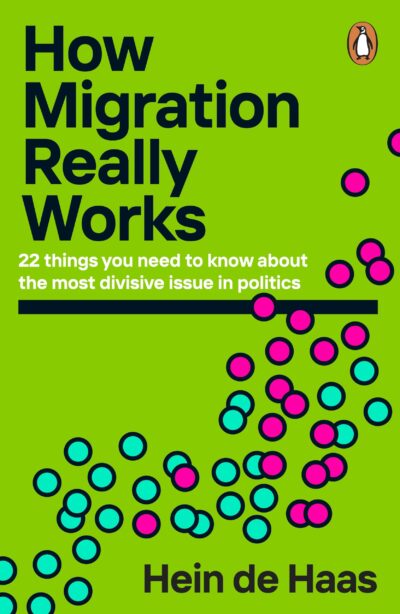
In today’s world, discussions about migration are rife with fear and misinformation. Politicians often talk about migration as a crisis or threat. Hein de Haas’s book How Migration Really Works challenges these ideas with facts and research. This is not just another academic book. It breaks down the myths about migration that have shaped government policies worldwide. De Haas is a sociology professor at the University of Amsterdam and one of the world’s leading migration experts. He has spent decades studying migration, and in this book, he answers crucial questions with evidence, not emotions.
The book’s central argument is simple but powerful: almost everything people believe about migration is wrong. Using historical data and research from around the world, de Haas shows that shared beliefs are false—such as the idea that poverty causes migration, that foreign aid reduces migration, that strong borders stop migration, and that migration is at record-high levels today.
Breaking Down the Myths
What makes this book special is how carefully de Haas proves his points. He doesn’t just say things are wrong—he shows why, using evidence from many countries and time periods. One of the most important myths he tackles is the connection between poverty and migration. Most people think that the world’s poorest people migrate the most, and that helping poor countries develop will reduce migration. De Haas proves this wrong with data showing that migration actually increases when countries develop, at least for some time. When people get better education and more money, they have both the ability and desire to move.
This finding is significant for poor countries, where migration is often seen as a sign of failure. De Haas shows it is actually a sign of progress—proof that people are gaining new opportunities. This has enormous policy implications: the billions of dollars spent trying to stop migration by helping poor countries may actually encourage more people to migrate.
De Haas also examines border security. Using decades of research, he shows that strict border controls rarely work as intended. Instead, they often increase illegal migration, make migrants stay longer (because they’re afraid they won’t be able to return if they leave), and help the smuggling networks they’re supposed to stop. The lesson is clear: militarising borders may actually create the problems governments are trying to solve.
Learning from History
One of the book’s best features is its use of history. De Haas shows that today’s “migration crisis” is neither new nor out of control. International migrants make up only about 3-4% of the world’s population—and this number has stayed roughly the same for decades. Also, most migration happens within countries, not between them, and most people in the world never migrate at all.
This historical perspective is essential because politicians often describe migration using scary words like “floods” or “invasions.” By showing that people have always moved throughout history, de Haas makes migration seem normal instead of dangerous. The book gives readers the tools to resist policies based on fear.
Jobs and Migration
The book’s most important contribution is its focus on jobs. De Haas argues that we cannot understand migration by only looking at why people leave (poverty, war, environmental problems). We must also look at the jobs available in destination countries. Migrants go where there is demand for workers in sectors with low pay and complex conditions: farming, construction, house cleaning, restaurants, and elderly care.
This is especially relevant for understanding migration in and from poor countries. In India, for example, both internal and international migrants often work in informal jobs where poor working conditions are the norm. De Haas effectively refutes the claim that migrants “steal jobs” or lower wages. Instead, he shows how the structure of labour markets and employer practices creates vulnerability for migrants.
However, de Haas doesn’t say that economic forces control everything. He argues that migration decisions are shaped by—but not entirely determined by—inequality. Social class, gender, education, and legal status all affect who migrates, when, and under what conditions. This balanced approach treats migrants neither as helpless victims nor as completely free agents.
What This Means for Policy
The book is highly relevant to policymakers. De Haas clearly understands how knowledge about migration is used—and misused—in public debates. He directly challenges policies based on fear rather than facts: programs that try to keep migrants in other countries, development aid used to control migration, and return agreements that fail because they misunderstand why people migrate.
His recommendations are practical, not idealistic: create more legal pathways for migration, protect migrant rights, and recognise that migration plays a vital role in modern economies. These solutions aren’t easy, but they’re based on reality. For people working in development, labour rights, and government policy, the book offers an evidence-based approach badly needed today.
Another strength is de Haas’s clear writing. While the research is thorough, the writing is easy to understand, even for readers without specialised knowledge. This book can speak to academics, policymakers, journalists, and regular citizens—something rare in migration research.
What the Book Is Missing
Despite its many strengths, How Migration Really Works has some limitations. The biggest weakness is that it doesn’t focus much on migrants’ personal experiences. The book is excellent at analysing patterns, trends, and policy outcomes, but we don’t hear much from migrants themselves. We learn what causes migration but hear little about how migration feels—the daily struggles with identity, the emotional pain of leaving home, the everyday difficulties of being an outsider.
This isn’t necessarily a major flaw; de Haas’s goals differ from Ooks’s, which focus on personal stories. But it does mean that readers wanting to understand the human side of migration will need to read other books as well. The book would be even better if it included more about migrant identity, belonging, and emotions—topics that would complement rather than contradict de Haas’s analysis.
Similarly, while the book uses many examples from poor countries, it takes a primarily global approach. A deeper examination of specific regional issues—colonial history, caste- or race-based discrimination, particular forms of government violence—would enrich the analysis. For example, how does caste shape migration patterns in India? How do colonial legacies affect migration routes from Africa to Europe? These questions are touched on but not fully explored.
The book’s discussion of diaspora (migrant communities living abroad) could also go deeper. While de Haas acknowledges cross-border connections—money sent home, communication, social networks—he doesn’t engage much with research on diaspora identity, culture, and belonging. Questions about how migrants maintain multiple identities, keep cultural practices alive across borders, or feel they belong to more than one place receive less attention than they deserve.
Contributions to Understanding Migration
Despite these limitations, How Migration Really Works is a landmark book in migration studies. It brings together decades of research into an accessible framework that challenges the assumptions behind current migration policies. The book does what good scholarship should do: it speaks truth to power, using evidence rather than ideology.
The book’s implications go beyond migration studies to broader questions about development, labour, and inequality. By showing that migration is a normal response to unequal opportunities rather than a crisis to be solved, de Haas asks fundamental questions about how we organise political and economic life in our connected world.
For scholars working on poor countries, the book offers particularly valuable insights. Its criticism of using development aid to control migration is directly relevant to policy debates in Africa, Asia, and Latin America, where Western donors increasingly make aid conditional on migration cooperation. Its analysis of labour demand provides tools for understanding the structural forces that shape migration decisions in contexts of deep inequality.
Conclusion: A Much-Needed Book
How Migration Really Works comes at a critical time. As debates about migration become more hostile across democratic countries, evidence-based analysis has never been more urgently needed. De Haas provides that analysis with clarity, thoroughness, and courage.
The book won’t settle all debates or answer all questions. Its focus on significant patterns means it cannot capture the full texture of migrants’ lives. Its global scope sometimes misses regional details. Future research could productively combine de Haas’s big-picture insights with closer attention to lived experience, or explore how his framework applies to specific contexts shaped by colonial histories and racial hierarchies.
But these are ways to build on, not criticisms of, de Haas’s work. The book achieves what it sets out to do: provide a clear, evidence-based explanation of how migration actually works, rather than how we imagine or fear it does. In a world where migration policy is based on myths rather than reality, this is a significant achievement.
For anyone wanting to understand one of the most critical issues of our time—whether as a scholar, policymaker, journalist, or concerned citizen—this book is essential reading. It offers not only knowledge but also a model for thinking clearly about controversial issues in an age of misinformation. That alone makes it invaluable.

Leave a Reply