Abstract
This study focuses on the political evolution of the Indian diaspora in the Caribbean. It explores their change from a largely ignored indentured labor population to a prominent political and diplomatic force in Caribbean democracies. Centering mainly on Guyana and Suriname, the author investigates how colonial labor migration, ethnic relations, democracy, and the formation of the postcolonial state influenced the paths of political integration of Indo–Caribbean people. Using comparative history as methodology, the paper shows that despite the colonial plantation society disparities, Indo–Caribbean communities slowly became empowered members in the areas of governance, electoral politics, coalition–building, and democratic representation. Also, the article contends that the present India, CARICOM interactions have converted the long–standing diasporic bonds into realms of soft power, South–South cooperation, and the diplomatic game. Besides that, the paper also looks at ethnic polarization, migration, climate vulnerability, democratic governance, and identity changes as well as other issues currently facing the Caribbean. Overall, this study shows that the Indo–Caribbean experience is just one example of how diaspora communities have become vibrant political actors in the Global South.
Keywords: Indian Diaspora, Guyana, Diaspora Diplomacy, Suriname, Indo–Caribbean Politics, South–South Cooperation, CARICOM, etc.
Introduction
The Indian diaspora in the Caribbean is largely a product of nineteenth–century colonial labor migration after the abolition of slavery in the British Empire. From 1838 through 1917, a great number of Indians were brought by the system of indentured labor to colonies with plantations such as British Guiana and Dutch Suriname to fill the acute labor shortages of sugar–based economies (Lal 2006, 12–15). Initially recruited as plantation laborers, Indo–Caribbean communities gradually emerged as influential political and social actors that significantly influenced electoral politics, inter–ethnic relations, good governance, and diplomacy of the Caribbean region in the postcolonial era.
Recently, scholars increasingly argue that Indian indenture was more than an economic labor system; it was also a system intricately linked to colonial administration and racial discrimination. Walton Look Lai and Brinsley Samaroo state that through the control of labor mobility, the disciplining of plantation workers, and planning of social organization, indenture was a key element of imperial economies (Look Lai 1993, 45–49; Samaroo 1996, 88–92). More current historical writings explain further that indenture was a form of forced labor post–slavery that continued the creation of structural inequalities associated with colonial exploitation (Fox 2022, 103–105). However, notwithstanding these limitations, Indo–Caribbean communities were able to found enduring cultural institutions, increase their economic power base, and slowly become part of the formal political systems in both the late colonial and post–independence phases.
However, the impact of the Indian diaspora in the Caribbean is not limited to electoral politics alone. Indo–Caribbean communities also played a role on a larger scale in national identity formation, cultural institutionalization, and regional diplomacy. The official recognition of Indian Arrival Day in Guyana and the deepening of India–CARICOM cooperation are examples of how diasporic ties have been transformed into political and diplomatic relations in the present day (Ministry of External Affairs 2023). In line with the Ministry of External Affairs of India, the India–CARICOM partnership has diversified through development initiatives, educational exchanges, climate projects, and South–South cooperation (Ministry of External Affairs 2023).
While there should be no doubt that Indian indenture and Caribbean migration have been widely studied in literature, there has only been a small number of studies on the long–term political changes of Indo–Caribbean communities within democratic institutions. Most of the works in the field have emphasized the history of migration and the preservation of culture and have given less consideration to the ways in which the systems and political structures during the colonial period resulted in different types of political incorporation in Caribbean societies. This article attempts to fill this gap through a comparative study of Guyana and Suriname in order to see how the Indian diaspora went from being a labor force under indenture to becoming a major political player in Caribbean democracies.
The study contends that the Indo–descendant communities of Guyana and Suriname followed diverse paths of political participation and incorporation despite the fact that both countries shared very similar histories of Indian indentured labor migration. These variations can be attributed to differences in colonial administration, interethnic relations, and political accommodation. Employing a comparative historical method inspired by diaspora studies and Caribbean political analysis, the article examines the ways in which Indo–Caribbean communities emerged as key actors in the areas of governance, ethnic politics, and regional cooperation in the Caribbean after independence.
Historical Foundations of the Indian Diaspora in the Caribbean
Historical roots of the Indian diaspora in the Caribbean are very much intertwined with the changing of colonial labor systems during the nineteenth century. When slavery was abolished in the British Empire in 1834, plantation economies across the Caribbean faced the problem of severe labor shortages, which endangered the profitability of the sugar industry. As a result, colonial authorities looked at India as a major reservoir of indentured workers for the plantation colonies, thus triggering one of the biggest organized labor migrations in the colonial–modern world (Lal 2006, 12–15). Over 500,000 Indians have been contracted to different Caribbean colonies, including British Guiana and Dutch Suriname, for plantation work after the end of slavery between 1838 and 1917 (Look Lai 1993, 18–22).
Even though colonial governments tried to depict indenture as a wage labor contract, scholars are finding more and more features in this system that are reminiscent of the colonial exploitation of slavery (Fox 2022, 103–105). The living conditions of indentured workers were harsh, and strict plantation discipline was just one of the many limitations imposed on them, such as restricted movement and legal safeguards that made them dependent on plantation authorities. Walton Look Lai points out that indenture was in fact one of the ways colonial powers controlled labor within plantation economies, not only managing economic production but also organizing social relations and maintaining racial supremacy (Look Lai 1993, 45–49). In the same vein, Brinsley Samaroo claims that Indian indenture was not only a form of labor but was also tightly interwoven with the very political and governance structures of the colonies, determining labor control and community building across the Caribbean (Samaroo 1996, 88–92).[1]
The migration of Indians to British Guiana and Suriname gradually changed the demographic and cultural characteristics of these communities. The first ship with Indian indentured laborers, the Whitby, brought them to British Guiana in 1838, thereby starting the large–scale Indian settlement in the colony. Following the abolition of slavery in Dutch territories, Suriname decided to continue the system of Indian indenture for plantation operations under Dutch colonial administration, and the laborers were mainly from North India (Seecharan 2011, 41–45). Consequently, Indo–descendant communities, despite the influences of colonial assimilation and plantation life, established religious institutions, cultural societies, and village networks that enabled them to preserve their linguistic, religious, and social traditions.
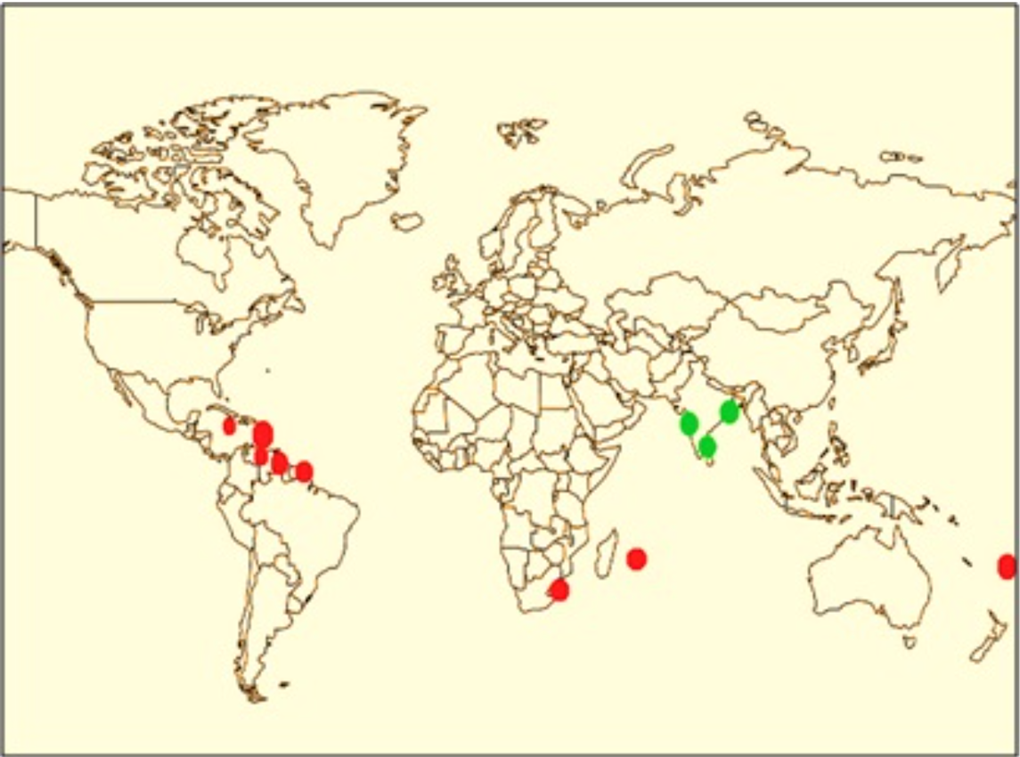
Figure 1.
Indentured Indian Migration from Indian Port Cities to Plantation Colonies across the Colonial World, 1838–1917.
Source: Royal Historical Society, “Beyond This Day: Indian Indentured Trade and the First Crossing,” 2020.
Migration and labor were only the first two factors through which the historical evolution of Indo–Caribbean communities happened. The new forms of identity and social organization that arose in plural colonial societies also had a great influence on their development. George Danns is of the opinion that the colonial Caribbean societies developed very hierarchical racial and ethnic divisions that placed Indo–Caribbean communities in the context of wider struggles over class, political representation, and national identity (Danns 2014, 65–77). Concentration of population and cultural retention helped Indo–descendant communities become separate social and political groups within the colonial order in both Guyana and Suriname (Ehrlich 1971, 177–179). These changes set the stage for the political progress of the Indo–Caribbean population in the twentieth century.
By the middle of the twentieth century, Indo–Caribbean communities had started to diversify their activities from working in plantations to other areas of economy, education, and politics. The conversion of indentured laborers into politically aware communities was part of the larger postcolonial transformation happening everywhere in the Caribbean. As colonial administrations got weaker and the scope of nationalistic movements increased, Indo–Caribbean communities were leaving their mark not only in electoral politics but also in trade unions and the discussions on citizenship, democracy, and the power of the state.
Hence, the history of indenture was to be one of the main supports for the political emergence of the Indian diaspora in the Caribbean democracies.
Political Mobilization and Democratic Representation
The rise of Indo–Caribbean populations as a political force in the twentieth century stands out as one of the most profound changes in the postcolonial Caribbean. Although Indians were initially brought as indentured laborers under colonial plantation systems, those in colonies like British Guiana, Trinidad and Tobago, and Suriname, over time, turned themselves into the main actors in the political arena. Their political transformation emerged through struggles over labor rights, citizenship, electoral participation, and finally, for their share of state power. This political consciousness of Indo–Caribbean people was, in a way, the outcome of a colonial social fabric that segregated communities along ethnic lines and allowed for only unequal participation of different groups within Caribbean societies (Allahar 2002, 13–18).
Ending the indentureship, a large number of Indo–Caribbean people started settling in agricultural rural areas, and through the cultivation of rice, petty trade, and local businesses, they slowly and steadily achieved economic stability. Economic progress made it possible for them to get involved not only in trade unions but also in educational institutions and nationalist politics. Political activism of the Indo–Guyanese was quite prominent during the work stoppages of the 1930s and 1940s, at which time workers’ organizations rebuked colonial economic dominance and demanded constitutional reforms. In the same manner, Indo–descendant populations in Trinidad and Suriname increasingly regarded political participation as a tool to defend communal interests in the ethnically plural societies that they inhabited (Samaroo 1996, 121–126).
Labor mobilization gave way to electoral politics, the change becoming very clear during the decolonization years post–World War II. Demand for self–rule and universal suffrage was everywhere in the Caribbean, but, at the same time, democratization also brought to light the deep–rooted ethnic antagonisms that had been latent due to colonial government systems. Historically, colonial governments had divided populations based on race and occupation, creating disunited societies in which Afro–descendant and Indo–descendant communities were often in competition for political and economic control. Anton Allahar maintains that the politics of the Caribbean still mirrored colonial patterns of race and class, with ethnicity becoming a main issue in political rivalries (Allahar 2002, 15–18). After independence, not only did ethnic identities not vanish, but they were further politicized, especially through electoral systems.
In Guyana, the political awakening of the Indo–Guyanese was mostly through the People’s Progressive Party (PPP), which Cheddi Jagan and Forbes Burnham started in 1950. The PPP at first was for anti–colonial nationalism and unity between ethnicities, but the Cold War and political rivalries among the locals caused the ethnic divide to become worse. Around the end of 1950s and early 1960s, the Indo–Guyanese voters mainly supported the PPP, whereas the Afro–Guyanese voters were increasingly going for Burnham’s People’s National Congress (PNC) (Hinds 2008, 388–392). Thus, the competition for political power was linked to the different ethnic groups and their fight for government control. It has been noted that the British Westminster parliamentary model, which Guyana inherited, was not suitable for handling multicultural societies like Guyana because its “winner–takes–all” approach increased the tension and fear of being left out by the different ethnic groups.[2]
Similarly, the political situation in Trinidad and Tobago is a good example of how race and political representation are connected in the Caribbean. Ralph Premdas points out that political life in Trinidad was shaped by the presence of several ethnic groups and by the fact that Afro–Trinidadians and Indo–Trinidadians looked at the elections as a competition between their communities (Premdas 2004, 17–20). Discussions at the political level were centered around who gets what from the state, cultural authenticity, and what it means to be a nation. The political organization of Indo–Trinidadians has been growing more prominent ever since the last few decades, with the highlight being the 1995 election of Basdeo Panday as the first Indo–Trinidadian prime minister. This win was a significant step in the recognition and political presence of the Indo–Caribbean communities in the Caribbean democracies.
Table 1. Political Representation of Indo–Caribbean Communities in Selected Caribbean Democracies.
| Country | Major Political Party | Key Indo–Caribbean Leader | Democratic Significance |
| Guyana | People’s Progressive Party (PPP) | Cheddi Jagan | Expansion of Indo–Guyanese political representation |
| Trinidad and Tobago | United National Congress (UNC) | Basdeo Panday | First Indo–Trinidadian Prime Minister |
| Suriname | Progressive Reform Party (VHP) | Jagernath Lachmon | Coalition–based ethnic accommodation |
Source: Compiled by the author using Hinds (2008), Premdas (2004), and Samaroo (1996).
In Suriname, the political history of the Indian diaspora took a different turn because of the Dutch colonial rule and the country’s coalition–based political system. The Indian communities, or Hindustanis, through their religious centers, schools, labor unions, and political parties fought for the rights of Indo–Surinamese. After the country gained independence in 1975, building coalitions became a must since no single ethnic group was dominant. Therefore, Indo–Surinamese political parties got into the act as major players in parliamentary talks and governments formed by coalitions (Danns 2014, 65–77). So, while Guyana went through a more divided political situation, Suriname leaned more on giving each other ethnic concessions through democratic governance.
Besides the tight integration of politics and ethnicity, the political rise of the Indian diaspora in the Caribbean also needs to be viewed on a global level. The transnational diasporic networks played a major role in political participation and representation, too. According to Peter Spiro, modern diasporas break the notion of citizenship linked to a single territory, as these diasporas maintain their political ties beyond borders (Spiro 2006, 207–210). Indo–Caribbean people living in North America, the UK, and the Netherlands have been more and more involved in activities such as lobbying, electoral campaigning, remittance networks, and cultural diplomacy related to Guyana, Trinidad, and Suriname. Maria Koinova points out that diaspora mobilization takes place both in the homeland and in the host state political environments, and hence the diaspora generates different forms of transnational political engagement (Koinova 2018, 1251–1254).
Even though ethnic tensions still exist, the overall pattern of Indo–Caribbean political involvement shows a spectacular change from colonial subjugation to democratic power. The great–grandchildren of indentured laborers, who were once the lowest caste in those societies, are now fully engaged in parliamentary politics, various state organs, higher studies, diplomacy, and regional administration. Their political ascendancy is a testimony not only to the strength of diasporic communities but also to the greater democratization of Caribbean societies post–colonial rule.
Case Studies: Guyana and Suriname
Guyana: Ethnic Polarization and Political Contestation
The Indo–Guyanese community’s political evolution is an outstanding example of the diaspora’s political mobilization in the Caribbean. Traditionally, electoral politics in Guyana has been dominated by ethnic divisions, mainly between Indo–Guyanese and Afro–Guyanese communities. With the increase in the power of representative institutions after the Second World War, political parties became more and more identified with the ethnic groups they represented. The People’s Progressive Party (PPP), established by Cheddi Jagan, slowly turned out to be the major political force of the Indo–Guyanese community, whereas the People’s National Congress (PNC) gained the support of most of the Afro–Guyanese people (Griffith 1997, 267–270).
After independence, ethnic divisions were so deeply institutionalized in Guyana’s democratic system that elections often arose disputes about chauvinist tactics, political distrust, and the lessening of the power of institutions. Electoral reports on Guyana during the last decade of the twentieth century have demonstrated numerous missteps in the election process that delegitimized democracy and exacerbated ethnic conflicts in politics (Electoral Conditions in Guyana 1991, 1–4). Even though reintroduction of free elections in 1992 was a milestone in the country’s democratic progress, ethnic divisions still dictate political actions and party competition.
Recent international election observation reports latest show how ethnicity continues to significantly determine political dynamics in Guyana. The APNU+AFC coalition won slightly over 50 percent of the vote in the 2015 general elections, illustrating how ethnic patterns of voting are still a major factor in Guyanese democracy (The Carter Center 2022, 6–7). The Carter Center’s report on the 2020 General and Regional Elections states that political divisions were still very much based on ethnic identity and party loyalty (The Carter Center 2022, 6–8). Likewise, the European Union Election Observation Mission pointed out that the electoral competition between the PPP/C and APNU was still primarily along the lines of ethnic groups that have been in place for years, despite efforts to promote politics based on issues rather than ethnicity (European Union Election Observation Mission 2025, 6–7). Therefore, Indo–Guyanese political engagement has been at the heart of the discussions on governance, constitutional reform, electoral legitimacy, and democratic representation in Guyana.[3]
Suriname: Coalition Politics and Ethnic Accommodation
Suriname, in contrast to Guyana, developed a political system that was relatively accommodation–oriented and in which coalition building became a feature of democratic governance. Suriname’s proportional representation system also encouraged negotiation among different ethnic and political groups. However, ethnic identity remained politically relevant. The Progressive Reform Party (VHP), which had long been seen as representing the Hindustani community, regularly participated in coalition governments with Creole, Javanese, and multiethnic political organizations (Krishnadath 2001, 1–2).
For political scholars in Suriname, ethnic voting patterns are one of the elements that have gradually been made more flexible by urbanization, modernization, and interethnic interaction. Ruben Gowricharn argues that although ethnicity continues to influence political behavior in Suriname, c communal voting patterns have gradually become less rigid over time, especially among younger and urban voters (Gowricharn 2018, 1–5). This change gave Indo–Surinamese political actors a chance to enter as not only representatives of a single ethnic bloc but also as partners operating within broader coalition configurations.
Historically, the democratic structure of Suriname helped nurture a rather consensual political culture. Although governance faces issues of administration and economy, they are reported by international organizations as the least factors. Coalition politics and constitutional mechanisms are recognized as the major vehicles for political continuity of democracy by these agencies (Inter–American Development Bank 2001, 1–9). Therefore, Indo–Surinamese political participation turned into accommodation and coalition bargaining rather than ethnicity as a source of conflicts as visible in Guyana.[4]
Comparative Analysis
Guyana and Suriname cases show rather clearly that Indo–Caribbean political incorporation had different democratic paths even though both, to a significant extent, were the outcomes of Indian indentured migration.
In Guyana, political participation is very much entwined with the ethnic bloc competition between the Indo–Guyanese and Afro–Guyanese communities within the parliamentary framework of the Westminster system, inherited from the British. A majoritarian “winner–takes–all” nature of this system made the electoral competition very strong and ultimately has facilitated the emergence of disputes over representation, legitimacy, and state authority on a repeated basis (Hinds 2008, 388–392).
On the contrary, Suriname has a proportional representation system that has been influenced by Dutch colonial traditions and coalition–oriented governance. And even though ethnicity still plays a very major role, the coalition politics lead to interethnic bargaining and decrease the type of confrontational and divisive electoral competition measured in Guyana (Gowricharn 2018, 1–5). Thus, in a way, Indo–Surinamese political involvement is more of a parliamentary negotiation type of politics and coalition–building rather than a direct ethnic confrontation one.
In fact, these different paths show that the political upsurge of Indo–Caribbean communities did not simply result from a migration history but also from a combination of colonial legacies, the features of electoral institutions, and the state–building process in a postcolonial context.
Table 2: Comparative Political Characteristics of Guyana and Suriname
| Feature | Guyana | Suriname |
| Dominant Political Pattern | Ethnic polarization | Coalition accommodation |
| Major Indo–descendant Party | PPP/C | VHP |
| Electoral Dynamic | Ethnic bloc competition | Multiethnic coalition politics |
| Main Democratic Challenge | Electoral contestation | Governance fragmentation |
| Political Trend | Persistent ethnic rivalry | Gradual decline of rigid ethnic voting |
Source: Compiled by the author using Griffith (1997), Krishnadath (2001), Gowricharn (2018), The Carter Center (2020), and European Union Election Observation Mission Report (2025).
India–Caribbean Relations and Diaspora Diplomacy
India’s relations with the Caribbean have not just been a cultural connection based on history but have now developed into a multifaceted diplomatic partnership that is driven by diaspora networks, South–South cooperation, and a strategic interaction with the Caribbean Community (CARICOM).[5] Although the basis of these relations is the nineteenth–century migration of Indian indentured laborers to plantation colonies, the nature of engagement today is far removed from just historical memory as it involves political, economic, and diplomatic cooperation at the institutional level. The Indian diaspora in the Caribbean has become, in fact, not only a cultural reminder of the colonial migration but also an active connecting link between India and Caribbean democracies through their political representation, cultural diplomacy, and transnational activities (Mishra 2016, 143–145).
The significant historical ties between India and the Caribbean continue to be the focus of India’s outreach in this region. In a country like Trinidad and Tobago, the population of persons of Indian descent, who are the descendants of indentured laborers to that country, is nearly 42 percent of the national populace, and these people occupy a very important position in the political, economic, and cultural arenas of the country (“India, Trinidad and Tobago Relations” 2025, 1). The diplomatic dialogues of India have often highlighted the symbolic significance of this common past, especially through high–level interactions such as the Pravasi Bharatiya Divas (PBD), cultural exchange programs, and India–CARICOM summits. Different administrations of India have continually used diaspora communities within foreign policy frameworks and have thereby converted Indian populations in other countries into instruments of soft power and diplomatic connectivity (Hall 2017, 8–11).
India’s relationship with CARICOM has become largely strategic based on a pattern of engagement established in the twenty–first century. Diplomatic relations formally widened with the establishment of the India–CARICOM Joint Commission in 2003, followed by Foreign Ministers’ meetings between India and CARICOM (“India–CARICOM Bilateral Relations” 2021, 1). From then on, the scope of relations has been extending to areas such as renewable energy, climate resilience, healthcare, digital infrastructure, agriculture, education, and capacity building. Prime Minister Narendra Modi’s gesture at the first India–CARICOM Summit in 2019 was a landmark in this association when India declared a US$14 million grant for community development projects and a US$150 million line of credit for renewable energy and climate–related initiatives in CARICOM member states (Ministry of External Affairs 2021, 1–2). These measures were part of a wider Indian strategy to depict itself as a prominent voice of the Global South and a development partner for small island developing states.
Table 3. Major Areas of India–CARICOM Cooperation Since 2019
| Area | Major Initiative |
| Climate Cooperation | US$150 million Line of Credit for renewable energy projects |
| Community Development | US$14 million grant assistance to CARICOM state |
| Digital Diplomacy | Digital public infrastructure and UPI cooperation |
| Health Cooperation | Vaccine Maitri and medical assistance during COVID–19 |
| Capacity Building | ITEC training and diplomatic exchange programmes |
| Cultural Diplomacy | PBD, ICCR programmes, Hindi and Yoga promotion |
Source: Ministry of External Affairs, Government of India, India–CARICOM Bilateral Relations (2021); Ministry of External Affairs, Government of India, Joint Statement: Second CARICOM–India Summit (2024); adapted and compiled by the author.
Recent diplomacy has further reinforced a path. The Joint Statement of the Second CARICOM–India Summit held in Georgetown in November 2024 stressed teamwork in food security, digital public infrastructure, healthcare, renewable energy, maritime connectivity, and climate governance. In addition, the summit pointed out common worries regarding the reform of global financial institutions and the exposure of small island developing states to climate change (“Joint Statement: Second CARICOM, India Summit” 2024). The developments are a sign that India–Caribbean ties are becoming more a part of wider global governance, sustainable development, and South–South solidarity discourses.
Diaspora diplomacy, in fact, continues to be a key factor in this relationship. Institutions like the Mahatma Gandhi Institute for Cultural Cooperation in Trinidad and Tobago, Hindi language classes, annual International Yoga Day celebrations, and educational programs through the Indian Technical and Economic Cooperation (ITEC) scheme have played a major role in deepening the bonds between India and the Caribbean societies (Ministry of External Affairs 2025, 6–8). Instead of just focusing on economic or geopolitical factors, India has managed to link developmental assistance with cultural exposure, thus renewing its old–time civilizational relations with the Indo–Caribbean communities.
Therefore, the relations between India and the Caribbean at present are a far cry from the era of indenture and have been reformed into a present model of diaspora diplomacy and strategic partnership. The Indo–Caribbean diaspora serves, on the one hand, serves as an epitome of the history of continuity and, on the other hand, as a key player in India’s growing association with the Caribbean region and the larger Global South.
Contemporary Challenges and the Future of Indo–Caribbean Politics
Indo–Caribbean communities politically rose significantly in Guyana, Trinidad and Tobago, and Suriname; however, Indo–Caribbean politics today still continues to be deeply structurally and geopolitically challenged. Ethnic polarization, migration, climate vulnerability, democratic distrust, and economic transformation are the main factors shaping the political future of Caribbean democracies. Besides, changing regional dynamics and India’s growing involvement with CARICOM countries are leading to a redefinition of the importance of the Indo–Caribbean diaspora within the wider contexts of South–South cooperation and transnational diplomacy.
The continued occurrence of ethnic–based political competition, especially in Guyana, is one of the most persistent issues. Even if democratic institutions have been fortified since competitive elections were reinstated in 1992, electoral mobilization still generally exploits ethnic divisions between the Indo–Guyanese and Afro–Guyanese political constituencies (Danns 2014, 65–77). The European Union Election Observation Mission, in its latest report, observed that political mistrust and polarization have been continuing to impact the democratic processes in Guyana after the contested 2020 elections (European Union Election Observation Mission 2025, 6–13). The discovery of oil and the fast rise in Guyana’s oil economy has sparked debates on governance transparency, institutional accountability, and resource distribution. Current research suggests that weak or ethnically polarized state institutions may intensify political competition and governance pressures, then the influx of oil revenues can increase political competition and create governance difficulties (Padula et al. 2023, 1–3).[6]
Besides electoral politics, Caribbean communities also have to deal with the ever–increasing developmental and environmental issues. The United Nations Development Programme points out that democracies in developing regions are facing a greater number of problems due to political distrust, inequality, and weak institutions (UNDP 2025, 3–5). In particular, these issues are very important for small Caribbean countries that are still very much dependent on the outside for their economies and are also exposed to climate–related disasters. As per the United Nations Framework Convention on Climate Change (UNFCCC), small island developing states are exposed to climatic risks on a disproportionate scale while their contribution to the global carbon emissions is very small (UNFCCC 2024, 1–2). Hence, climate vulnerability, hurricanes, and economic insecurity have been the major reasons for increasing migration and transnational mobility in the Caribbean region.
The movement of people or migration has, in fact, become an additional element affecting the shape of future Indo–Caribbean politics. According to the Migration Policy Institute and the Inter–American Development Bank, growing regional and international migration has resulted in the strengthening of transnational diaspora networks, but at the same time, concerns have been raised about demographic change, brain drain, and the decreasing political participation of youths (Lacarte et al. 2023, 1–5). Young Indo–Caribbean people are now more likely to develop hybrid and multicultural identities that are largely influenced by globalization, urbanization, and interethnic contact instead of just by the memory of the ancestors or the history of the plantation (Ramdihal 2023, 1–4). While this change has facilitated greater social integration, it has also changed the traditional ways in which ethnic groups are politically mobilized and communal political solidarity is formed.
Table 4. Contemporary Challenges Affecting Indo–Caribbean Politics
| Challenge | Political Impact |
| Ethnic Polarization | Electoral mistrust and party fragmentation |
| Oil Economy in Guyana | Governance pressure and resource competition |
| Climate Vulnerability | Migration and economic instability |
| Diaspora Migration | Brain drain and transnational political influence |
| Identity Transformation | Decline of traditional communal politics |
Source: Adapted and compiled by the author using UNDP (2025), UNFCCC (2024), Lacarte et al. (2023), and Padula et al. (2023).
However, the understanding of the future of Indo–Caribbean politics cannot remain limited to the aspect of crisis. The strengthening of India’s ties with the countries of CARICOM through climate action, digital connectivity, healthcare diplomacy, education exchanges, and development partnerships has led to the opening of new doors for regional collaboration (Ministry of External Affairs 2022; Ministry of External Affairs 2024). In fact, the relationship between India and the Caribbean is no longer seen as only ‘diaspora affinity’ but quite the opposite, a ‘regional strategy,’ which speaks to the growing geopolitical importance of Indo–Caribbean ties in the context of the Global South (Observer Research Foundation, 2024).
Therefore, it might well be the case that the political destiny of the Indo–Caribbean populations depends on their capability to not only survive and compete with each other as different ethnic groups but also to find ways to work together in more inclusive democratic governance, regional cooperation, and transnational engagement.
Currently, the politics of the Indo–Caribbean communities at a different level of development can be seen as a move away from the ethnic politics of first survival to a wider struggle encompassing issues of democratic resilience, economic governance, climate change adaptation, and global political relevance. Today, the Indo–Caribbean diaspora is much more than just a colonial migration legacy; it has, in fact, emerged as an important agent in current discussions on democracy, development, and South–South diplomacy.
Conclusion
The political development of the Indian diaspora in the Caribbean is arguably one of the major changes in the postcolonial history of the Atlantic region. The Indo–Caribbean people, who were initially brought to the Caribbean as indentured laborers through exploitative colonial plantation systems, slowly became prominent political, cultural, and diplomatic figures in the democratic societies of places like Guyana, Suriname, and Trinidad and Tobago. Their journey from disadvantaged labor groups to players in governance, electoral politics, coalition–building, and regional diplomacy is indicative of the general democratization of Caribbean societies post–colonial rule.
This study demonstrates that the politicization of Indo–Caribbean communities varied and depended on their different colonial heritages, electoral systems, and ethnic arrangements. For instance, ethnic divisions remained a hallmark of Guyanese politics under the majoritarian electoral system, whereas Suriname’s politics took the form of ethnically accommodative coalition–building. These differences point to the important role that democratic institutions in postcolonial societies played in the political integration of diaspora groups in multi–ethnic societies.
In addition, the Indo–Caribbean story is not limited to the local political scene. Today, India’s relations with CARICOM reflect how the diasporic links of the past have become means of soft power, South–South collaboration, and strategic diplomacy. Diaspora contacts are no longer just reminders of the past but actively facilitate the Caribbean’s engagement with global political and developmental trends.
Nevertheless, the next generation of Indo–Caribbean political leaders will be largely determined by how well these Caribbean democracies can deal with polarizing ethnic issues, governance, climate vulnerability, migration, and economic inequality within the context of the ever–accelerating globalization of their political environments. In the end, the story of the Indian diaspora in the Caribbean has shown that diaspora communities are not mere leftovers of colonial migrations but are instead vibrant political agencies capable of reforming democratic institutions, cross–border identities, and regional diplomacy in the Global South.
Bibliography
Allahar, Anton. Caribbean Charisma: Reflections on Leadership, Legitimacy and Populist Politics. Kingston: Ian Randle Publishers, 2002.
Danns, George K. “The Impact of Identity, Ethnicity and Class on Guyana’s Strategic Culture.” American International Journal of Contemporary Research 4, no. 11 (2014): 65–77.
Ehrlich, Allen S. “History, Ecology, and Demography in the British Caribbean: An Analysis of East Indian Ethnicity.” Southwestern Journal of Anthropology 27, no. 2 (1971): 166–180.
Electoral Assistance Bureau. Electoral Conditions in Guyana. Georgetown: Electoral Assistance Bureau, 1991.
Fox, Dylan Arthur. Administering Indenture through Suspension: British Guiana and the System of Indian Indenture, c.1834–1917. Master’s thesis, Université Paris Cité, 2022.
Gowricharn, Ruben. “The Decline of Ethnic Voting Patterns in Plural Societies: Evidence from Suriname.” Politics 38, no. 1 (2018): 1–15.
Griffith, Ivelaw L. “Political Change, Democracy, and Human Rights in Guyana.” Third World Quarterly 18, no. 2 (1997): 267–285.
Hall, Kenneth. “Diaspora Diplomacy: The Indian Experience in the Caribbean.” Journal of Global Diplomacy 5, no. 2 (2017): 8–15.
Hinds, David. “Ethnopolitics and Power Sharing in Guyana: History and Discourse.” New West Indian Guide / Nieuwe West–Indische Gids 82, no. 3/4 (2008): 291–316.
Inter–American Development Bank. Governance in Suriname: Public Sector Reform and Institutional Development. Washington, DC: Inter–American Development Bank, 2001.
Koinova, Maria. “Diaspora Mobilisation for Conflict and Postconflict Reconstruction: Contextual and Comparative Dimensions.” Journal of Ethnic and Migration Studies 44, no. 8 (2018): 1251–1269.
Krishnadath, Jnan H. Electoral Politics in Suriname: Ethnicity and Coalition Formation. Paramaribo: Suriname Political Studies Institute, 2001.
Lacarte, Valerie, et al. Migration, Integration, and Diaspora Engagement in the Caribbean. Washington, DC: Migration Policy Institute and Inter–American Development Bank, 2023.
Lal, Brij V. The Encyclopedia of the Indian Diaspora. Honolulu: University of Hawai‘i Press, 2006.
Look Lai, Walton. Indentured Labor, Caribbean Sugar: Chinese and Indian Migrants to the British West Indies, 1838–1918. Baltimore: Johns Hopkins University Press, 1993.
Ministry of External Affairs, Government of India. Caribbean Community (CARICOM). Accessed May 22, 2026. https://www.mea.gov.in/Portal/ForeignRelation/Caribbean_Community–_CARICOM.pdf
Ministry of External Affairs, Government of India. Joint Statement: Second CARICOM–India Summit. Accessed May 22, 2026. https://www.mea.gov.in/outoging–visit–detail.htm?38601%2FJoint+Statement+Second+CARICOMIndia+Summit=
Mishra, Vijay. What Was Multiculturalism? A Critical Retrospective. Melbourne: Melbourne University Press, 2016.
Observer Research Foundation. From Diaspora Affinity to Regional Strategy: India and the Caribbean. Accessed May 22, 2026. https://www.orfonline.org.
Padula, Raphael, et al. “Guyana: Oil, Internal Disputes, the USA and Venezuela.” International Affairs Review (2023): 1–12.
Premdas, Ralph R. “Ethnicity and Political Development in the Caribbean.” In Identity, Ethnicity and Culture in the Caribbean, edited by Ralph R. Premdas, 15–37. St. Augustine: University of the West Indies Press, 2004.
Ramdihal, Keshav. “Identity Transformation among Young Indo–Caribbeans in the Global Era.” Caribbean Diaspora Studies 7, no. 1 (2023): 1–10.
Samaroo, Brinsley. “Politics and Indian Identity in the Caribbean.” In India in the Caribbean, edited by David Dabydeen and Brinsley Samaroo, 88–126. London: Hansib Publishing, 1996.
Seecharan, Clem. India and the Shaping of the Indo–Guyanese Imagination, 1890s–1920s. Leeds: Peepal Tree Press, 2011.
Spiro, Peter J. Beyond Citizenship: American Identity after Globalization. Oxford: Oxford University Press, 2006.
The Carter Center. Observing the 2020 Guyana General and Regional Elections. Accessed May 22, 2026. https://www.cartercenter.org/country/guyana/
United Nations Development Programme (UNDP). Human Development Report 2025. Accessed May 22, 2026. https://hdr.undp.org/
United Nations Framework Convention on Climate Change (UNFCCC). Small Island Developing States and Climate Vulnerability Reports. Accessed May 22, 2026. https://unfccc.int/process–and–meetings/parties–non–party–stakeholders/parties/party–groupings
[1] Dylan Fox, “Administering Indenture through Suspension,” Journal of Colonial Labour Studies 14, no. 2 (2022): 103–5.
[2] David Hinds, “Ethnopolitics and Power Sharing in Guyana: History and Discourse,” New West Indian Guide / Nieuwe West-Indische Gids 82, no. 3–4 (2008): 388–392.
[3] Walton Look Lai, Indentured Labor, Caribbean Sugar: Chinese and Indian Migrants to the British West Indies, 1838–1918 (Baltimore: Johns Hopkins University Press, 1993), 45–49.
[4] Ruben Gowricharn, “The Decline of Ethnic Voting Patterns in Plural Societies: Evidence from Suriname,” Politics (2018): 1-5.
[5] Treaty of Chaguaramas, 1973, establishing the Caribbean Community (CARICOM).
[6] See Richard M. Auty, “Industrial Policy Reform in Six Large Newly Industrializing Countries: The Resource Curse Thesis,” World Development 22, no. 1 (1994): 11–26.

Leave a Reply