
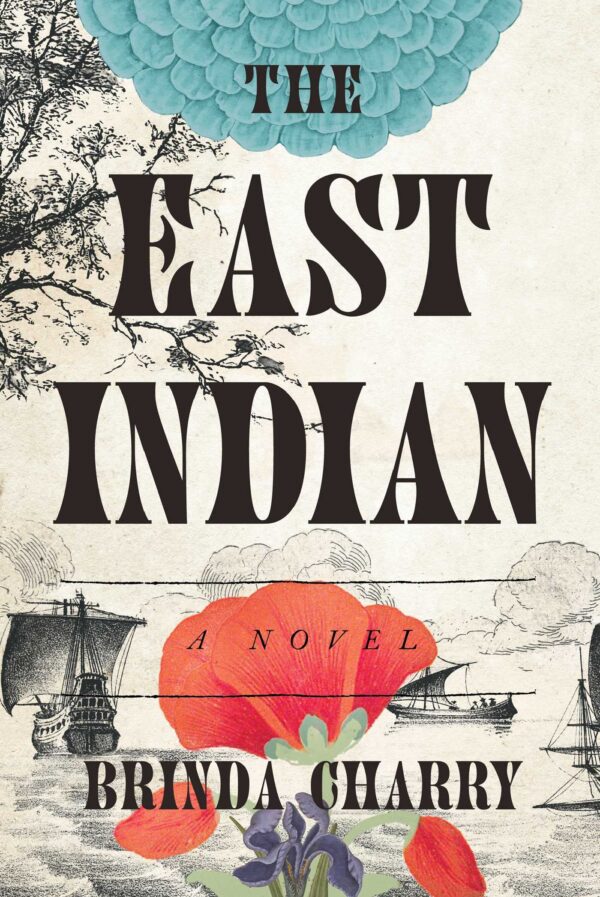
Brinda Charry, The East Indian. HarperCollins, 2023.
Brinda Charry’s The East Indian is a remarkable contribution to the growing corpus of literary works that reimagine early modern migration, the global flows of labour, and the precursors of indenture. Published in 2023, the novel offers a deeply textured narrative that reconstructs the journey of one of the earliest known Indians to set foot in colonial America. With extraordinary sensitivity and scholarly depth, Charry opens a literary window into the seventeenth-century world of oceanic mobility, colonial violence, and the everyday negotiations of a brown body in the Atlantic world.
Narrative Framework and Thematic Architecture
The novel begins aboard a ship tellingly named God’s Gift, immediately framing the text within the contradictions and hypocrisies of early colonial modernity. The execution of Mistress Brady—accused of witchcraft—sets the tone for the novel’s exploration of fear, superstition, and the moral economy of power on transoceanic voyages. Charry masterfully uses this event as a metaphor for the broader anxieties of the powerless: while survival, disease, and starvation were immediate concerns aboard the ship, it is the policing of a ‘witch’ that preoccupies the crew. This juxtaposition exposes the irrationality underpinning the colonial worldview and foreshadows the structures of domination that await the protagonist.
Reconstructing the World of Armagon and Early Colonial South India
Chapter One transports the reader to Armagon (Durgarazpatnam), the East India Company’s second settlement in the Madras region. Charry’s rendering of this socio-cultural landscape is vivid, historically grounded, and unusually attentive to the interpersonal dynamics of early colonialism. Tony’s upbringing—raised among a grandmother, an uncle, and a courtesan mother—allows the author to explore social marginality, hybridity, and the ambiguous intermediaries who inhabited colonial South India.
The introduction of Master Day and Sir Francis Day situates Tony’s early life within the crosscurrents of Portuguese influence, the English commercial presence, and the spread of Christianity. Importantly, Charry accomplishes something that conventional historiography often fails to do: she brings to life the everyday interactions between the colonised and the colonisers, revealing colonialism not merely as a structure of power but as a lived human encounter.
Becoming “The East Indian”: Race-Making in London and Virginia
Tony’s arrival in London in Chapter Two marks a profound moment of identity transformation. In India he was simply Tony; in England he becomes “the East Indian.” Charry captures with sharp clarity the racialisation of the brown body in seventeenth-century England, where difference was not self-ascribed but imposed through the gaze of the dominant society. This chapter anticipates one of the most important theoretical contributions of the novel: its insight into early racial formation long before the formal institutionalisation of race in the eighteenth and nineteenth centuries.
From London, the narrative shifts to Virginia, where Tony is thrust into a world structured by indenture, enslavement, and settler-colonial expansion. Charry’s portrayal of the plantation landscape—its hierarchy, violence, and precarities—is both historically accurate and emotionally resonant. The novel refuses to romanticise indenture; instead, it depicts the institution as a precursor to and companion of slavery, marked by brutal labour regimes, corporal punishment, and the constant fear of death.
Life Among the Enslaved and the Indentured: Violence, Solidarity, and the Human Condition
Chapters Three to Six offer some of the most compelling reflections on labour, commodification, and racialised exploitation. Tony’s friendships with Sammy and Dick highlight the fragile bonds of solidarity that formed among indentured labourers and enslaved Africans—relationships constantly threatened by the absolute power of plantation masters.
Charry provides an unsentimental account of the commodification of human beings: the ease with which Tony is wagered, transferred, and appraised in monetary terms reveals a world where personhood is entirely subsumed into property relations. Significantly, Tony’s new master, Walsh, is “better” only in the sense that he inflicts less violence—an indictment of the narrow moral vocabulary available to those trapped within oppressive systems.
The Colonial Mind and the Limits of Freedom
The middle chapters of the novel interrogate the psychological consequences of enslavement and indenture. Charry explores not only physical bondage but also the colonial colonisation of the mind—how fear, dependency, and internalised hierarchies gradually shape the subordinate self. The attempted servant revolt, its hesitation, and its failure illuminate the deep structures of domination that inhibited collective action. These sections echo foundational works in subaltern and postcolonial studies, illustrating how power operates not only through violence but through the systematic erasure of agency.
Tony’s conversion to Christianity, discussed in Chapter Nine, becomes a tragic symbol of coerced cultural abandonment. His belief that conversion will improve his status exposes how colonial rule manipulated religion to create internal divisions, reward loyalty, and strip migrants of the cultural worlds they inhabited.
Medicine, Mortality, and a New World of Precarity
Tony’s apprenticeship with Doctor Herman introduces the reader to early colonial medical practices—a mixture of ignorance, experimentation, and desperation. His misadventures with drugs and treatments expose both the comedy and the cruelty of a society grappling with disease but lacking scientific understanding. The death of Ganter and Tony’s subsequent trial highlight the racialised injustice of the colonial legal system: Tony is pronounced innocent not because of legal fairness but due to superstition and the intervention of a white patron.
Memory, Identity, and the Fragility of Survival
As epidemics ravage Jamestown, Charry directs our attention to the disproportionate suffering of the poor, the enslaved, and the indentured. Even after conversion, Tony retains a deep interiority shaped by memories of India—Hindu gods that appear in visions, stories that resurface in moments of fear, and the longing for a home he can no longer return to.
The concluding chapters depict Tony’s escape with Lydia and his eventual settlement in Maryland, where he narrates his story to his daughter. The novel’s ending—linking Tony to the mysterious “man who would not die”—is a poetic assertion of survival and resilience. Tony becomes a metaphor for countless unnamed migrants who endured unimaginable suffering but shaped the foundations of the modern Atlantic world.
Contribution to Migration and Indenture Studies
The East Indian is a pioneering literary intervention for several reasons:
- It recovers a little-known strand of early Indian migration—predating formal indenture by two centuries.
- It situates the Indian body within the broader Atlantic world, foregrounding its entanglement with African slavery and English servitude.
- It humanises the pre-indentured migrant, giving voice to a figure otherwise absent from archival narratives.
- It challenges Eurocentric historiographies that erase non-European presence in early America.
- It offers a postcolonial critique through storytelling, illustrating that fiction can fill the silences left by official records.
Conclusion
Brinda Charry’s The East Indian is an exceptional novel—historically informed, emotionally rich, and theoretically significant. It succeeds not merely as a work of literature but as an important text for scholars of migration, diaspora, slavery, and colonial history. Through Tony’s life, Charry reconstructs an entire world of marginality, resilience, and cultural negotiation. In doing so, she ensures that an “East Indian” who might have disappeared from history is restored to memory—with dignity, complexity, and humanity.

Leave a Reply