
Introduction
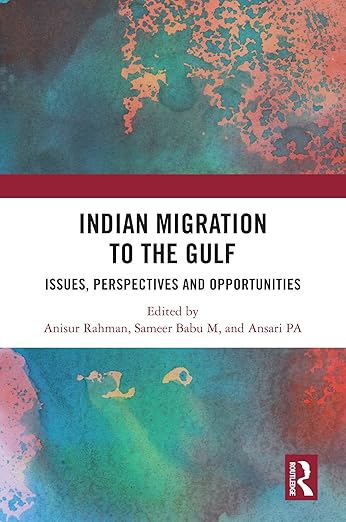
Over the past fifty years, labour migration from India to the Gulf states has become one of the most defining socio-economic trends in the region. Millions of Indian workers – often from Kerala and other states – have sought jobs in Gulf countries, and their remittances have become a vital lifeline for many communities in India. This new edited volume, Indian Migration to the Gulf: Issues, Perspectives and Opportunities (Rahman et al., 2023), provides a timely, interdisciplinary exploration of this phenomenon. It blends historical analysis with current policy research, drawing on sociology, economics, and political science.
Organisation and Scope
This volume is divided into four thematic parts. It covers the historical foundations of migration, socio-economic and cultural impacts, governance and labour policy, and emerging future directions, such as the impact of COVID-19 and digital technology. It contains village-level case studies and quantitative analyses of remittance flows. Several essays explicitly compare India’s situation to other South Asian countries, offering a regional perspective and policy recommendations.
Historical and Socio-Cultural Dimensions
The opening chapters provide a firm historical grounding. They trace how Indian merchants, sailors, and labourers travelled to Gulf ports long before the oil era. By situating today’s labour flows in this extended history, the volume shows they are an outgrowth of older South–South connections. The authors also critique simplistic “push–pull” models and emphasize the role of social networks, recruitment routes, and policy structures in shaping migration.
Later chapters explore migrants’ social lives and identities. For example, one chapter examines how Gulf migrants navigate dual belonging, introducing a concept of transnational membership. Charan shows that migrants form community networks abroad while maintaining ties to home. These findings emphasise that migration reshapes values and social identities, not just economies.
Gender is a key theme in this section. Several chapters highlight female migrants – often domestic workers in the Gulf. They document the vulnerabilities these women face: long hours, social isolation, and minimal legal protections under the Gulf sponsorship system. The book highlights women’s resilience and the informal networks that support them. This gender attention to female migration assists in redressing the balance of the male-dominated narrative that prevails in the study of migrations in the Gulf.
According to the contributors, there are also cultural spillover effects: Gulf remittances have transformed consumption, housing, and social life in the sending areas. These findings further confirm the multidimensional nature of the impact of migration not only on the economic but also on the cultural and communal life.
Economic Implications
The book’s second part analyses economics, especially the role of remittances. The authors document how remittances have boosted household incomes and local investment in sending areas. However, they warn of “remittance dependency,” where growth may slow if large inflows suddenly stop. This was evident during the COVID-19 crisis when sudden wage cuts and job losses in Gulf economies left many migrant families without support.
Another chapter examines skilled Indian professionals in the Gulf, such as engineers and teachers. It finds that these jobs can rapidly raise living standards but often at the cost of stress and family separation. For instance, many families leave their children with relatives, which can impact education and emotional well-being. These analyses balance the monetary gains with such social costs.
The authors draw policy lessons from these findings. They suggest expanding financial literacy and savings programs for migrant households and providing retraining for returnees. In summary, the economic chapters link data to development policy, illustrating how India can leverage remittances more effectively and support migrant welfare.
Governance, Rights, and Policy
The third section is policy-intensive, reviewing migration governance on both sides. One part analyses India’s emigration laws and programs: for example, it traces the history of the Emigration Act (1983), Pravasi schemes, and draft bills. These chapters reveal gaps between policy and reality: many official schemes exist on paper, yet numerous migrants remain unaware of their rights or unable to access grievance mechanisms.
The editors discuss the kafala system of sponsorship in the Gulf. They record kafala as a system by which workers are bound to employers and cannot move freely, and they can abuse their workers. Certain Gulf countries have already implemented reforms, although the implementation has been uneven. Other chapters also criticise the Gulf-India labour agreements, stating that they are usually more diplomatic than protective of workers. In a valuable comparative analysis, one chapter finds that India lags behind Bangladesh, Nepal, and Sri Lanka in basic migrant protections, such as pre-departure training and insurance.
The book also highlights the roles of expatriate associations, NGOs, and international bodies, such as the ILO, in advocating for migrants. Throughout this section, the authors effectively blend critique with practical recommendations, thereby reinforcing its value for policymakers.
COVID-19 and Future Directions
A chapter on the COVID-19 pandemic provides a vivid case study of that crisis. It shows how early 2020 lockdowns led many Gulf employers to cut wages or send workers home. Many returned migrants arrived in India without jobs, revealing the fragility of current migration arrangements. These accounts underline how migrant communities can be left vulnerable in crises.
For future challenges, the editors discuss new tools and trends. They emphasise that even mobile apps to send remittances or lawyers could assist, but warn that digital inequality and privacy concerns could pop up. They also place migration within the UN Sustainable Development Goals framework and ask the Gulf countries and India to ensure that migrant welfare is a part of the decent work and inequality agendas.
Strengths and Contributions
The book succeeds in its comprehensive scope, surveying India–Gulf migration from multiple angles. The interdisciplinary approach enriches the analysis and broadens the volume’s audience. The regional comparisons highlight best practices and underscore common challenges across South Asia. It is relevant to academics and practitioners, as it is relevant to policy, especially in managing crises and reintegrating offenders. The contributions are rich in empirical evidence, which contains valuable documentation that will be beneficial to future researchers. Although the focus on migrant agency adds some valuable nuance to the migration story, it is the empirical evidence that is most notable.
Limitations
There is an obvious limitation to excessive focus on Kerala and South India. This emphasis is intensive but gives a partial portrait of the multi-ethnic migrant populations in India. Also, interactions with the Gulf-side shifts, such as the diversification of the economy or citizenship reforms, are relatively few. While the book addresses gender dimensions, the experiences of female migrants, particularly domestic workers, receive inadequate attention. Greater use of participatory methods and intersectional analysis would have enriched the discussion.
Conclusion
Indian Migration to the Gulf: Issues, Perspectives and Opportunities is a timely and essential contribution. Blending historical narrative, empirical research, and policy analysis offers both academics and practitioners value. The book’s interdisciplinary breadth and data-driven chapters suggest that it will be a key reference point for years to come.
This book offers diagnosis and direction to India, where Gulf incomes continue to support millions of people. It demonstrates the areas where existing systems perform well and fail, indicating the required changes in worker registration, bilateral agreements, and reintegration programs. To the Gulf states and the international migration community, it is a source of lessons on handling labour mobility more justifiably. Most importantly, it redefines India’s migration into the Gulf as a South-South dominant narrative where migrants are not passive but reclaim their own worlds and societies through active participation.
Finally, the importance of this volume is not limited to its immediate topic. Still, it shows that the joint work of disciplines can lead to a subtle perception of a complex social phenomenon. It focuses on transnational views and multidimensional analysis, providing a basis for future scholarship that can be enriched by its insights, while mitigating its shortcomings. It contributes to academic discourse, informs policy discussions, and amplifies the voices of migrants whose work supports the economies of both their native and host countries.
Expanded Analysis
Historical Context and Early Migration Networks
The way the volume addresses historical migration is interesting in that it transcends the naive attempts to pin the migration process only to economic need. By tracing maritime trade paths that connected India and the Arabian Peninsula, the editors shed light on centuries of cultural, religious and linguistic interchange preceding the modern labour migration. Merchants of India, particularly of Kerala and Gujarat, often came to the Gulf ports, and these traders formed kinship networks and trade relationships. These networks formed the pre-existing patterns of labour migration when oil exploration brought about enormous labour demands in the 1970s.
Moreover, the authors criticise Eurocentric ideas of migration that usually dismiss or neglect migration between the South and the South. The book is richer by introducing archival materials, oral history, and anthropological knowledge on how informal networks and recruitment channels dominate in determining mobility patterns rather than formal state policies.
The Impact of Remittances on Sending Communities
The remittance chapters offer, rather than a financial representation of money transfers, an examination of how remittances have impacted social status, household investments, and upward mobility ambitions. Remittances have been used to fund school buildings, religious organisations and small enterprises, which have changed local developmental frontiers. The conflict between consumption and investment is well-documented by the authors and shows how the income of migrants is both (a) an instrument of empowerment and (b) a debt.
The Kerala ethnographic reports clearly show the ripple effect of migration. In particular, education is given priority by families with hopes of getting better employment opportunities in other countries. However, they are not exempt from the issues of expectations management and social inequalities caused by income differences. The results lead the reader to think not of migration as an economic exchange but as a transformative experience that alters the social structure of sending areas.
Gendered Experiences of Migration
The chapters devoted to women’s migration experiences are among the most compelling in the volume. Through interviews and fieldwork conducted among female domestic workers, the authors expose systemic vulnerabilities such as wage theft, lack of healthcare access, and employer dependency. Women’s experiences reveal how migration intersects with patriarchal norms, cultural stigma, and bureaucratic neglect.
Meanwhile, the volume does not diminish the female migrants to mere victims. It puts emphasis on their strength, networks of solidarity, and survival mechanisms. The gaps created by the neglect of the government are usually filled in by civil society organisations, religious groups, and expatriate associations. These informal networks are crucial in maintaining migration to women and promoting improved working conditions.
The authors’ insistence on a gendered approach to the migration problem introduces a necessary dimension to the discourse. They shift the focus to women, disrupting the mainstream migration narratives that focus on male-dominated sectors like construction and manual labour.
Governance Frameworks and Legal Protections
The chapters discussing the policy analysis provide a sober perspective on the governance systems that govern migration. The emigration policies in India have been reviewed to show a sad lapse between what is written on paper and what is applied on the ground. Although there are various protection schemes, migrants often face bureaucratic drag and poor redressal of grievances.
The discussion of the kafala system of sponsorship presented in the book highlights that it is a structural barrier to the mobility of workers. Certain employers categorise employees, causing the exploitation, involuntary labour and suppression of remuneration. Some Gulf states have already implemented reforms; however, the authors report an uneven distribution of reforms and the persistence of antiquated regulations.
It is helpful to compare analyses with those of other countries in the same region, such as Bangladesh and Nepal. Based on these chapters, India could enhance its training initiatives, insurance programs, and reintegration efforts by learning from the experiences of its regional counterparts. Policy recommendations are efficient and evidence-based, highly applicable to practitioners and lawmakers.
Migration in Times of Crisis: Lessons from COVID-19
The COVID-19 pandemic is a stark example of how migration systems can fail under pressure. The case studies in the book paint a picture of how job loss, wage arrears and immediate border closures ruined the lives of migrant families. Many workers were left in foreign countries and were unable to access medical services or emergency assistance. When returning home, they were met with financial devastation, social stigma and access to fewer reintegration services.
The authors not only write about the plight of migrants but also provide solutions. They propose improved emergency response strategies, portable social security initiatives and mutual arrangements between the sending and receiving states. The analysis employs a balanced approach, combining emotion and data to evaluate the situation.
Technology and the Future of Migration
The prospective chapters in the book deal with the rise of technology in migration management. Technology has opportunities and ethical challenges, such as digital remittance platforms and biometric tracking systems. Although better data management can help make the process more transparent and efficient, the authors caution against enhanced surveillance and the amplification of inequality.
The volume emphasises that technology should be applied in conjunction with human-centred policies. The availability of migrants to smartphones, the internet, and digital literacy is not uniform, especially in rural areas. Therefore, the challenging aspects of implementing equitable technology-driven solutions are infrastructure and inclusivity.
Contribution to Migration Studies
Indian Migration to the Gulf is not just descriptive, it redefines migration as a dynamic process shaped by historical relationships, cultural interactions, gender experiences and failures of governance. The book does not support the traditional paradigm of push and pull. Still, it presents the network theoretical comprehension of mobility influenced by kinship, labour intermediaries, and state policy.
It also gives voice to the marginalized groups such as women, children or returnees, compelling the reader to face the human aspects of migration. The interdisciplinary nature of the inquiry made by the authors makes the volume relevant in various disciplines, including but not limited to economics, sociology, political science and development studies.
Final Reflections
Finally, the best part of the book is that it avoids getting lost in the vagueness of multiple viewpoints and retains its analytical acumen. The editors introduce migration as a multidimensional process influenced by structural inequalities and human agency. Its policy suggestions are based on sound fieldwork, whilst its theoretical interventions confront the paradigm.
Despite some drawbacks, like the local emphasis on Kerala or insufficient coverage of the aspects of intersectional identities, which might be eliminated in further editions, these drawbacks do not diminish the scholarly role of the volume. The work is an indisputable source of knowledge about one of the world’s most significant and large-scale migration flows.
This is a book that any policymaker, scholar and civil society participant must read. Its studies of government, gender, and transnational belonging will impact future studies and reforms. With labour mobility becoming dominant in global economic trends, Indian Migration to the Gulf provides a roadmap to more humane, fair, and responsible migration systems.

Leave a Reply