
India and Uganda share historical relations spanning over a century. There are ample evidences to prove that India’s connection with East Africa existed from ancient times and that even in the pre-European period, there were Indian settlements at various places on the east coast of Africa. The substantial presences of the Indian community in Uganda and particularly their tremendous economic contribution have always played a decisive role in maintaining and strengthening the cordial relations between India and Uganda. The bilateral relationship between India and Uganda has largely been close and friendly, except, during the period between 1972 and 1979, when the dictatorial regime of Idi Amin expelled Indians from Uganda (Shukla, 2009). This research paper strives to explore the reasons regarding what transpired this disastrous expulsion of Indians from Uganda despite being beneficial to country from various aspects, especially the economic aspect, and how the Indian government learnt a lesson and charted a path towards strategic diplomacy and reinstating the past relations amicably and with co-operation.
- The Chronology of Expulsion –
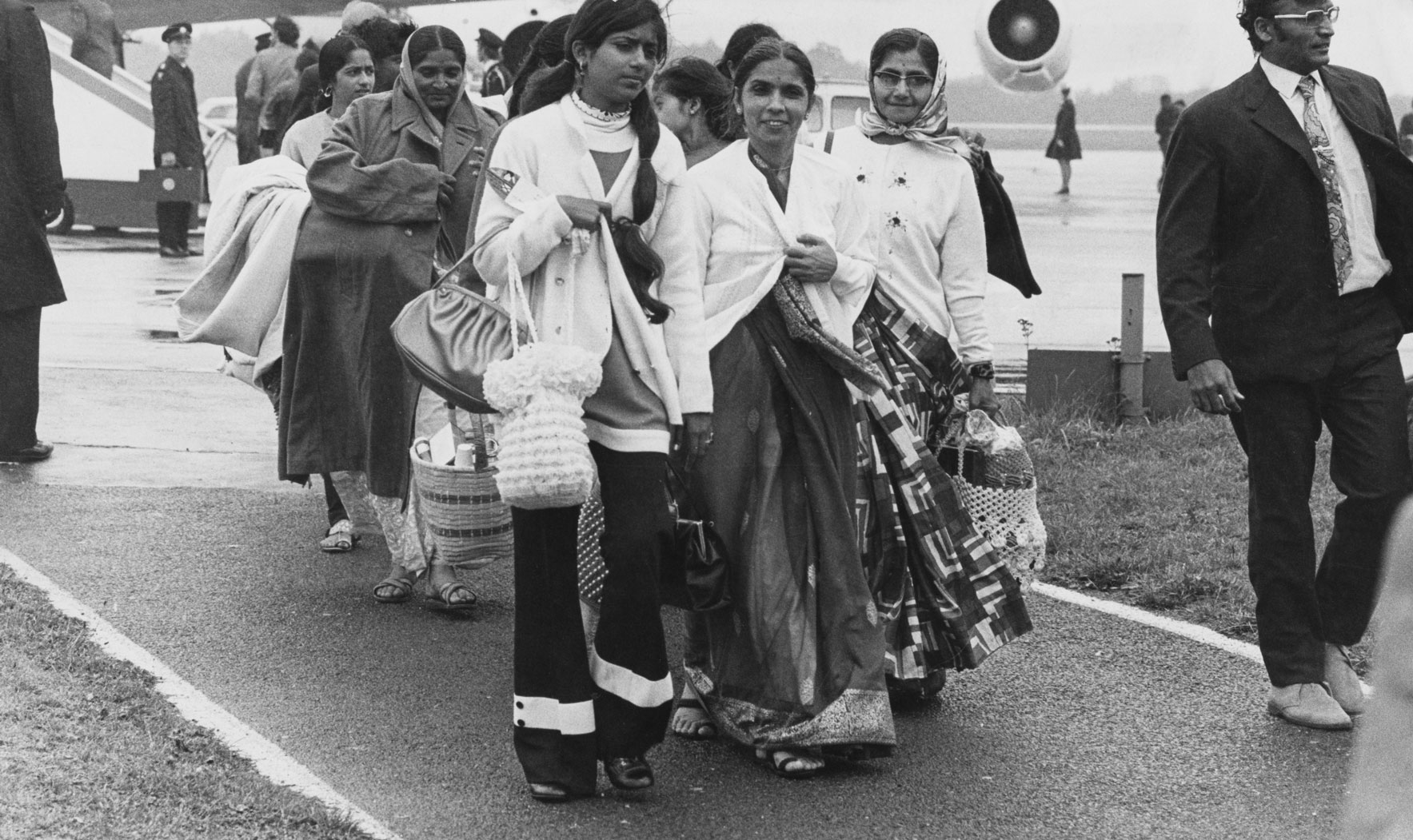
Many Indians had been brought to Uganda in 1894, while it was under British rule, to build railways. Those who remained went on to become dominant figures in the country’s economy – something Idi Amin resented. It’s been more than 50 years since Uganda’s ruler, dictator Idi Amin, told about 70,000 Asians living in the East African country they had just 90 days to leave. Thus began the final chapter in the story of the Indian presence in Uganda. General Amin had once again made newspaper headlines all over the world. Roughly 30,000 Asians, most of whom had British passports, came to the UK. Many of those who came over faced difficulties and sometimes physical harm while trying to flee.
Indians in Uganda were shocked, and many were stricken with panic. It seemed that Amin was playing a cruel joke. Many Indians – especially non-citizens who had engaged in the professions, trade, commerce and industry had viewed the assumption of power by Amin in January 1971 with considerable relief; a huge weight was being lifted off their chests: the weight of much frustration over citizenship/entry permit applications, and of fear over the many economic reforms which Obote had pursued in an effort to redress the economic inequalities between Africans and non-Africans. And at first, it did appear that the Amin government was exercising exceptional magnanimity with respect to those who had lost out in the coup. In Uganda a new era seemed to have been ushered in along with Amin who took quickly to the role of conciliatory leader. He was looked upon as the father of the nation who would heal the wounds of the past, unify the people, and create an atmosphere of cordiality and confidence in Uganda.
For Indians, a bitter turn had been taken in October 1971 when all Indians, wherever they might be, were required to be present for the Indian Census or forfeit their claim to living in Uganda. Many Indians – whether they happened to be in or outside Uganda – went to special camps to be counted in what has come to be known as the “cattle count.” It is interesting that despite Amin’s faith in racial intermarriage as the best form of integration, children of Indo-African parentage were not exempt from the Indian Census (Patel, 1972).
In the face of Amin’s divinely ordained dream, however, the immediate post-coup period of high-minded generosity had little chance of surviving. What was the substance of this divine dream? There was much talk of a “war of economic liberation,” of getting rid of the Indian exploiters and cheaters who had monopolized many sectors of the Ugandan economy and who had posed an obstacle to black Ugandan advancement, of Indians now having to pay the price of their refusal to integrate into Uganda’s African society, of turning Uganda into a black country. An important insight into the divine dream is found in Amin’s famous statement to the first Indian conference wherein he detailed numerous charges against the Indian community without distinguishing between citizen Indians and non-citizen Indians in Uganda. True to his style of the grand gesture, Amin called an Indian conference for December 7-8, 1971. Indian representatives of the various districts in Uganda attended the conference, and thus Amin inadvertently unified the Indian population. What had been perceived by Indians as a genuine gathering of the Head of State and his Indian people for the amelioration of race relations was turned into an attack on the Indian community irrespective of citizenship, and the racial perspective was there for all to see – a black Head of State inveighing against the brown populace (Patel, 1972).
- A comparison of two memorandums – The socio-political and economic contexts:
Indians had prepared a memorandum for presentation to Amin in which Indians had been extremely uneasy about statements made by government leaders which expressed dissatisfaction with the community and about the spate of what they regarded as “false, malicious, and inflammatory and racial propaganda levelled against the Asians in the news media.” They voiced their hope that the conference would mark a new era in race relations in Uganda. The memorandum detailed the Indian viewpoint on social integration, education and employment, civil rights, problems relating to citizenship and immigration, the contribution of the Indian community to economic development, and commerce and industry. Considerable attention was given to the leading role of Indians in service organizations, sports, charities, and cultural bodies to indicate that Indians had helped to promote integration. On education, the memorandum alluded to Indian contributions to the development of schools and the contribution of Indian teachers. It condemned employment discrimination against qualified Indian personnel and placed heavy emphasis on the desegregated school as the proper and most effective mechanism for integration. On civil rights, Indians stated that there was a visible lack of equal opportunity to participate in governmental and parastatal bodies, that expatriates were often given preference over local qualified Indians, and that Indians did not have full rights with respect to land acquisition. They added that existing legal provisions could be utilized to combat incitement to hatred as evidenced in the local press, and hoped that the government would consult Indians in any matter which affected them. On the Indian contribution to economic development, mention was made of Indian development of the primary produce processing industries (e.g. cotton ginning, coffee processing, oil-seed crushing, and flour milling), of sugar and tea industries, manufacturing industries (rayon, cotton textiles, steel, paper, glass, plastics, timber) and service industries, of an effective goods distribution system, of financial and industrial organizations, of investments in fixed property, of efficient and competent Indian professional cadres. All this was now at stake because of the apprehension felt by Indians, and they asked the government for a clearcut policy outlining areas of economic activity on which the government preferred that Indians concentrate. On trade and commerce, Indians argued that because of the historical denial to them of settlement and agricultural rights on the land, many had been confined to the areas of trade and commerce, thereby contributing a great deal to the development of the towns in Uganda. Since independence, the Uganda Development Corporation (U.D.C.) and the National Trading Corporation (N.T.C.) as well as the larger Indian business houses had aided black Ugandans in trade and commerce. Also, the 1969 Trade Licensing and Immigration Acts worked in favour of black Ugandans, and through the Cooperative Movement a virtual monopoly had existed for black Ugandans in cotton, coffee and tea processing, and marketing industries. In spite of this, Indians were being accused of predominance in trade and commerce, and this was being done by self-seekers who wanted to use Indians as scapegoats.
On December 8, 1971, General Amin presented his now famous declaration against the Indian community in Uganda. The contrast between Amin’s worldview and that of the Indians was immediately apparent to Indians who felt that the General had not even bothered to read their memorandum before presenting his reply. Amin paid tribute to the Indian role in developing the towns, trade, commerce, and industry, and to the part played by Indian professionals in education, medicine, and government. He was mindful of their more general role in providing employment for many Ugandans, but – and this was a very big but – there were many disturbing features about Indians which he wanted rectified. The Amin memorandum attributed poor Indian-African relations to Indian disloyalty, non-integration, and commercial malpractice. Disloyalty was spoken of in conjunction with government assistance for the education of Indians in Uganda and overseas. Many Indians (particularly doctors, lawyers and engineers) simply did not return to Uganda upon graduation, or, if they did, they went into private practice. Those who joined government service were either reluctant to accept or simply refused up-country transfers. Non-integration was viewed as the most painful (and most publicized) question. The extent to which Indians had refused to integrate was evident in the small number of marriages that had taken place between Indian girls and African men; only six such marriages were known of, and all had been contracted overseas. Commercial malpractice greatly disturbed the General. Examples of such malpractice were violation of Exchange Control Regulations by foreign deposits of goods exported; the undervaluing of exports and overvaluing of imports (the difference being paid in foreign accounts); smuggling of commodities like sugar, maize and hoes to neighbouring countries with resultant artificial shortages; and hoarding of goods to create artificial shortages. Deliberate sabotage of government policy was seen in the inflated rents to which African businessmen were subject; the locking up of businesses rather than permitting Africans to lease them; rental of the front part of buildings to African businessmen who did not then have access to the back rooms, toilets, and cooking facilities; price discrimination in favour of Indian fellow traders which helped to undercut African traders (unfair competition); the tendency of Indian businesses to be family businesses; the hiring of Africans to fill managerial posts as window-dressing; a refusal to grant any authority to African salesmen in Indian shops; a general lack of trust in African employees; evasion of income tax by two sets of books; the use of another (Indian) language, Gujarati, in keeping books; and corruption by Indians of public officials. (Patel, 1972)
Amin’s salvo created extreme disquiet among Indians. Although Amin had qualified many of his statements, his passing reference to the contributions made by Indians to Uganda and the fact that he had not implicated any other community in commercial malpractice convinced the Indians that Amin himself saw only their community in such negative terms. In the eyes of many Indians, the die had been irrevocably cast against the Indian presence in Uganda. Indeed, the Head of State had added fuel to the more generalized attacks against Indians, for he had blamed only the Indians for bad African-Indian relations. There was a feeling that nothing could now be done to save the situation; all one could do was wait for the bell to toll. Later, however, in an atmosphere of greater calm, Indian leaders assembled once more and began to prepare what Amin had requested, a further memorandum listing concrete steps which might lead to an improved situation. After much delay, on January 4, 1972, the Indians leaders met with General Amin. The General and the Indians talked at each other rather than with each other. The critical parts of the various memoranda have been presented in order to show the dynamic at work between Indians and the Ugandan Head of State. A conference called to iron out the “misunderstandings” between Africans and Indians failed to do so, and if anything, race relations in Uganda were pitched at a higher level of antagonism than before. Indians for their part presented their anxieties, outlined areas of discrimination, forwarded some concrete proposals, and argued that while they would help in various ways, ultimately it was up to the government to set the tone and direction of change in Uganda. The General, on the other hand, voiced common and long-standing complaints against the Indians and looked to them for immediate redress of the situation. The possibility of progress seemed slight.
The final storm broke out on August 4, 1972 when General Amin announced that Uganda had no place “for the over 80,000 Asians holding British passports who are sabotaging Uganda’s economy and encouraging corruption.” Amin informed the soldiers that he wanted to see Uganda’s economy in the hands of Ugandans, especially black Ugandans. What appeared a casual insertion in his speech before the troops finally spelled the end of the Indian presence in Uganda.
- Indian Government’s Response to the crisis –
The Uganda expulsion became a defining moment in the history of the Indian diaspora in Africa – a stark demonstration of how vulnerable PIOs were when political winds shifted. Even in countries that were not as overtly hostile, Indian communities faced subtler but persistent challenges: discrimination in workplaces and schools, resentment over their economic success, and questions about their true allegiance.
The Indian Government, long used to abrupt expulsion orders of migrants of Indian origin by African and Asian countries, was largely indifferent to the plight of the Asians in Uganda. But agitated world opinion, especially in Britain and the United States was finding a distant echo in India. Strong editorials began appearing in newspapers, condemning President Adi Amin of Uganda. Indian government officials were still wary of displaying their resentment, freely expressed privately, for fear of starting a racial controversy between Asians and Africans. The New Delhi Government had decided to send a high-ranking official to Kampala for ‘a first‐hand study of the problem caused by General Amin’s order that Asians holding British passports would have to leave Uganda.’ An official of the Foreign Ministry concerned with the African states, flew to the Ugandan capital in August, 1972.
According to official estimates, there are only 3,000 migrants in Uganda holding Indian passports and there is no reason for India, to feel too much concern about the others, who held British passports. India had taken the position that the problem of Asians in Uganda is largely a British problem and that Britain has no right to drag India into it. The British authorities were turning back people of Indian ancestry who had left Uganda. They were being diverted to India by immigration officials at the London airport. The Indian Government had recently introduced a visa system to prevent British Indians from entering the country freely. Normally visas were not required of Commonwealth citizens who seek to enter India. One explanation for the cold attitude of the Indian Government toward the plight of the Asians in Uganda was that, because of the wish to promote solidarity between African and Asian nations, India did not want to magnify the problem of displaced citizens of Indian origin. As far as New Delhi was concerned, the term racism applied only to the practice of “whites” discriminating against coloured people. India had made South African racism a common issue for both Asians and Africans. Nevertheless, public opinion was not inclined to make such summary distinctions. “Racialism is by no means a stigma attaching to the ‘whites versus the, coloured,” declared the mass‐circulation daily Indian Express, back then. “It could coexist within the coloured bloc of black, brown and, for that matter, yellow. It is a thought to which President Amin might devote some reflection before jumping to his next unpredictable action.”
Further, as Amin’s regime ignores international condemnations and confiscated diasporic assets, India eventually severed all diplomatic ties with Uganda under the administration of Prime Minister Indira Gandhi.
- Impact on the Indian Diaspora –
A family lens is a particularly powerful way to explore the Ugandan Asian expulsion. Not only do family stories expand our understanding of resilience and agency within post-colonialism, but the expulsion also upended traditional migratory patterns. The shock of the 90-day order fractured the typical migratory route favoured by South Asians, which had been seen in movements from the Indian continent to East Africa, and beyond. This typically saw the male head of the house traveling first to scout, assess and even establish a base before moving the rest of the family. Instead, whole families were forced to leave together, and the ramifications of this played out as breadwinners faced pressure to establish themselves to meet the immediate needs of their families. For others, the question of citizenship, such as when men had taken on Ugandan citizenship for business purposes, while their families retained British passports, led to the issue of split families in the winter of 1972 and 1973, a hot political issue in these times (Cosemans 2018). After conceding on the Ugandan Asians who had a form of British citizenship, the government picked a battle over the stateless, leaving it until perilously close to Amin’s deadline, when the UNHCR was able to confirm around 5000 people remained and required emergency evacuation. The stateless Ugandan Asians cut out of the UK became the first significant group of refugees from the Global South to be resettled in the Western world, housed in camps across Europe from Germany to Italy (Cosemans 2021).
Amongst the Ugandan Indians, some returned to India, others were accepted by Canada, while the majority entered the United Kingdom as British passport holders. The initial effect of the transition to the West, following Amin’s edict of expulsion from Uganda, seemed to have been household fragmentation. Some joint families became nuclear, and some nuclear families became sub-nuclear. (Adams 1977). Those expelled effectively became ‘twice migrants’ – a term that comes from Parminder Bhachu’s 1985 book on East African Sikh settlers in the UK. The Ugandan Asians’ forbears had been brought by the British from India in the nineteenth century to run the railways, serve in army or staff the civil service; then they were made to move on in a messy process of diasporisation – or ‘re-diasporisation’ perhaps. Unlike other South Asian migration over several decades to the UK and other places, this scattering was precipitated by a single episode, the 1972 expulsion.
Partly under international pressure, legislation was introduced in Uganda years after the expulsion to restore property or compensate for its loss, and Asians were encouraged to come back by the Yoweri Museveni regime. Quite substantial numbers returned to Uganda. Many had difficulties in reclaiming property, despite the legislation allowing restitution, but some have been successful. In some cases, those returning have become very wealthy. One who left with his parents as a young man in 1972 returned decades later and now runs a bank, a private school, a club, and a resort and conference centre – which has hosted a reunion of those expelled in 1972. A new wave of migration from India to Uganda has emerged as returned expellees – or their descendants – bring in people to help them run their enterprises.
In his contribution to the 1992 conference, Mahmood Mamdani – expelled himself in 1972 – underlined the heterogeneity of the Ugandan Asian population, and distinguished three groups within it after the expulsion. One was the tiny group who stayed after the expulsion: excluded from the patronage they had previously enjoyed, they pursued wealth through investment – sometimes successfully. The second group was the majority who made a home in their new countries of settlement. They had been salaried workers (mainly civil servants and teachers), professionals or petty traders. They had had limited assets in Uganda, for which they sought compensation rather than restitution. A third group was the fifty or so families who had owned substantial industrial, commercial and residential property, and who sought restitution of these assets.
There are some simple lessons from these personal and larger histories. Not least among the lessons is that, as well as harming those kicked out, expulsion is detrimental to those doing the expelling – Uganda went further downhill after the expulsion as parts of the economy were hit by the Asians’ departure. Another lesson is that, given the right conditions and will, people suddenly uprooted can be incorporated into a new society and help it to thrive.
- From adversities to opportunities – The current status of the expelled diaspora –
Today, Uganda’s Indian-origin population is estimated at around 35,000 to 37,000 people. Despite accounting for less than 1 per cent of the population, the community contributes nearly 65 per cent of Uganda’s income tax revenues and maintains an outsized role in manufacturing, banking and trade. Then came the reversal. When Yoweri Museveni came to power in 1986, he openly admitted Uganda had made a historic mistake. He called Amin’s expulsion order “rubbish” and invited Indians back, promising political stability, property restoration and economic reforms. Uganda needed capital, entrepreneurship and investor confidence restored — and Indians became central to that revival. Many returned cautiously. Some rebuilt from scratch. Indian-origin firms today have major footprints across sugar and agro-processing, steel, manufacturing, banking, hospitality, healthcare, pharmaceuticals, education, real estate and urban construction. India-Uganda bilateral trade has crossed $1.2 billion, driven by investments in manufacturing, agriculture, services and infrastructure. But the story remains more complex than economic success alone. The memory of 1972 still lingers in Uganda’s social fabric. Questions around inequality, labour rights and foreign economic dominance continue to surface. Yet many Ugandans also acknowledge the stabilising role played by Indian businesses, especially compared to criticism directed at some newer foreign investors. For Uganda’s Indian community, exile changed perspectives too. Business families who returned after decades abroad often speak about the need for stronger local integration, employment generation and deeper community engagement. The trauma of expulsion created a generation more conscious of acceptance and coexistence, not just commercial success.
More than five decades later, Uganda’s Indian story has come full circle. A community once driven out as outsiders returned to help rebuild the same economy that collapsed without them, turning exile into one of the most remarkable Indian diaspora comeback stories in modern Africa.
- A lesson learnt & its implications for diaspora policy and crisis management –
The most powerful lesson that Indian diplomacy has learnt in over 60 years of working with its overseas community is the need for the home country to factor the presence of a diaspora closely into the management of its relationship with the country concerned, and to strive diplomatically to prevent situations that may lead to the diaspora’s political or economic isolation. If and when real crisis erupts, the home country lacks the levers of influence to intervene meaningfully on its diaspora’s behalf. The Ugandan expulsion brought home this hard lesson.
- Institutional arrangements to handle diaspora affairs have evolved over the past 25 years. In 1982 a small unit was created in the Ministry of External Affairs (MEA) to deal with the diaspora. The unit gradually evolved into a full division, one of about 40 in this ministry. Around the same time, the responsibility for handling issues relating to the Indian contract workers in the Gulf region was transferred from MEA to the Labour Ministry; the Protector of Emigrants was charged with looking after the welfare of blue-collar workers, relying on a network of labour attachés posted in Indian missions. In the mid-1990s, the Finance Ministry created the post of Commissioner-General for Overseas Indians, but the post withered away after a few years.
- The Singhvi Committee (January 2002) had recommended the creation of an ‘autonomous and empowered body’ along the lines of the Planning Commission to oversee matters relating to Indians overseas, but after the 2004 elections, a new Ministry of Overseas Indian Affairs (MOIA) was created, under a cabinet minister. Plans were announced in 2008 to establish centres for overseas Indians, which would presumably function in the manner of culture centres and would perhaps duplicate the work of embassies.
- Since 2002 a series of annual Pravasi Bhartiya diaspora conferences has been hosted by the government in different Indian cities. Indian ministers and officials routinely participate in similar ‘global Indian’ conferences held overseas, and those catering to different regional and language groups, where diaspora-related issues are debated threadbare. Special awards have also been instituted to recognize outstanding diaspora achievements in different fields, thus supporting networking among the diaspora, reinforcing their identity and strengthening their Indian links.
- The area where Indian policy has delivered results is the sustained cultivation of the diaspora, reaching out to this community and working with it, as it begins to play an active economic and political role in its adopted home. This has been handled as a mainstream diplomatic task, executed by Indian embassies and consulates. Indian missions abroad now pay special attention to cultivating the diaspora, and this work is usually led by the ambassador, who may designate an official for this task, especially in large embassies that are located in major diaspora centres. In the countries of old migration, this work has political and cultural dimensions, with sizeable economic overtones.
The Ugandan Asian Expulsion taught India that relying solely on the host country’s goodwill is dangerous and the economic isolation of diaspora can lead to disastrous consequences for the diaspora populace. This crisis forced the Indian government, rightly so, to transition from a passive posture to proactive diaspora engagements. Today, most of the contingencies are better handled and the diaspora feels more supported from their home country making them feel safe and protected.
References –
1. Shukla, D. (2009). [Review of India-Uganda Relations: A New Model for South-South Cooperation, by S. N. Yadav]. The Indian Journal of Political Science, 70(1), 295–297. https://www.jstor.org/stable/41856519
2. Patel, H. H. (1972). General Amin and the Indian Exodus from Uganda. Issue: A Journal of Opinion, 2(4), 12–22. https://doi.org/10.2307/1166488
3. India Sends Envoy to Uganda for a Talk on Asians (1972). The New York Times Archives. https://www.nytimes.com/1972/08/25/archives/india-sending-envoy-to-uganda-for-a-talk-on-asians.html
4. Cosemans, S. (2018). The politics of dispersal: Turning Ugandan colonial subjects into postcolonial refugees (1967–76). Migration Studies, Volume 6, Issue 1, Pages 99–119. https://doi.org/10.1093/migration/mnx024
5. Cosemans, S. (2022). Undesirable British East African Asians. Nationality, Statelessness, and Refugeehood after Empire. Immigrants & Minorities, 40(1–2), 210–239. https://doi.org/10.1080/02619288.2021.1967752
6. ADAMS, B. N. (1977). Ugandan Asians in Exile: Household and Kinship in the Resettlement Crisis. Journal of Comparative Family Studies, 8(2), 167–178. https://www.jstor.org/stable/41601005
7. Hear, N. (2012). Four Decades After the Expulsion of Ugandan Asians. Centre on Migration, Policy and Society (COMPAS). https://www.compas.ox.ac.uk/article/four-decades-after-the-expulsion-of-ugandan-asians
8. From Expulsion to Empire How Indians Returned to Rebuild Uganda’s Economy (2026). The Firstpost. https://www.firstpost.com/business/from-expulsion-to-empire-how-indians-returned-to-rebuild-ugandas-economy-14010745.html
9. Rana, K. (2009). India’s Diaspora Diplomacy. The Hague Journal of Diplomacy, 361-372. https://kishanrana.diplomacy.edu/wp-content/uploads/2020/08/HJD-Diaspora-Oct09.pdf

Leave a Reply