
Executive Summary
The H-1B Visa Program: Talent Under ScrutinyThis report provides a comprehensive analysis of the H-1B visa program, examining its evolution from a solution for U.S. skilled labor shortages to its current status as a highly scrutinized and politicized instrument. It utilizes documentary analysis and primary data from interviews with experienced immigration attorneys to assess the impact of recent, dramatic policy shifts, particularly the proposed $100,000 annual fee for new applicants (as proclaimed in September 2025). The proposed $100,000 fee represents the most significant and controversial shift yet, viewed by legal experts as an extreme protectionist measure that will likely be challenged. This reflects a broader trend of American protectionism economic nationalism aimed at safeguarding domestic employment even as it risks undermining the very global talent networks that have long fueled U.S. innovation. The history of the H-1B program has been a “tug of war” between accommodating global talent and protecting domestic labor, with the cap shifting from an initial 65,000 to temporary highs and eventually settling at the current cap with a lottery system. The proposed $100,000 fee represents the most significant and controversial shift yet, viewed by legal experts as an extreme protectionist measure that will likely be challenged. While experts predict that the sheer demand for U.S.-India talent mobility described as a “Goldrush” will persist, the immediate effect is widespread uncertainty.The implications of this policy shift are transversal, impacting three key stakeholders. For companies, the steep fee acts as a near-total barrier to entry for small and mid-size enterprises, while large corporations are forced to be more judicial in their hiring, potentially leading top outsourcing firms to pursue offshore models. For professionals, especially Indian tech workers who comprise 71% of recipients, opportunities are limited to the most specialized individuals, creating job insecurity and psychological strain for current visa holders and international students. Economically, this policy is predicted to cause a decline in U.S. innovation and growth. To stabilize the system, this report recommends replacing the current random lottery with a robust, transparent, and merit-based selection system. Lastly, many experts advocate for the re-evaluation and litigation of the $100,000 fee proclamation along with call for stricter enforcement of existing laws. A better visa system can only be achieved with better protection measures such as increased grace periods for legal high-skilled immigrants. Ultimately, the future pathway for the H-1B program must prioritize predictability and human equity over political expediency.
Introduction
The Indian diaspora, a global community of over 32 million people of Indian origin living abroad often considered to be one of the most dynamic transnational communities in the world. The community largely affects the dynamics in the host country through various aspects and through contributions including technological, political, social, cultural and most importantly global mobility. The H-1B visa policy is one of the channels that facilitates global mobility, largely shaping Indian-US talent mobility, economic interdependence etc. Intended for highly skilled professionals in “specialized occupations” with at least a bachelor’s degree or equivalent the H-1B visa acts as a major channel for US-India talent mobility. Indians comprise about 71% of the total H-1B visa recipients for the FY2024 highlighting the role India plays in global talent mobility (Fleck, 2025). However, the H-1B system presents a labyrinth of procedural and policy complexities including policy shifts, administrative changes etc which we will explore in our report. The primary objective of this report is to provide a nuanced, comprehensive analysis of the H-1B visa program, its timeline and the diaspora impact of such policy shifts.
Methodology
This report uses a qualitative research methodology that systematically integrates telephonic interviews and documentary analysis of secondary sources. The research design is based on the Thematic analysis methodology, which aims to comprehend the H-1B policy framework and legal standpoint through an analysis of subjective experiences and expert perspectives. The primary data for this report was collected through short, 15-20-minute, semi-structured, open-ended interviews with immigration lawyers specialising in global immigration and Indian employment law. The interviews provided a nuanced perspective on the policy dynamics regarding the H-1B visa policy. An in-depth review of academic texts, government records and data, historical documents and scholarly articles will be used to gather the secondary data of this report. This includes data from the government records, reports from think tanks and scholarly articles that focus on the H-1B visa framework. The usage of inputs from the interviews along with scholarly works and government records would enable the report to give a holistic understanding of the H-1B policy framework.
H-1B Visa Policy Framework
The H-1B is a temporary (nonimmigrant) visa classification that allows employers to petition for highly educated foreign professionals to work in “specialty occupations”. The H-1B visa program was enacted under the Immigration Act of 1990 and has a basic requirement for an applicant is at least a bachelor’s degree or the equivalent. Employees in fields such as mathematics, engineering, technology, and medical sciences etc are often among the top applicants (American Immigration Council, 2025). The primary object of this policy was to fill a critical gap in the US skilled labour market with the help of talent mobility.
The current cap for the H-1B visa filings is 65,000 visas with an additional masters cap of 20,000 visas reserved for individuals holding advanced degrees from US institutions besides the cap of 65,000. The H-1B visa is granted for a period of three years with an extendable period for up to six years. During this span the H-1B visa holder can only work for the sponsor employer unless they file a change in employment with the USCIS.
From a wider perspective, the H-1B visa has become an important stepping stone in the global talent mobility particularly in the technology sector. In the further section of our report we’ll analyze the evolution of the H-1B policy from its inception in the 1990 to its current controversial reforms of 2025. For Indians the H-1B visa specifically considered important as Indians amount for the most beneficiaries of the H-1B program.
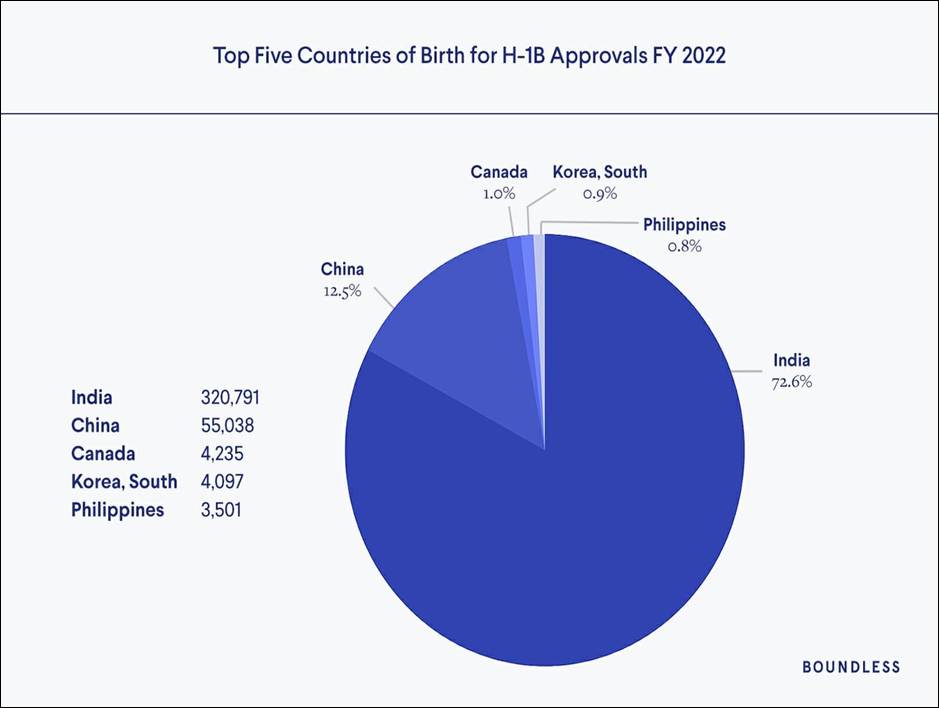
Figure 1: Top five countries of H-1B visa holders
(Source: Boundless Immigration)
H-1B Visa Policy Evolution Timeline
The H-1B visa program was enacted under the Immigration Act of 1990 which created a non-immigrant classification for speciality occupations with an initial annual cap of 65,000 (US Congress, 1990). The primary purpose of this visa program was to deal with the acute shortage of employees in highly skilled professions such as healthcare, technology and engineering and to authorize the temporary employment of qualified individuals.
The annual cap of 65,000 was reached for the first time in the year 1997 due the expanding demand in the technology sector (USCIS, 2006.) This rapid growth pushed the policymakers to make legislative amendments to accommodate the growing talent mobility. The American Competitiveness and Workforce Improvement Act (ACWIA) of 1998 was one such amendment which led to the rise of the H-1B visa cap to 115,000 for the fiscal years of 1999 and 2000. This cap was further increased to 107,500 for the fiscal year of 2001. Under the ACWIA Under ACWIA, an H-1B Nonimmigrant Petitioner Fee account was established to fund training and education programs administered by the Department of Labor and the National Science Foundation under which the Employers were required to pay a $500 fee for each H-1B worker sponsored. In 2000 the 106th congress further passed two H-1B bills that impacted the H-1B landscape largely. These two bills were the public law 106-311 and The American competitiveness in the 21st century act (AC21), the first increased the ACWIA fee to $1000 and while exempting additional types of employers not described in INA 212(p)(1) from payment of this fee and extending the applicability of the fee provision to qualifying petitions filed by employers through September 30, 2003 and the AC21 increased the cap to 195,000 for the fiscal year of 2001 till 2003 temporarily while exempting certain H-1B workers from these numerical limits. These reforms reflected the tug of war between meeting the high skilled employee demands and foreign labour entry.
Next on our timeline is the H-1B Visa Reform Act 2004 which was enacted as a part of the Consolidated Appropriations Act of 2005 (The Indian Express,2025.) It permanently reinstated the ACWIA fee, increasing it to $1,500 for large employees and $750 for small employers. This reform further introduced a Fraud Prevention and Detection Fee of $500 for initial H-1B or L petitions and employer transfers and created a 20,000 cap exemption for U.S. advanced degree holders (Government Accountability office, 2022).
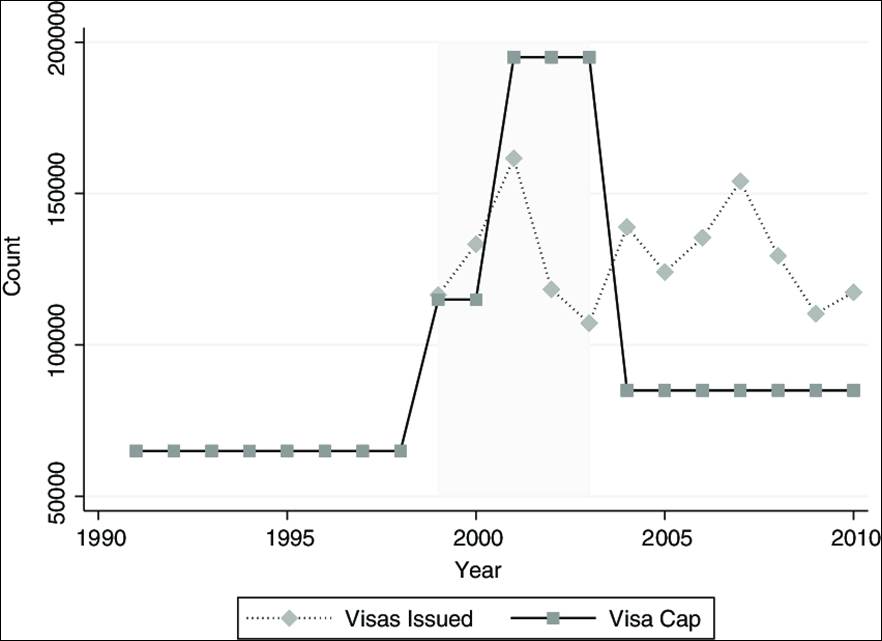
Figure 2: the H1B visa cap and visa issuances over time
(Source: Choudhary and Kim, 2018)
The next development in the H-1B policy was when the United States Citizenship and Immigration Services which comes under the U.S department of homeland security clarified the definitions of “affiliate” and “subsidiary” through a policy memo. This clarification helped to regulate the proper collection of ACWIA fees. By 2019, the United States Citizenship and Immigration Services enforced an electronic registration system for H-1B cap-subject petitions. This electronic system required the employer to pre-register and pay a registration fee before filing a full fledged petition.
Another major development in the H-1B Program occurred in the fiscal year of 2023. This major development was the introduction of a lottery system where a random lottery on electronic registrations was used to meet the annual cap of 65,000 visas plus the 20,000 advanced degree exemptions. In order to increase the transparency and accountability in the visa procedures the U.S. Citizenship and Immigration Services released detailed data on petitions, ACWIA fee collections, fraud submissions and exemptions.
Recently, In September 2025 under the Trump administration, several significant policy shifts occurred in the H-1B visa policy program. On September 19, 2025 a presidential proclamation imposed a $100,000 annual fee for the new H-1B applicants which was a sudden increase from the previous $1500-2000 charge Per filing. The stated goal for this sudden hike was to incentivize employers to hire domestic workers and reduce the overall foreign labour dependence of American companies. Despite the stated intentions, this fee hike has faced criticism from tech owners and legal experts warning that this could deter global talent (Wiessner,2025).
In essence, the history and present of the H-1B policy evolution has been an interplay between economic necessity, talent mobility and domestic labor protection. From the policy’s inception in 1990 to its current controversial stance reflects a broader context of shifts in the priority of US policy.
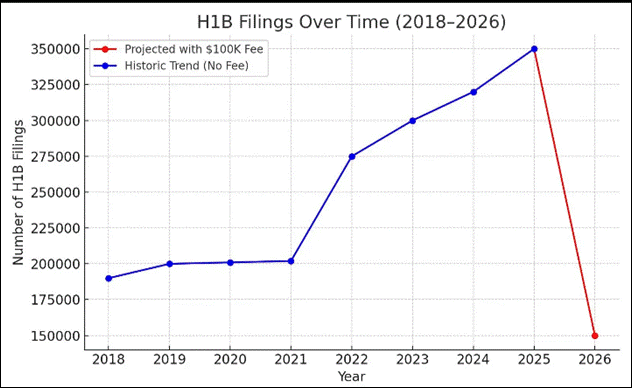
Figure 3:Line graph showing projected drop in filings after the $100K fee takes effect.
(Source: The Herman Legal Group)
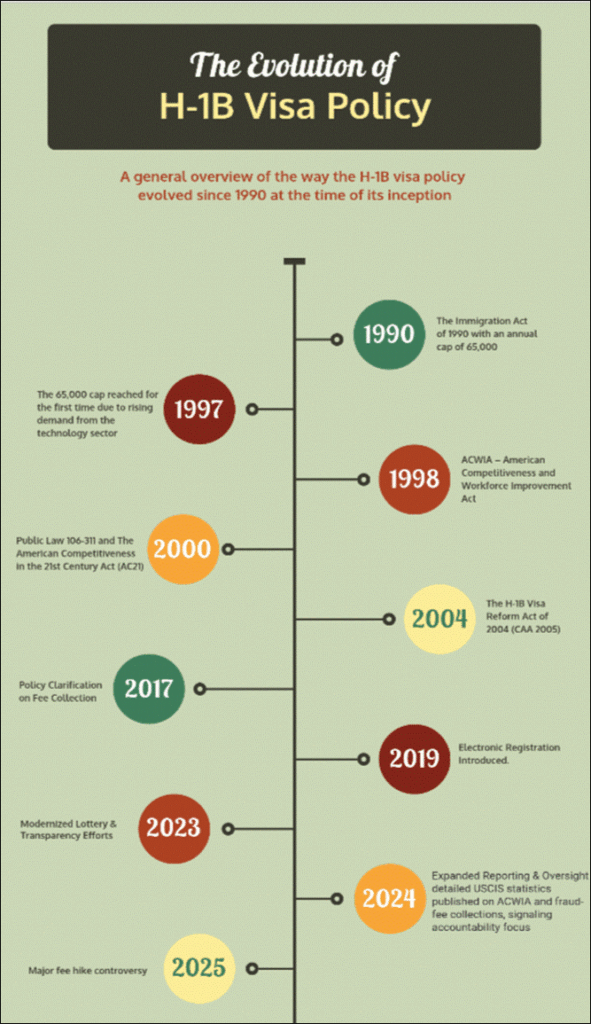
Figure 4: Policy Evolution of H-1B
Case Study: Interviews
In order to assess the real world implications of the shifting H-1B policy landscape, immigration laws and the practical aftermath of the recent policy shifts in the visa framework, the Pravasi Setu Foundation conducted telephonic interviews of two seasoned legal experts:
1) Ms. Poorvi Chothani (founder of LawQuest): An Indian origin cross-border employment lawyer with 22+ years of experience in Indian immigration.
2) Mr. Gnanamookan Senthurjothi (founder of The visa code): A seasoned attorney with 18+ years of experience in U.S. policy compliance and global mobility.
Their nuanced perspectives reflected on how procedural changes in policies can lead to larger geo-political impacts including effects on global mobility affecting Indian working professionals and the future of talent mobility.
The interviewees collectively recalled the evolution of H-1B visa from a readily accessible employment visa to a highly regulated and politicised process. According to Mr. Senthurjothi when he initially began his journey in the pre-2010s, securing an H-1B visa was fairly easy for an individual with “genuine documentation”. This large volume of approvals began to erode with Obama-era regulations particularly scrutinizing applicants who were working in a third-party location. Meanwhile, Ms. Chothani pointed out quantitative constraints imposed by the permanent cap reduction (from 195,000 to 65,000). She further emphasized the reduction in paper wastage after the 2020 transition to electric lottery system.
Both experts viewed the proposed $100,000 annual proclamation fee as Protectionist. Mr. Senthurjothi described this fee hike as a “huge blow” giving us a realist perspective to the policy shift further explaining how this shift can price out the small and mid size enterprises. He also suggested that companies might adopt L-1 intra company transfers or offshore hiring as strategic mitigation measures to the sudden policy shifts. Ms. Chothani adopted a pragmatic optimist viewpoint, stating that the fee hike status remains just on paper and is un-implementation as of yet. She further pointed out that the uncertainty itself will become the biggest impact affecting everyone however she claimed that regardless of the changed businesses would adapt as “business is like water, it will find its own level” highlighting how policy shifts do have an impact but there are always methods to mitigate these impacts.
Simultaneously, both the attorneys acknowledged the human aspect by accepting the consequences of policy shifts on an individual’s life. Ms. Chothani recalls previous cases which caused severe psychological strain, one such case that she recalls was of an Indian employee and their spouse where the Indian employee got an H-1B visa and their spouse received a H-4 visa which doesn’t allow them to work in the states losing their professional identity. Mr Senthurjothi similarly highlights how such stringent policies can lead to family separation, job insecurity, insecurity of being able to return to your home etc. He further adds to the discussion how he received a few cases where the visa of students on L-1 was cancelled leading to chaos in their families. These experiences conclude that policy shifts are not only economical, social or political but rather deeply human as at its core it affects personal well being including the psychology of an individual.
The root cause of his sudden policy shift according to both practitioners lies in the inconsistent policy and hidden political agendas. Mr. Senthurjothi claimed that the administrative tightening is a reaction to the previous very few regulatory abuse cases and is backed by the political narrative of “America First”. Ms. Chothani viewed these shifts from an economic lens of protectionist ideology that support a wage based filter for immigrants so that “only the brightest of the bright” gets benefitted from these programs. These insights suggest how the H-1B visa program is no longer just a talent mobility instrument but rather an economic as well as political tool.
Upon being asked about future recommendations and pathways for the policy framework both the experts emphasized transparency and meritocracy. Mr. Senthurjothi claimed that the current framework is already good enough but needs better enforcement, he predicted that a legal challenge would strike down the $100,000 fee when the time comes. On the other hand Ms. Chothani pushes for a more merit based selection while acknowledging that merit can’t be measured in a universal measure. Despite their differences in opinions both experts were sure that the talent mobility to the U.S would remain strong, Mr. Senthurjothi gave a metaphor explaining the talent mobility between India and US as the “Goldrush” saying that no matter the price of gold people will continue to buy it.
Both these expert interviews revealed how the H-1B visa policy lies at an intersection of policy, administration and human life. They further gave a nuanced insight on the whole policy shift landscape, adding that the flow of talent would remain strong regardless of the policy due to high demands as well as supply of highly skilled individuals willing to work in the US.
Implications of the Policy Shift
The policy shift in the H-1B program has a transversal effect across various sectors. The further section of the report divides the effects of policy shift into three distinct yet interconnected stakeholders namely, The companies, professionals and the economy as a whole.
Impact on companies
The fee hike in the H-1B filing is considered to result in a financial strain due to a steep decrease in the H-1B filings as predicted by JPMorgan economists Michael Feroli and Abiel Reinhart (Times of India, 2025). According to the estimate of Feroli and Reinhart the work authorizations would decline subsequently depicting the skeptical situation of even big companies when it comes to retaining and maintaining global talent with inconsistent visa policy. The policy’s impact can be synonymous to ripple effects with the tech sector at the center. The Ramifications of the policy shift differ in large and small companies, for large cooperation like Microsoft and Google
The cost of hiring employees with H-1B visa increased leading them to make more judicial use of funds by hiring only the top ranking individuals for the H-1B visa. As for the startups and small businesses it is predicted that this extra $100,000 cost can hurdle them from accessing the much needed global talent. This concern was highlighted by CNBC was that high-growth startups depend on H-1B workers. A $100,000 filing fee is a near-total barrier to entry for small firms (Butts, Dylan. 2025.). The policy is believed to affect the top outsourcing companies like Infosys and Tata consultancy deeply as well.. These companies were among the top sponsors of the H-1B visa, some experts predict that these companies will move offshore after a cost benefit analysis for better alternatives. Emarkerter analyst, Jeremy Goldman warns that while the policy may bring short-term revenue, it risks eroding U.S. innovation by driving global talent elsewhere.
Impact on Professionals
The fee hike is expected to significantly affect the professional opportunities for the Indian tech professionals as they comprise the majority of H-1B visa card holders. The access to opportunities in the states will probably be limited to only the highly specialized individuals making it difficult for the freshers or even mid career professionals. Further adding to this problem even the already H-1B holders might face problems in future with costly renewals, job insecurity etc. According to India today up to 140,000 professions will lose job opportunities if the fee hike is fully enforced as we can see in the figure 5 which gives us an approximate of the projected fall in the H-1B visa filings and approvals. This development can further impact the international students as the top institutions like MIT, Harvard etc would lose their global edge as international students see no viable path to the H-1B visa program.
Figure 5: Projected fall in visa filings and approvals
(Source: Herman Legal Group)
Impact on Economy
The H-1B policy shift is predicted to have a broader economic implication on economies of the countries involved i.e majorly United States of America and India. The H-1B visa card holders are not just immigrants but rather active contributors to the economy as indicated in figure 6 which shows the estimated annual contribution of H-1B visa card holders in the US economy. These workers are not simply filling existing jobs, they are often crucial drivers of new patents, the establishment of new companies, and the development of cutting-edge technologies etc.
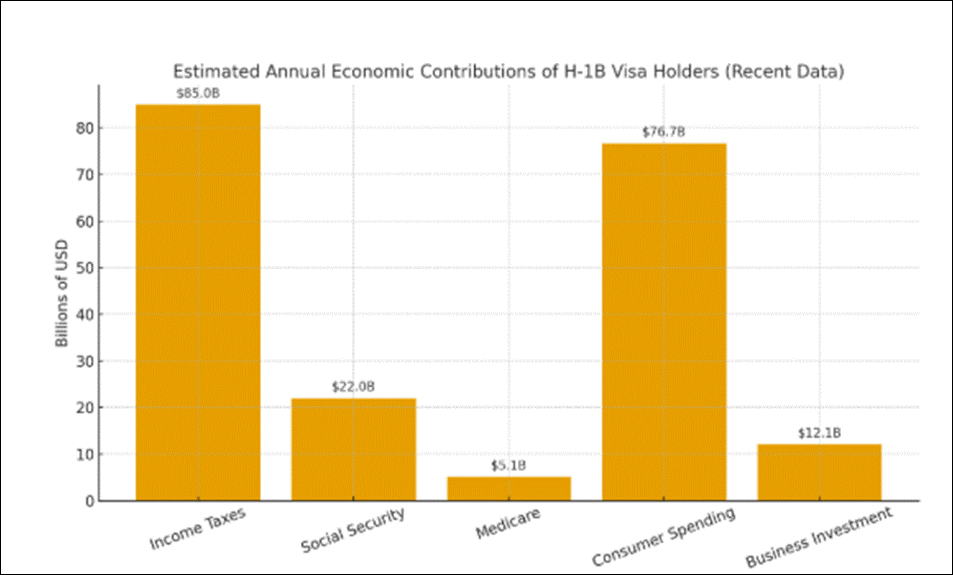
Figure 6: Estimated annual contribution of the H-1B visa holders
(Source: The South Asian Insider)
H1B immigrants contribute up to one-third of U.S. innovation output. With fewer workers entering, innovation growth of the U.S would decline as well. Some economists also predict that this policy shift would encourage offshoring i.e as companies will be unable to hire the highly skilled individuals they require leading companies to move their high value research and technical operations to other countries with less restrictive visa policy.
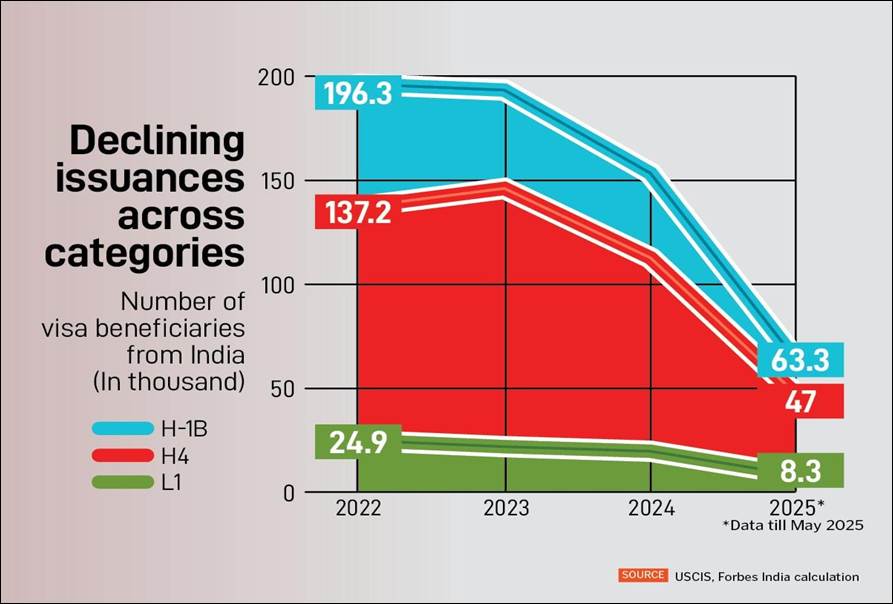
Figure 7:Number of visa beneficiaries from India
(Source: Forbes India)
Recommendations and Strategic Pathways
The drastic shifts in H-1B policy, particularly the proposal of a $100,000 fee, require coordinated action to protect the economic interests of all involved parties. In the further section of our report we will look into some recommendations and strategic pathways that can be adopted by the stakeholders in the H-1B visa framework. These strategies aim to replace uncertainty with sustainable, merit-based talent pathways.
Replacement of Random lottery system: The current visa system is based around an electronic lottery system which is used to randomly select candidates for the H-1B visa when the annual cap is exceeded. As recommended by one of our expert interviewees, this unsure lottery system can be replaced by a more robust, transparent and manageable merit based system where the allocation is based on merit. This would benefit the highly skilled immigrants by removing the anxiety of a pure lottery.
Re-evaluate and litigate the $100,000 fee proclamation: The fee hike from about $2500 to $100,000 is an extreme fee, one of our expert interviewees believe that this proclamation would be soon struck down by the court as unreasonable and too extreme regardless of this there is a need of either withdrawal or lowering down of this fee.
Enforceability and Revision : The H-1B visa program is not one without flaws and needs a revision along with stricter enforceability of existing laws that punishes the abusers and protects the highly skilled legal immigrants with better measures of protection like increased grace periods.
Conclusion
Through our analysis we can say that the H-1B visa policy which was designed for filling critical gaps in the US high skilled labour market has evolved into a highly scrutinized political instrument over time. As established by this report, the policy’s evolution depicted a constant “tug of war” between accommodation of global talent and protecting its own domestic markets and workers. The recent fee influx of $100,00 annual fee can be seen as the latest yet the most dramatic point of change in the policy’s evolution.
The reports dwell into the idea that the current H-1B system can be characterized through extreme uncertainty with a human cost to it. The semi-structured interviews with expert immigration attorneys highlighted how these policy shifts are not just procedural or administrative change but rather deeply human issues, several times costing the mental health of individuals as well. Further the metaphor of “Goldrush” given by one of our expert interviewees highlights the future of US-India talent mobility depicting that regardless of these changes it’ll remain significant.
Through our report we also highlighted the ripple effect of such policy shifts across US and Indian economies leading to a space of uncertainty among stakeholders. Therefore, the strategic pathway forward must be guided by the dual principles of predictability and human equity. From our report it is evident that such Policy shifts have a multilevel transversal impact across various sectors and thus must be dealt with a robust plan.
References
Fleck. 2025. “Indian Talent Is in High Demand in the U.S.” 2021. Statista Infographics. November 30, 2021. https://www.statista.com/chart/9008/h1b-recipients-by-country-of-birth/.
American Immigration Council. 2025. “Trump’s $100,000 Fee for H-1B Visas: What You Need to Know – American Immigration Council.” https://www.americanimmigrationcouncil.org/blog/trump-100000-fee-h1b-visa/.
101st US Congress . 1990. Review of The Immigration Act of 1990. 1990.
https://www.congress.gov/bill/101st-congress/senate-bill/358
Bound, John, Gaurav Khanna, and Nicolas Morales. 2017. “Understanding the Economic Impact of the H-1B Program on the U.S.” Www.nber.org. February 13, 2017. https://www.nber.org/papers/w23153.
Butts, Dylan. 2025. “Startups and Founders Could Be Hardest Hit by $100,000 H-1B Visas.” CNBC. September 23, 2025. https://www.cnbc.com/2025/09/23/startups-and-founders-could-be-hardest-hit-by-100000-h-1b-visas.html.
Reuters. 2025. “Trump to Impose $100K Fee per Year for H-1B Visas, Likely to Impact Indians.” @Bsindia. Business Standard. September 20, 2025. https://www.business-standard.com/immigration/trump-to-impose-100k-fee-per-year-for-h-1b-visas-likely-to-impact-indians-125092000089_1.html.
“Times of India.” 2025. Times of India. 2025. https://www.google.com/amp/s/www.newindianexpress.com/amp/story/business/2025/Sep/20/a-timeline-on-how-h1b-visa-program-evolved-over-the-years.
Edmonds, Lauren, and Katherine Tangalakis-Lippert. 2025. “What Is an H-1B Visa? Skilled Foreign Worker Program Explained.” Business Insider. September 20, 2025. https://www.businessinsider.com/h1b-visa-trump-executive-order-what-to-know-2025-9.
Herman, Richard T. 2025. “Understanding the Economic Impact of H-1B $100,000 Filing Fee.” Herman Legal Group. September 24, 2025. https://www.lawfirm4immigrants.com/economic-impact-of-trump-h1b-100000-filing-fee-analyzing-the-new-policy/#toc-3.
Ganguly. 2025. “How Bad Will the Impact of H1-B Visa Fee Hike Be on Tech Companies?” Forbesindia.com. ForbesIndia. October 13, 2025. https://www.forbesindia.com/article/news/how-bad-will-the-impact-of-h1-b-visa-fee-hike-be-on-tech-companies/2987943/1.
Choudhury, Prithwiraj, and Do Yoon Kim. 2018. “The Ethnic Migrant Inventor Effect: Codification and Recombination of Knowledge across Borders.” Strategic Management Journal 40 (2): 203–29. https://doi.org/10.1002/smj.2977.

Leave a Reply