
Introduction
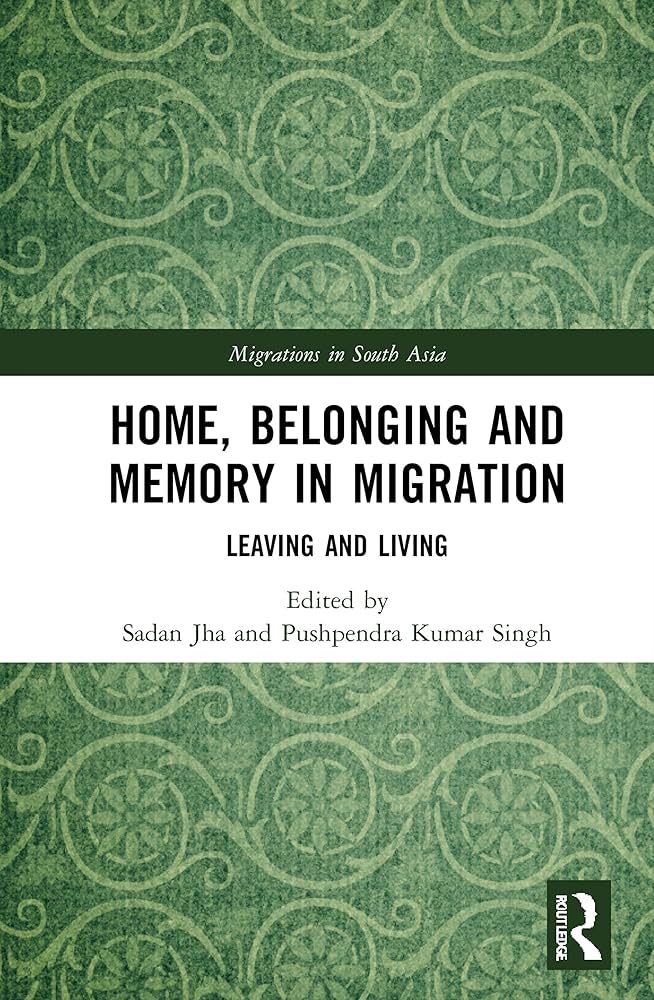
Migration involves the movement of people across places, but it is also a deeply emotional, cultural, and psychological process. The migration narrative focuses on questions of belonging, the continuity of memory, and the construction of the notion of home. Migration: Leaving and Living: Home, Belonging and Memory, edited by Sadan Jha and Pushpendra Kumar Singh (Routledge India, 2023), is a new addition to the existing body of literature on migration in South Asia. The book is a compilation of a wide range of essays that critically reflect on the issues of how memories of migration form the perceptions of and responses of individuals and communities to their conceptions of home, how they negotiate the displacement, and enforce their identities in the rural and urban open spaces as part of the Migrations in South Asia series.
The review assesses the book’s main arguments, methodological decisions, and contribution to the theme of Memory and Migration within a broader study of rural lifescapes. It is also a reflection of how the book helps us learn about the modern discourse on migration, identity, and belonging in India and elsewhere.
Overview of the Book
The book is organised thematically, with essays examining how memory mediates migrant lives. The editors explain that migration cannot be described in economic or demographic contexts. Instead, the book preempts personal and social memory to chart the personal and emotional aspects of migration. The essays discuss a variety of situations, including the displacement of communities during Partition, the migration of workers from rural Bihar and Uttar Pradesh, the cultural reproduction of memories in folk songs, and the experiences of women domestic workers. These essays go beyond numbers to reveal how recollections of loss, yearning and desire influence how the migrants write about their pasts and futures.
Memory is the book’s primary focus, and it is both a strength and a weakness. Stated more simply, memory gives continuity and rootedness in certain instances, and enhances displacement in others. This strain makes the volume analytical-filled.
Key Themes
1. Home as a Contested Category
Among the recurring questions throughout the essays is: What is the meaning of home for migrants? Home is both a physical location and a spiritual anchor for rural workers who temporarily leave their villages at specific times of the year. It is, however, also a controversial field, with exclusion, caste, and gender roles. The book makes it clear that migrants are more likely to recreate their home not as a physical location but as a moveable object, taking it with them in the form of memory, stereotypes, and rituals.
This method is of particular interest to the analysis of rural lifescapes, in which home is not merely connected to land and blood ties but also to ecological affiliation. The essays also require us to pose the following question: how do the memories of drought, poverty, or violence influence the decision to migrate, and how do they mediate the desire to return?
2. Memory as Resistance and Survival
The other strong theme is the exploitation of memory as a survival tool. Migration oral histories reveal that remembering the past is one way to endure current sufferings. Folk songs, tales, and religious practices serve as a medium for conveying memories, and as long as migrants relocate to new territories, they will not forget their cultural roots.
For women, memory often overlaps with gendered labour. The domestic worker essays reveal how the women migrants reconstruct memories concerning kinship to find a sense of unity in the new cities. Then, memory is not merely nostalgically focused; it is a daily, concentrated survival strategy.
3. The Politics of Belonging
The book also highlights the political stakes of memory. Migrants’ claims to belonging — in their places of origin and destination — are often shaped by how they narrate their histories. Partition migrants, for example, remember trauma not only as personal loss but also as collective suffering that demands recognition. Similarly, rural migrants in modern India utilise their memories of deprivation to assert their rights to housing, social protection, and welfare.
Therefore, the Political economy of memory cannot exist without the material realities of migration. The book also helps us remember that memory is not a concrete storage facility; there is more to it than that; it is a battleground where identities are being bargained, and power is wielded. This theme is significant in contemporary India, where migration is increasingly politicised through welfare, citizenship, and identity claims.
Methodological Contributions
The choice of methods is one of the strengths of this edited volume. The contributors rely on oral histories, ethnography, folk traditions, and archival materials to describe how memory works in everyday situations. This is important, as migration research often privileges quantitative methods that risk dehumanising migrants. In comparison, this book demands hearing voices, narratives and songs.
The book enables the use of oral histories to amplify voices that are often silenced in official versions. Rural women, informal workers and the lower caste migrants do not appear as passive victims but speak out about their stories themselves. Such a methodological decision is akin to Memory and Migration, focusing on the subjective aspect of rural landscapes.
Critical Reflections
Although the book makes significant contributions, it leaves room for thought.
To begin with, the essays lack balanced coverage. Specific chapters are grounded in empirical studies, whereas others are more theoretical. Although this may not be exceptional in edited books, it is inconsistent in terms of the depth of analysis.
Second, the book might have approached international migration more systematically. Despite the need to pay attention to rural and internal migration, most South Asian households currently have members working in global labour markets. The way memories cross transnational spaces is a question.
Lastly, the book could also have been more engaged with theoretical arguments in the study of memory. Although the essays apply the concept of memory in their work, they occasionally fail to generalise their results to broader theories. A longer, deeper interaction with authors such as Maurice Halbwachs or Jan Assmann might have added more depth to the analytical frame. A stronger theoretical engagement would have helped situate the empirical findings within broader debates in memory studies.
Relevance to Rural Lifescapes and Development Debates
Despite these limitations, the book is especially valuable for the Rural Lifescapes theme. It shows how rural life is not static but is constantly reshaped by migration and memory. Villages are remembered not only as spaces of belonging but also as sites of exclusion. Migration gives rise to new forms of community, sometimes imagined through memory rather than physical presence.
From a development perspective, the book also challenges purely economic readings of migration. Policymakers often view migration in terms of remittances or labour supply. This volume argues that migration must also be understood in relation to memory, identity, and belonging. For scholars and practitioners alike, this is a reminder that development interventions must engage with migrants’ affective lives. This has direct implications for development planning, which often overlooks migrants’ emotional and social attachments.
Conclusion
Home, Belonging and Memory in Migration: Leaving and Living is a relevant and essential contribution to migration research in South Asia. By foregrounding memory, it transcends figures and statistics to illustrate the lives of migrants. The essays all affirm that migration is not only about parting, but also about lugging, recollecting and re-establishing.
The book is especially topical for scholars of rural lifescapes, as it situates migration within everyday life, encompassing songs and rituals, trauma, and nostalgia. Its methodological interest in oral histories ensures that the voices of migrants are heard, whereas its thematic interest in belonging provides new grounds for analysis.
There are specific strong and weak points about the book, but ultimately, it is the idea that it encourages readers to gain a more detailed understanding of how memory works in the lives of migrants. It is required reading among scholars, researchers, and learners of migration studies, rural studies, and memory politics. At a broader level, it demonstrates the existence of a memory warehouse in any narrative of movement – a kind of resource that migrants must access to come to terms with their worlds. Migration is not only the departure, but also the migration of memories, the reinterpretation of the past, and the acquisition of a sense of belonging.

Leave a Reply