
ABSTRACT
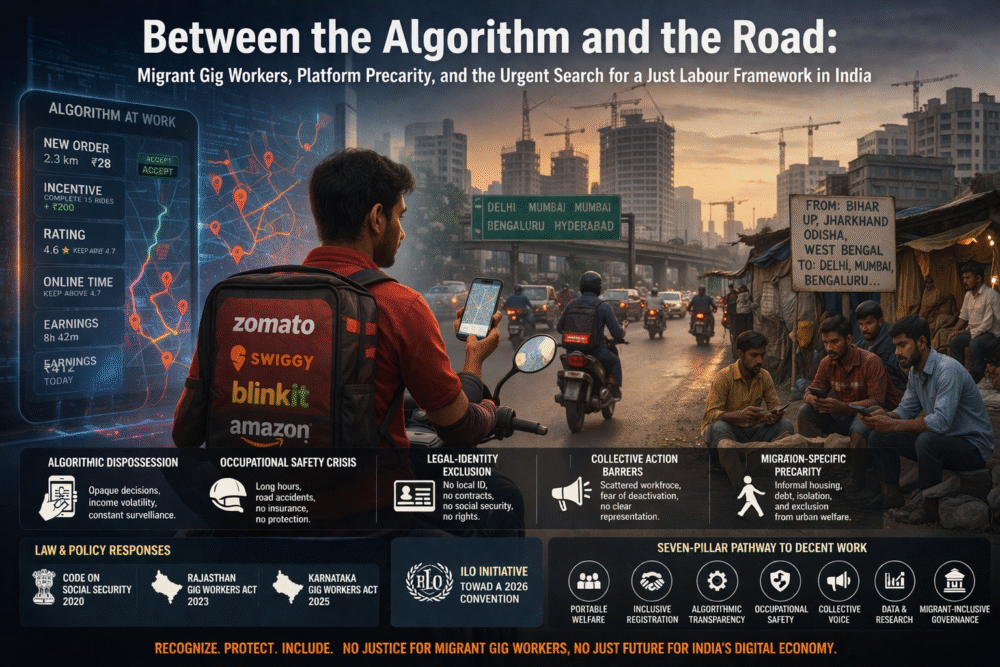
India’s gig and platform economy, employing approximately 7.7 million workers as of 2020–21 and projected to absorb 23.5 million by 2029–30, is disproportionately built on the labour of internal migrant workers. Yet, this migrant-platform nexus remains one of the most under-researched intersections in Indian labour studies. This article presents a critical, research-based analysis of the structural vulnerabilities, occupational hazards, legal exclusions, and emerging policy responses affecting migrant gig workers in urban India. Drawing on the scholarly frameworks of Jamie Woodcock and Mark Graham (King’s College London / Oxford Internet Institute), the Indian labour political economy scholarship of Babu P. Remesh (Ambedkar University Delhi) and Praveen Jha (JNU), empirical research on the South Asian gig-migration nexus, ILO findings on decent work in the platform economy, and field evidence from Indian cities, the article identifies five interlocking domains of vulnerability: algorithmic dispossession, occupational safety crisis, legal-identity exclusion, collective action barriers, and migration-specific precarity. Against this landscape, it evaluates India’s nascent legislative responses—the Code on Social Security 2020, the Rajasthan Platform Based Gig Workers (Registration and Welfare) Act 2023, and the Karnataka Act 2025—alongside the ILO’s standard-setting initiative culminating in the expected 2026 Convention, and proposes a seven-pillar policy roadmap grounded in the ILO’s Decent Work Agenda. The article argues that genuine protection for migrant gig workers requires not just legal reform but structural redesign: portable welfare identities, algorithmic transparency, mandatory safety infrastructure, and migrant-inclusive registration systems.
Keywords: migrant gig workers; platform economy; algorithmic management; precarious work; ILO Decent Work; labour law reform.
1. Introduction: The Invisible Engine of India’s Digital Economy
Every morning, millions of young men—most of them migrants from Bihar, Uttar Pradesh, Jharkhand, Odisha, and West Bengal—strap on a backpack bearing the logo of Zomato, Swiggy, Blinkit, or Amazon, mount a two-wheeler, and disappear into the traffic of Delhi, Mumbai, Bengaluru, or Hyderabad. They are the invisible engine powering India’s celebrated digital consumption economy. Yet, in the eyes of the law, the platforms, and much of mainstream scholarship, they barely exist—classified as ‘independent contractors’ or ‘partners’, denied the protections of employment, and left to bear the full weight of a system that extracts their labour while disavowing any responsibility for their survival.
The gig economy is not new as a concept, but it has undergone a radical transformation through digitalisation. As Jamie Woodcock and Mark Graham define it, the gig economy involves platforms that use digital infrastructure and algorithms to ‘bring together the supply of, and demand for, labour’ (Woodcock & Graham, 2019, p. 37). This apparently neutral mechanism has deep consequences: it enables businesses and governments to generate value while passing significant risk—of income volatility, accidents, illness, and old age—directly to workers (Woodcock & Graham, 2019). In the Global South, and particularly in India, this transfer of risk lands overwhelmingly on internal migrants, who constitute the backbone of on-demand, location-based platform work (Ray, 2024; Altenried, 2024).
NITI Aayog’s landmark 2022 report established that 7.7 million workers were engaged in India’s gig economy in 2020–21—a figure projected to grow to 23.5 million by 2029–30. A more recent study by the VV Giri National Labour Institute (2025) extends the projection to 61.6 million by 2047. Yet these numbers almost certainly undercount migrant gig workers, who are often invisible to standard labour surveys because they lack local domicile documents and register on platforms using borrowed or informal identity credentials (Remesh, 2020; Ray, 2024). As the Pravasi Setu Foundation’s own research documents, gig workers in Delhi, Mumbai, and Hyderabad routinely sign into apps under their relatives’ names, work multiple platforms simultaneously, and live in conditions of extreme informality (Pravasi Setu Foundation, 2025).
Academic scholarship on this intersection is growing but remains thin relative to the scale of the phenomenon. Woodcock (2021, 2023) has charted the global contours of platform capitalism and worker resistance; Van Doorn and Vijay (2021) have theorised how platforms function as migration infrastructure; Remesh (2020) has analysed the structural vulnerabilities of South Asian migrants in labour markets; Jha and Kumar (2020) have documented COVID-19’s devastating impact on India’s informal workforce; and Ray (2024) has provided rare fieldwork-based accounts of migrant gig workers coping in Indian cities. The ILO (2021, 2024, 2025) has steadily built a normative framework toward decent work in the platform economy. Yet a synthesis that brings together Indian migrant studies, platform labour analysis, occupational safety data, and current legal developments—with concrete policy recommendations—remains absent. This article attempts to fill that gap.
The structure of the article is as follows. Section 2 reviews the existing scholarly landscape and identifies research gaps. Section 3 sets out the methodological approach. Section 4 analyses the scale and composition of India’s migrant gig workforce. Section 5 presents a five-domain vulnerability framework. Section 6 evaluates current legal and policy responses. Section 7 develops a seven-pillar policy roadmap drawing on ILO standards and comparative experience. Section 8 concludes with implications for research and advocacy.
2. Literature Review: What We Know and What We Don’t
2.1 Global Platform Labour Scholarship
The foundational analytical framework for understanding gig work comes from the critical political economy tradition. Woodcock and Graham’s The Gig Economy: A Critical Introduction (2019) established four strategies for achieving a fairer platform economy—regulatory intervention, platform cooperativism, worker organisation, and consumer action—while demonstrating that the gig economy is not a new economy but a restructured version of capital-labour relations where algorithmic management replaces supervisory control. Woodcock’s subsequent work (2021) traces the emergence of transnational resistance movements among platform workers, arguing that the same technical infrastructure that enables exploitation also creates the basis for new forms of collective action.
Nick Srnicek’s (2017) concept of ‘platform capitalism’ provides the structural backdrop: platforms are lean firms that extract value from data and labour without owning the means of production. This model is particularly powerful in the Global South, where it taps into large reservoirs of semi-skilled, recently urbanised, and often migrant labour. Vallas and Schor (2020) have argued that platforms do not merely facilitate work but actively constitute new labour markets, reshaping who works, under what conditions, and at what price.
The migration-platform nexus has received growing attention from scholars like Van Doorn and Vijay (2021), who argue that gig platforms have become ‘key actors in remaking contingent markets’ by integrating migrants into low-wage labour markets through principles of efficiency, self-dependency, and flexibility. Alyanak et al. (2023) found that in Berlin and London, migrant platform workers face compounding disadvantages—structural racism in conventional labour markets, language barriers, and legal precarity from immigration status—that make platform work simultaneously attractive and deeply exploitative. Altenried (2024) describes ‘mobile workers as contingent labour’: migrants whose mobility is itself managed and valorised by platforms.
2.2 Indian Labour Scholarship
Within India, the scholarship on gig workers has developed rapidly since 2019 but has significant gaps. Praveen Jha and Manish Kumar’s (2020) analysis of labour in India during COVID-19 documented how the pandemic’s destruction of informal employment pushed millions toward platform work, but without addressing the migrant-specific dimensions. Jha’s broader body of work on labour in contemporary India (2016) provides the structural context: India’s labour market is characterised by informality, casualisation, and a vast ‘missing middle’ between formal protected employment and completely unprotected casual work—the gig economy falls squarely in this missing middle.
Babu P. Remesh, whose work on South Asian migration labour markets (2020) is among the most comprehensive in the region, has highlighted how internal migrants in India occupy the most vulnerable positions in urban labour markets—typically excluded from public services, social security, and collective bargaining due to their mobility and non-local status. His work on the SAAPE South Asia Migration Report (2020) makes clear that short-term and circular migrants—precisely the profile of most delivery and ride-hailing workers—are the most systematically neglected in policy design.
Aditya Ray’s (2024) fieldwork-based study in Ranchi and Kolkata is among the most valuable recent contributions, documenting how migrant gig workers rely on ‘digitally organised informality’—informal urban-rural networks of care, credit, and support—to survive the precarity of platform work. Ray’s finding that labour organisation and union participation are even lower among migrant gig workers than among non-migrant gig workers is critical and underexplored. Ghatak’s (2025) Ahmedabad-based study provides primary data on how the pandemic intensified gig work precarity, while confirming that labour jurisprudence has only partially recognised informal gig worker collectives.
2.3 Research Gaps
Despite this growing body of work, the literature has three critical gaps. First, there is almost no study that specifically tracks internal migrant gig workers across their full life-cycle—from origin-state departure through urban arrival, platform onboarding, working conditions, occupational hazards, and attempts to access welfare—in a single empirical frame. Second, occupational safety, particularly road accident risk, is treated as a secondary concern despite constituting the most immediate mortal threat to delivery workers. Third, the legislative developments since 2020 have not been adequately assessed for their practical impact on migrants, whose identity and domicile conditions make standard registration mechanisms inaccessible. This article attempts to address all three gaps.
3. Methodology
This article employs a qualitative, multi-method research design grounded in critical political economy. The methodological approach integrates three complementary modes of inquiry: systematic literature review, secondary data analysis, and policy document analysis. Together, these methods produce a synthetic, evidence-based account of the structural conditions facing migrant gig workers in urban India.
3.1 Systematic Literature Review
A systematic review of peer-reviewed scholarship was conducted across databases including JSTOR, Google Scholar, Taylor & Francis Online, and the ILO’s LABORDOC repository. Search terms included combinations of: ‘gig economy India’, ‘platform labour Global South’, ‘migrant workers platform economy’, ‘algorithmic management’, ‘informal labour India’, ‘gig worker welfare India’, and ‘precarious work digital platforms’. The review was bounded temporally (2015–2025) to capture the emergence and consolidation of the gig economy as a scholarly field, with select foundational texts (e.g., Srnicek, 2017; Woodcock & Graham, 2019) included on thematic grounds. A total of 47 sources were reviewed in depth, of which 32 are cited in this article. Priority was given to empirically grounded studies, India-specific research, and scholarship engaging with migration-platform intersections.
3.2 Secondary Data Analysis
Quantitative data informing this article is drawn from official government datasets, ILO publications, and established research institutions. Primary statistical sources include: NITI Aayog’s India’s Booming Gig and Platform Economy (2022), which provides the baseline and projected figures for gig workforce size and skill composition; the V.V. Giri National Labour Institute (VVGNLI) report commissioned by the Ministry of Labour and Employment (2025), providing the 2047 projection; Ministry of Road Transport and Highways (MoRTH) annual Road Accidents in India reports (2014–2023); the ILO Social Protection Module (2023) for global comparative data on platform worker coverage; and IDInsight’s (2024) primary survey data on gig worker earnings. Where data gaps exist—most significantly, the absence of nationally disaggregated, profession-specific road accident statistics for gig workers—these are explicitly acknowledged as research gaps requiring future attention (see Section 8).
3.3 Policy and Legal Document Analysis
The legislative and policy analysis in Section 6 draws on close reading of primary legal texts—the Code on Social Security, 2020; the Rajasthan Platform Based Gig Workers (Registration and Welfare) Act, 2023; the Karnataka Platform Based Gig Workers (Social Security and Welfare) Act, 2025; and the Tamil Nadu Government Order (G.O. Ms. No. 187, 2024)—alongside secondary commentary from the International Bar Association (2023), the International Social Security Association (2024), and specialist legal commentary (Bhatt & Joshi Associates, 2025; Cyril Amarchand Mangaldas, 2023). ILO normative documents, including Recommendations, World Employment and Social Outlook reports (2021, 2024), and proceedings of the 113th International Labour Conference (June 2025), are analysed for their implications for India’s platform economy governance. Comparative policy frameworks from Belgium, Spain, Argentina, and the EU Platform Work Directive (2024) are incorporated where they illuminate potential pathways for India.
3.4 Primary Field Evidence and Limitations
The article incorporates field evidence from the Pravasi Setu Foundation’s ongoing research programme, which has conducted structured interviews and surveys with migrant gig workers in Delhi, Mumbai, and Hyderabad (2023–2025). This primary fieldwork, cited as Pravasi Setu Foundation (2025), provides qualitative texture to the structural analysis—capturing workers’ experiences of algorithmic opacity, borrowed-account practices, living conditions, and barriers to welfare access. The authors acknowledge the methodological limitation that this field evidence is drawn from a single organisational source; future research should incorporate independent multi-city ethnographic work to strengthen the empirical base. The article also draws on media-reported case evidence (Think Global Health, 2023; East Asia Forum, 2023; IndiaSpend, 2025) for illustrative documentation of occupational safety incidents, used to complement, not substitute for, systematic data.
4. Scale and Composition: Who Are India’s Migrant Gig Workers?
Understanding the migrant gig workforce requires confronting the limits of official data. India’s Periodic Labour Force Survey (PLFS) does not capture platform-based gig work in a methodologically sound way, leading to significant discrepancies between estimates (VVGNLI, 2025). NITI Aayog’s 2022 methodology uses proxy variables—age, education, urban location, mobile phone ownership, bank account access—to estimate the eligible gig workforce. While imperfect, these estimates provide the best available baseline.
Table 1: India’s Gig Workforce — Historical and Projected Growth
| Year | Gig Workers (millions) | % of Total Workforce | Source |
| 2011–12 | 1.5 (est.) | 0.54% | NITI Aayog, 2022 |
| 2019–20 | 7.7 | 1.50% | NITI Aayog, 2022 |
| 2020–21 | 7.7 | 1.50% | NITI Aayog, 2022 |
| 2029–30 (proj.) | 23.5 | 4.10% | NITI Aayog, 2022 |
| 2047 (proj.) | 61.6 | 14.89% | VVGNLI/MoLE, 2025 |
Source: NITI Aayog (2022); VVGNLI/MoLE (2025); PIB Government of India (2023).
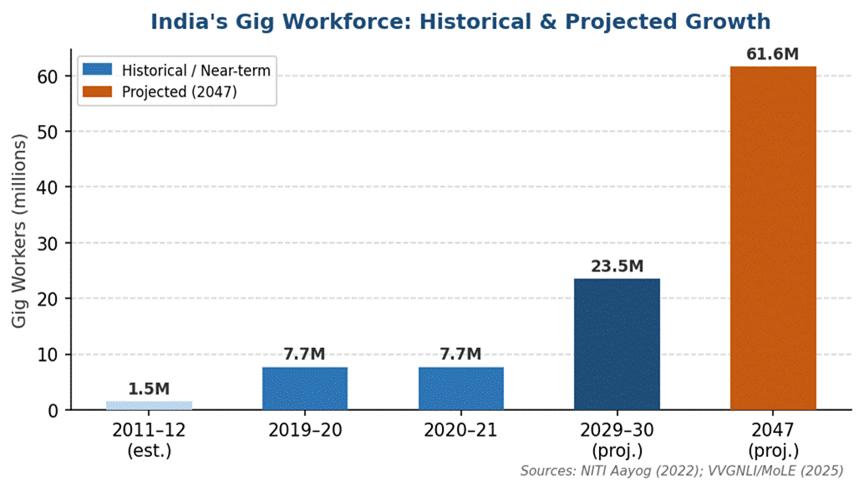
Figure 1: India’s Gig Workforce Growth. Source: NITI Aayog (2022); VVGNLI/MoLE (2025).
Of India’s estimated gig workforce, location-based platform workers—delivery riders, ride-hailing drivers, household service providers—constitute the largest and most precarious segment, and within this segment, migrants are dominant. Empirical studies from Delhi, Mumbai, Bengaluru, and Hyderabad consistently find that 60–80 per cent of delivery riders are internal migrants (Pravasi Setu Foundation, 2025; Ray, 2024). These are typically men aged 20–35 from semi-rural or peri-urban backgrounds who have migrated without formal employment offers, attracted by the low entry barrier of gig platforms: no references, no interviews, earnings from day one (Pravasi Setu Foundation, 2025).
Table 2: Skill Composition of India’s Gig Workforce (2020–21)
| Skill Category | Share of Gig Workers | Examples |
| Low-Skilled | 31% | Delivery riders, household cleaning, and loading |
| Medium-Skilled | 47% | Driving, logistics, data entry, customer care |
| High-Skilled | 22% | Software dev, design, consulting, tutoring |
Source: NITI Aayog (2022). India’s Booming Gig and Platform Economy.
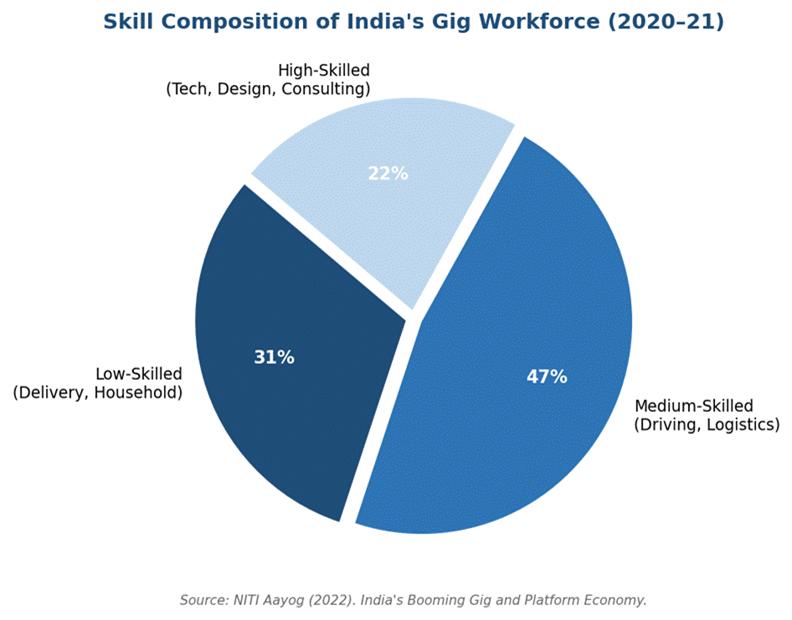
Figure 2: Skill Composition of Gig Workforce. Source: NITI Aayog (2022).
The low- and medium-skilled segments—constituting 78 per cent of the total gig workforce—are where migrant workers are overwhelmingly concentrated. Platform companies actively design their onboarding systems to maximise throughput of this population: simple KYC processes, minimal skill verification, algorithmic induction replacing human training. This creates a labour supply that is large, interchangeable, and easy to deactivate—precisely the conditions Woodcock (2021) describes as the ‘contractual trick of self-employment’ that allows platforms to grow quickly while keeping costs low.
The demographic profile of the migrant gig worker in India reveals intersecting vulnerabilities. Most come from states with high agricultural distress and limited industrial employment—Bihar, Uttar Pradesh, Madhya Pradesh, Rajasthan, Odisha—where structural unemployment and the MGNREGA wage floor make city-based gig earnings comparatively attractive, even if volatile. They typically live in shared accommodation in peri-urban slums or chawls, spending a disproportionate share of earnings on rent, food, and vehicle maintenance. Studies suggest that after these deductions, net hourly earnings are often at or below the local minimum wage—sometimes less than ₹50 per hour for delivery workers in peak competition conditions (IDInsight, 2024; Pravasi Setu Foundation, 2025).
5. Five Domains of Vulnerability: A Structural Analysis
5.1 Algorithmic Dispossession
The most fundamental form of control in the platform economy is algorithmic management—what Woodcock (2024) describes as a system of data-driven control that replaces direct supervision with automated systems that assign tasks, set prices, evaluate performance, and can deactivate workers without human review or appeal. For migrant gig workers, this system is particularly opaque and punishing.
Workers sign into apps and accept tasks but have no say in how those tasks are assigned, how their performance is evaluated, or why their accounts might be deactivated. As the Pravasi Setu Foundation (2025) documents, the result is a labour force that ‘never gets far ahead but always manages to scrape by.’ The ratings system is especially problematic for migrant workers: language barriers, unfamiliarity with platform interface design, and structural disadvantages in customer interactions—including discrimination based on caste identity, religion, or regional origin, which Indian media documented extensively in 2022—produce systematic rating penalties that affect earning potential.
The ILO (2024, 2025) has identified this information asymmetry as a structural injustice: platform firms hold vast data on worker productivity, income, and behaviour, but workers have no right to access, challenge, or transfer this data. A 2024 study in London estimated that data held by ride-hailing and delivery platforms masks as much as £1.9 billion in unpaid wages; while India-specific estimates are unavailable, the structural conditions for similar wage theft are present (TNI, 2025).
5.2 Occupational Safety Crisis: Speed, Roads, and Neglected Bodies
The occupational safety dimension of migrant gig work is India’s most urgent and under-acknowledged crisis. Delivery riders operate under algorithmic time pressure—’quick commerce’ platforms promise 10–30 minute delivery windows—that directly incentivises dangerous riding behaviour. As the East Asia Forum (2023) noted: ‘Accidents are inevitable given the tight deadlines employees are required to meet while navigating heavy traffic.’
The national road safety data makes this visible in stark terms. According to Ministry of Road Transport and Highways (MoRTH) data analysed by IndiaSpend (2025), two-wheeler deaths in India rose from 30 percent of all road accident deaths in 2014 to 45 percent in 2023—representing approximately 75,000 deaths annually. Every hour in India, nine two-wheeler riders die on the road. Of these deaths, 73 percent involved riders not wearing helmets, and 10 percent involved unlicensed or learner-licence holders. A Mumbai study cited by Crashfree India found that approximately 50 percent of 431 surveyed gig riders reported experiencing a road crash, and nearly 75 percent reported near-miss incidents. India’s official road crash data does not capture profession-specific statistics for gig workers, making systematic tracking impossible—a gap that urgently needs addressing.
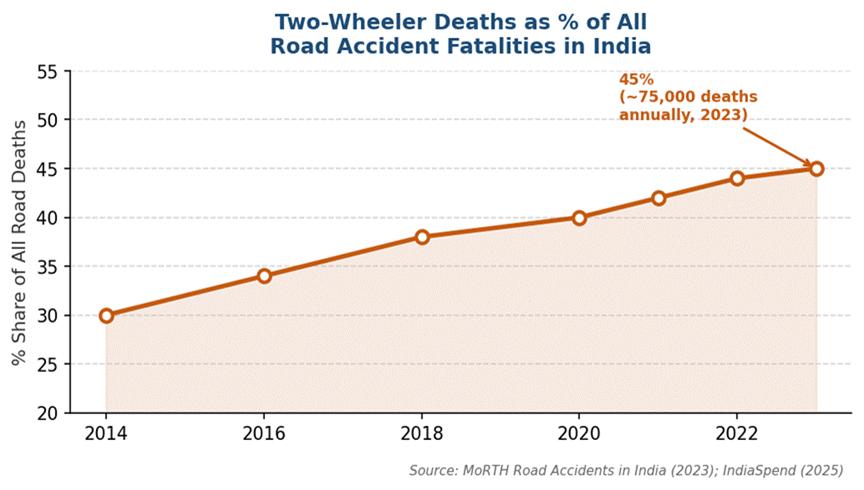
Figure 3: Two-Wheeler Deaths as % of All Road Fatalities, India (2014–2023). Source: MoRTH (2023); IndiaSpend (2025).
The human cost is not abstract. In January 2023, 23-year-old Mohammad Rizwan, a Swiggy delivery worker in Hyderabad delivering under his brother’s account, fell from a third-floor balcony after being startled by a customer’s dog and died three days later, his family left to borrow money for hospital bills (Think Global Health, 2023). In the same period, an Uber driver in Hyderabad had her neck slashed by assailants; a Flipkart delivery agent was stabbed for an iPhone delivery. In each case, platform companies initially denied knowledge of or responsibility for the incidents (East Asia Forum, 2023).
These cases are not aberrations—they reflect the design logic of platform work: workers bear all risk while platforms bear none. The platforms’ third-party insurance arrangements are typically unknown to workers and their families, and the claims process is inaccessible to migrants with limited literacy and documentation (Think Global Health, 2023). India’s occupational safety legal architecture—designed for factories and construction sites—has no mechanism to cover platform-based road workers.
5.3 Legal-Identity Exclusion
India’s welfare architecture is built around domicile and formal employment. Migrant workers who live outside their home state—and who constitute the majority of delivery riders in major cities—face systematic exclusion from social services that require local residency proof, ration cards, state health cards, and municipal voter registration. The gig economy layers an additional exclusion: independent contractor classification means that even the limited protections available to inter-state migrant workers under the Inter-State Migrant Workmen (Regulation of Employment and Conditions of Service) Act 1979 do not apply to platform workers, since they are not employed through licensed contractors.
The Code on Social Security 2020 formally recognised gig workers as a distinct category—a landmark step. However, its implementation depends on state governments notifying rules, establishing social security funds, and operationalising registration through the e-Shram portal. As of 2025, implementation remains far from complete. Many workers—especially migrants—are unaware of their rights, and the e-Shram registration rate among gig workers remains low. Registration itself is complicated for migrants who lack local documents, and the Aadhaar-linked system, while portable in principle, requires digital literacy and banking access that many newly arrived migrants lack.
5.4 Barriers to Collective Action
Platform work is structurally designed to prevent collective action. Workers are geographically dispersed; they do not share a physical workspace; they are algorithmically pitted against one another through competitive ratings and earnings incentives; and their ‘self-employed’ status places them outside the scope of the Industrial Disputes Act and the Trade Unions Act under most legal interpretations. As Van Doorn et al. (2023) note, ‘without migrant workers, the platform economy would not exist in its current form’—yet these workers have the fewest tools to exercise collective power.
For migrant workers specifically, barriers to organising are even higher. Language differences between migrant workers from different origin states, fear of platform deactivation, lack of stable urban social networks, and the constant threat of return to origin-state unemployment create what Ray and John (2025) call a ‘fourth wave’ challenge: new platform worker unions in India (TGPWU, IFAT) have begun leveraging electoral politics and welfare board advocacy, but their reach among the most marginalised migrants remains limited.
The 2023 Delhi delivery worker protests, referenced in the Pravasi Setu Foundation (2025) research, demonstrated both the potential and limits of gig worker collective action: workers called for fair pay, medical support, and basic dignity, but the protests produced no binding employer commitments.
5.5 Migration-Specific Precarity
Migrant gig workers face a distinct set of vulnerabilities that arise specifically from their migration status, overlaid on the general precarity of platform work. They live in the most expensive urban areas relative to their incomes, spending 30–50 per cent of their earnings on shared accommodation. They lack access to public distribution system (PDS) food rations, urban health centres, and housing schemes because these require local domicile. They are more likely to be working on borrowed accounts—as the Mohammad Rizwan case illustrates—because ID verification processes disadvantage migrants who have recently arrived and lack locally-recognised documents.
Ray (2024) finds that migrant gig workers’ resilience depends critically on informal rural-urban networks—remittance flows, return migration during crises, and support from caste and village networks—rather than on any formal institutional support. This reliance on informal support structures is a survival mechanism, not a solution: it works until it doesn’t, and when it breaks down—as during COVID-19—migrant gig workers are left without any safety net whatsoever.
6. Policy and Legal Responses: Progress and Persistent Gaps
6.1 The Code on Social Security, 2020
The Code on Social Security, 2020, represents a genuine advance in the recognition of gig and platform workers. For the first time in Indian legal history, it defined ‘gig workers’ and ‘platform workers’ as distinct categories, acknowledged their exclusion from traditional employment protection, and mandated the creation of social security schemes covering life and disability cover, accident insurance, health and maternity benefits, and old-age protection. It also established a Social Security Fund to be financed by aggregator contributions of 1–2 percent of annual turnover.
However, the Code has significant limitations. Most importantly, it does not grant gig workers the status of ’employees’, making them ineligible for gratuity, maternity leave, provident fund, and other employment benefits (International Bar Association, 2023). Social security is conditional on registration on the e-Shram portal, which requires Aadhaar linkage, bank account, and mobile number—a combination that creates significant barriers for newly arrived migrants. As of 2025, the central rules under the Code have not been fully notified, leaving implementation to states, with highly uneven results.
6.2 State-Level Initiatives
In the absence of central implementation, several states have taken pioneering action. Rajasthan’s Platform-Based Gig Workers (Registration and Welfare) Act, 2023—the first dedicated state legislation for gig workers globally—established a Welfare Board, mandated registration of all workers and aggregators, and created a welfare fund financed by a per-transaction cess of 1–2 per cent. The Act introduced a Central Transaction Information and Management System (CTIMS) to track all platform payments transparently and provided workers with a unique identification number valid across all platforms. Karnataka’s 2025 Act was built on Rajasthan’s framework, raising the welfare fee ceiling to 5 per cent, mandating human contact points for worker queries, and establishing a two-tier grievance mechanism.
Tamil Nadu’s Government Order establishing the Platform-Based Gig Workers Welfare Board (2024) and Jharkhand’s parallel initiative represent further momentum. These state-level efforts are significant because they demonstrate that sub-national governments can drive innovation in worker protection when central action lags—a pattern historically consistent with India’s unorganised-sector welfare architecture (Ray & John, 2025).
Table 3: Key Legislative and Policy Frameworks for Gig and Migrant Workers in India (2020–2025)
| Legislation / Policy | Year | Key Provisions for Gig / Migrant Workers |
| Code on Social Security, 2020 (Central) | 2020 | First national law to formally define and recognise gig and platform workers; mandates social security schemes including life, accident, health, and maternity benefits; establishes Social Security Fund financed by aggregator contribution (1–2% of annual turnover). |
| e-Shram Portal (Central) | 2021 | Creates national database of unorganised workers with Aadhaar-linked UAN; enables gig and migrant workers to register and access welfare schemes. |
| Rajasthan Platform Based Gig Workers (Registration & Welfare) Act | 2023 | First state-level legislation for gig workers; establishes Welfare Board; mandates per-transaction welfare cess (1–2%); creates Central Transaction Information and Management System (CTIMS); provides grievance redressal mechanism. |
| Karnataka Platform Based Gig Workers (Social Security & Welfare) Act | 2025 | Builds on Rajasthan law; increases welfare fee range to 1–5%; mandates human contact point for worker queries; two-tier grievance mechanism; health and accident coverage. |
| Tamil Nadu Platform Based Gig Workers Welfare Board (G.O. Ms. No. 187) | 2024 | State-level welfare board; provides basic social security to gig workers in Tamil Nadu; tailored state-specific benefit schemes under development. |
Source: Compiled from ISSA (2024); IBA (2023); Cyril Amarchand Mangaldas (2023); Bhatt & Joshi Associates (2025); ILO Digital Labour Platform Tracker (2024).
Despite these advances, critical implementation gaps persist. The change of government in Rajasthan after December 2023 elections stalled rule notification, leaving the Act without operational force. Karnataka’s Act is too recent for implementation assessment. No state has yet operationalised a system that is specifically accessible to non-domicile migrant workers—the welfare boards assume a stable, locally-registered workforce that does not reflect the reality of circular migration. Registration systems linked to Aadhaar are theoretically portable but practically inaccessible for workers lacking smartphones, digital literacy, or stable connectivity.
6.3 International Standards: The ILO’s Evolving Normative Framework
The International Labour Organisation has developed the most comprehensive global framework for platform worker protection. The ILO’s World Employment and Social Outlook 2021 documented the rapid growth of digital labour platforms from 193 in 2010 to more than 1,070 by 2023. It was established that most workers in the Global South rely on platform work as their primary source of income. The ILO’s research has consistently found that only about 40 per cent of platform workers have any health insurance, less than 20 per cent are covered for employment injury, and old-age protection is nearly non-existent (ILO Social Protection Module, 2023).
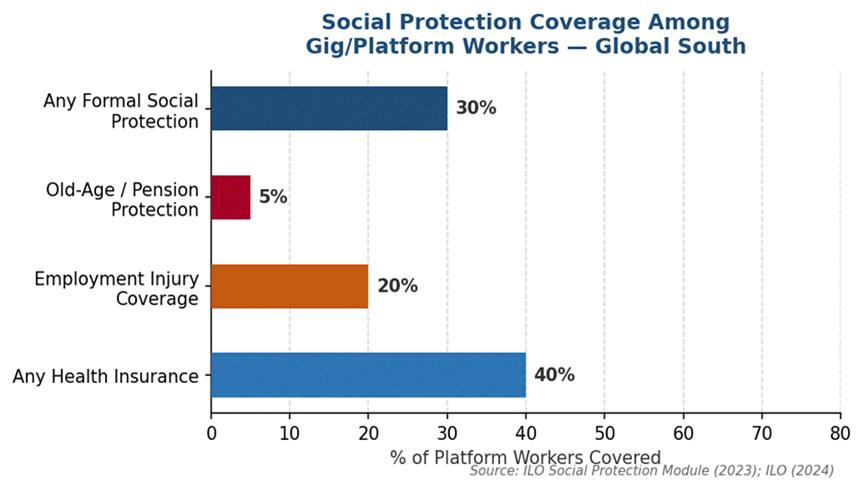
Figure 4: Social Protection Coverage Among Gig/Platform Workers — Global South. Source: ILO Social Protection Module (2023); ILO (2024).
In June 2025, the 113th International Labour Conference took the historic step of agreeing to establish binding international labour standards for the platform economy—a decision described by the Transnational Institute (2025) as the culmination of years of organising and pressure by workers, unions, and allied movements across 187 member states. The ILO is expected to adopt a binding Convention and a non-binding Recommendation at the 2026 ILC, which would establish substantive protections for platform workers across diverse legal and employment regimes. This is a critical moment for India, as ratification of the Convention would create enforceable obligations regarding decent work, algorithmic transparency, and social protection for the 7.7+ million workers in India’s platform economy.
7. Toward a Just Framework: A Seven-Pillar Policy Roadmap
The analysis above points to the need for structural redesign, not incremental adjustment. Drawing on the ILO’s Decent Work Agenda, comparative international experience (Belgium, Argentina, EU Platform Work Directive 2024), and the specific conditions of India’s migrant gig workforce, this article proposes a seven-pillar policy roadmap.
Table 4: Seven-Pillar Policy Roadmap — ILO-Grounded Recommendations for India’s Migrant Gig Workers
| ILO Pillar | Specific Recommendations |
| Decent Work & Fair Pay | Platforms must ensure minimum-wage-equivalent earnings after costs; overtime recognition; transparent task-allocation algorithms; elimination of ‘invisible labour’ (unpaid wait time). |
| Social Protection | Universal health insurance, accident coverage, maternity benefits, and old-age protection regardless of employment status; portable benefits tied to worker identity, not platform. |
| Employment Classification | Rebuttable presumption of employment when platform controls key work conditions; multi-stakeholder tripartite determination; prohibition of misclassification. |
| Algorithmic Transparency | Workers’ right to explanation of algorithmic decisions affecting pay, task allocation, and deactivation; independent audit rights; data portability. |
| Freedom of Association | Platforms must not penalise collective action; recognise gig worker unions; and ensure the right to collective bargaining, even for self-classified independent contractors. |
| Occupational Safety | Compulsory quality helmet provision and training; crash detection app features; safety audits of delivery time pressure; mandatory accident insurance before platform onboarding. |
| Migrant-Specific Protections | Language-accessible registration processes; portability of e-Shram UAN across states; access to ration/health services without domicile requirement; migrant worker helplines. |
Source: Compiled from ILO (2021, 2024, 2025); ISSA (2024); TNI (2025); Woodcock & Graham (2019); Bhatt & Joshi Associates (2025).
7.1 Portable Welfare Identity: Decoupling Protection from Domicile
The single most important structural reform for migrant gig workers is the creation of a portable welfare identity that travels with the worker across states, platforms, and forms of employment. The e-Shram Universal Account Number (UAN) already provides a national worker identity. Still, its adoption among migrants is hindered by the complexity of registration, Aadhaar-linking requirements, and the lack of outreach in origin states. India should establish dedicated ‘Migrant Gig Worker Registration Camps’ at major bus and train stations in destination cities—places like Delhi’s Anand Vihar, Mumbai’s Lokmanya Tilak Terminus, and Bengaluru’s Majestic bus station—where newly arrived migrants can register on the e-Shram portal, link to social security schemes, and receive their UAN. Registration should be available in multiple regional languages and require minimal documentation.
Additionally, welfare benefits under state gig worker welfare boards must be available based on UAN, not on state domicile. A Swiggy rider registered in Rajasthan who works in Delhi must be able to access Delhi’s welfare board benefits without having to re-register or prove local residency. This requires inter-state portability agreements—similar to the portability of Aadhaar-linked ration benefits introduced under the One Nation One Ration Card (ONORC)—as a standard feature of the gig worker welfare architecture.
7.2 Mandatory Occupational Safety Infrastructure
India must urgently address the road safety emergency for delivery workers through a combination of regulatory and platform-side interventions. Platforms should be required, as a condition of operating in Indian cities, to: (a) provide ISI-certified, branded helmets to all registered delivery riders and verify helmet use through camera-based onboarding; (b) integrate crash-detection technology and emergency response features into their apps; (c) remove 10-minute and 15-minute delivery time commitments that create algorithmic pressure to speed; (d) provide mandatory road safety training before a rider completes their first delivery; and (e) establish no-fault accident compensation funds with defined minimum payouts, available within 24 hours of a documented incident, without requiring proof of employment status.
Concurrently, the government must mandate that all platform workers be covered by occupational accident insurance from the moment of platform registration, not from the moment of their first delivery. This removes the ‘active work’ gap that left Mohammad Rizwan’s family unprotected, since he was working under his brother’s account precisely because informal account-sharing has become normalised as a coping mechanism in a system that doesn’t reliably provide workers with timely account creation.
7.3 Algorithmic Transparency and the Right to Explanation
India’s emerging data protection regime under the Digital Personal Data Protection Act, 2023, provides the starting framework for addressing algorithmic opacity, but it does not go far enough for platform workers. Building on the EU’s Platform Work Directive (2024) and the ILO’s normative gap analysis (2024), India should require platforms to: (a) disclose to workers the criteria used for task allocation, pricing, and account deactivation; (b) provide workers with access to their own performance data in machine-readable format; (c) establish an independent grievance mechanism where workers can challenge algorithmic decisions, with human review guaranteed within five working days; and (d) submit algorithmic management systems to annual third-party audits for discriminatory outcomes—including detection of patterns that systematically disadvantage workers from certain states, castes, or religions.
7.4 Central-State Funding Architecture for Welfare
The per-transaction welfare cess model established by Rajasthan (1–2%) and extended by Karnataka (up to 5%) is the most promising funding mechanism for gig worker welfare in India. However, the current state-level implementation creates fragmentation: workers in states without legislation have no cess collection, and workers who migrate between states lose continuity. India needs a centralised welfare fund—administered by the Ministry of Labour and Employment, with a dedicated Gig and Platform Workers Board—that consolidates cess collections from all platforms operating nationwide and distributes benefits based on workers’ UANs, regardless of the state in which work is performed. This would be analogous to the EPFO model for provident fund portability, adapted for the informal, non-contributory nature of most gig work.
7.5 Redefining Employment Status: The Rebuttable Presumption Model
The independent contractor classification that underlies all platform business models in India is a legal fiction—delivery riders have no genuine independence from the platforms that set their prices, determine their algorithms, control their ratings, and can deactivate them without notice. India should adopt the ‘rebuttable presumption of employment’ model being advanced by the ILO (2025): a legal presumption that a worker is an employee whenever a platform exercises meaningful control over working conditions, reversible only if the platform affirmatively demonstrates the worker’s genuine economic independence. This model—already adopted in Spain, France, and parts of the EU Platform Work Directive—does not require categorical re-classification of all gig workers as employees, but ensures that the most vulnerable workers receive employment protections by default.
7.6 Strengthening Gig Worker Organising Rights
India’s Trade Union Act, 1926, and Industrial Disputes Act, 1947, were designed for factory workers. They are inadequate for workers who have no shared workplace, variable earnings, and no recognised employer. India needs dedicated legislation for platform worker collective bargaining: (a) recognition of gig worker unions without the requirement of a fixed employee list; (b) mandatory consultation with registered gig worker unions before platform algorithm changes that affect earnings; (c) protection from platform deactivation for workers who participate in collective action or union leadership; and (d) representation of gig workers on the Welfare Boards established under state acts, with workers chosen through democratic worker elections, not government or platform nomination.
7.7 Migrant-Inclusive Registration and Awareness Campaigns
Finally, the gap between rights on paper and rights in practice for migrant gig workers is fundamentally a problem of awareness and accessibility. India should fund a dedicated national awareness campaign—conducted in at least twelve regional languages and delivered through community radio, WhatsApp, and partnerships with origin-state panchayats—informing migrant workers of their rights under the Code on Social Security, the process for e-Shram registration, how to access the Welfare Board grievance mechanism, and how to report platform deactivations or wage theft. The Pravasi Setu Foundation’s research network, NGO partners in origin and destination states, and digital labour platforms themselves should be mandated to contribute to this campaign as part of their operating licence conditions.
8. Conclusion: From Invisible to Indispensable
India’s migrant gig workers are not a marginal feature of the digital economy—they are its foundation. Without the millions of young men from Bihar, UP, Jharkhand, and Odisha who ride through monsoon rains and summer heat to deliver food in ten minutes, India’s ₹455-billion platform economy would not function. Yet the system is designed to extract their labour while denying its dependence on them: classifying them as independent contractors, shifting all risk to them, leaving them without insurance when they crash, and deactivating their accounts without appeal.
This article has argued that the crisis facing migrant gig workers in India has five interlocking dimensions—algorithmic dispossession, occupational safety collapse, legal-identity exclusion, collective action barriers, and migration-specific precarity—and that existing policy responses, while significant, have not yet addressed these dimensions in a structurally adequate way. The Code on Social Security 2020 is a landmark but unimplemented. Rajasthan’s 2023 Act is pioneering but stalled. Karnataka’s 2025 Act is promising but untested. And no existing framework specifically addresses the portability problem that renders all welfare systems inaccessible to circular migrants, who constitute the bulk of the delivery workforce.
The moment is, however, genuinely hopeful. The ILO’s 2025 decision to pursue a binding Convention on platform work—to be finalised at the 2026 International Labour Conference—creates an international normative framework that India should help shape and then ratify. The seven-pillar roadmap proposed here—portable welfare identity, mandatory safety infrastructure, algorithmic transparency, central-state funding architecture, rebuttable presumption of employment, organising rights, and migrant-inclusive registration—provides a concrete policy agenda grounded in both international standards and Indian reality.
For researchers, this article identifies the most urgent gaps: longitudinal tracking of migrant gig worker welfare trajectories; profession-specific road safety data; evaluation of state welfare board implementation; and comparative studies of ILO Convention ratification pathways across South Asian economies. For advocates, including the Pravasi Setu Foundation, it reinforces the value of direct engagement with migrant workers, systematic documentation of their conditions, and targeted lobbying for migrant-inclusive provisions in welfare legislation. For platform companies, it offers a challenge: the business model that extracts value from migrant vulnerability is not a natural law—it is a choice, and it can be changed.
India has the legal imagination, the institutional infrastructure, and the demographic imperative to build a genuinely just platform economy. What it needs is the political will to treat the workers who power this economy—the migrant riders, drivers, and service providers—as something more than background noise in the story of digital growth.
References
Altenried, M. (2024). Mobile workers, contingent labour: Migration, the gig economy and the multiplication of labour. Environment and Planning A: Economy and Space, 56(4), 1113–1128.
Alyanak, O., Cant, C., López Ayala, T., Badger, A., & Graham, M. (2023). Platform work, exploitation, and migrant worker resistance: Evidence from Berlin and London. The Economic and Labour Relations Review, 34(4), 667–688.
Bhatt & Joshi Associates. (2025). Gig and platform workers: Social security coverage for the new-age workforce. Retrieved from https://bhattandjoshiassociates.com
Crashfree India / Aastha Shreeharsh. (2025). Cited in The Wire, ‘One Crash, Years of Crisis’. March 2025.
Cyril Amarchand Mangaldas. (2023). Gig workers in India: Key legal developments and regulatory framework. Mumbai: Cyril Amarchand Mangaldas. Retrieved from https://www.cyrilamarchandblogs.com
Deepika, M.G., & Madhusoodhan, M. (2022). Labour laws for gig workers in the context of labour law reforms. Economic and Political Weekly, LVII(30), 38–44.
East Asia Forum. (2023, October 28). India’s platform workers are being flexed to death. Retrieved from https://eastasiaforum.org
Ghatak, A. (2025). Status of gig workers in India: Evidence from Ahmedabad City post-COVID-19 pandemic. The Indian Journal of Labour Economics. https://doi.org/10.1177/09722661251396653
IDInsight. (2024). What the data reveals about India’s gig workers. India Development Review. Retrieved from https://idronline.org
ILO (International Labour Organization). (2021). World Employment and Social Outlook: The role of digital labour platforms in transforming the world of work. Geneva: ILO.
ILO. (2023). Providing adequate and sustainable social protection for workers in the gig and platform economy (Joint technical paper with ISSA and OECD). Geneva: ILO.
ILO. (2024). Expansion of the gig and platform economy in India. Geneva: ILO Bureau for Employers’ Activities.
ILO. (2025). Platform power and the future of work [Roundtable proceedings]. International Labour Conference, 113th Session, Geneva, June 2025.
ISSA (International Social Security Association). (2024). Platform workers and social protection: International developments. Geneva: ISSA.
International Bar Association. (2023). Rules governing India’s gig economy. London: IBA.
Jha, P. (2016). Labour in Contemporary India (Oxford India Short Introductions). Oxford University Press.
Jha, P., & Kumar, M. (2020). Labour in India and the COVID-19 pandemic. The Indian Economic Journal, 68(3), 417–434.
Ministry of Road Transport and Highways (MoRTH). (2023). Road Accidents in India: 2023. New Delhi: Government of India.
NITI Aayog. (2022). India’s booming gig and platform economy: Perspectives and recommendations on the future of work. New Delhi: Government of India.
Pravasi Setu Foundation. (2025). Migrants on the move: Life, labour, and loss in India’s gig economy. Retrieved from https://psfresearch.com
Ray, A. (2024). Coping with crisis and precarity in the gig economy: ‘Digitally organised informality’, migration and socio-spatial networks among platform drivers in India. Environment and Planning A: Economy and Space. https://doi.org/10.1177/0308518X231220296
Ray, A., & John, A. (2025). A new politics of welfare? The origins and strategies of India’s gig and platform workers’ unions in the era of digital capitalism. Global Labour Journal. https://doi.org/10.1177/10245294251339391
Remesh, B.P. (2020). South Asia migration report 2020 (SAAPE). Ambedkar University Delhi / SAAPE.
Srnicek, N. (2017). Platform capitalism. Cambridge: Polity Press.
Think Global Health. (2023). India’s gig workers. Council on Foreign Relations. Retrieved from https://www.thinkglobalhealth.org
Transnational Institute (TNI). (2025). Platform power and the future of work. Retrieved from https://www.tni.org
Vallas, S., & Schor, J.B. (2020). What do platforms do? Understanding the gig economy. Annual Review of Sociology, 46, 273–294.
Van Doorn, N., & Vijay, D. (2021). Gig work as migrant work: The platformization of migration infrastructure. Environment and Planning A: Economy and Space. https://doi.org/10.1177/0308518X211065049
Van Doorn, N., Ferrari, F., & Graham, M. (2023). Platform work, exploitation, and migrant worker resistance. The Economic and Labour Relations Review, 34(4), 623–648.
VVGNLI (V.V. Giri National Labour Institute). (2025). Gig and platform workers: Vision 2047. Noida: Ministry of Labour and Employment, Government of India.
Woodcock, J. (2021). The fight against platform capitalism: An inquiry into the global struggles of the gig economy. London: University of Westminster Press.
Woodcock, J. (2023). Class composition in the digitalised gig economy. In M. Atzeni et al. (Eds.), Handbook of research on the global political economy of work (pp. 351–359). Cheltenham: Edward Elgar.
Woodcock, J. (2024). On algorithmic management. Weizenbaum Journal of the Digital Society, 4(3).
Woodcock, J., & Graham, M. (2019). The gig economy: A critical introduction. Cambridge: Polity Press.

Leave a Reply