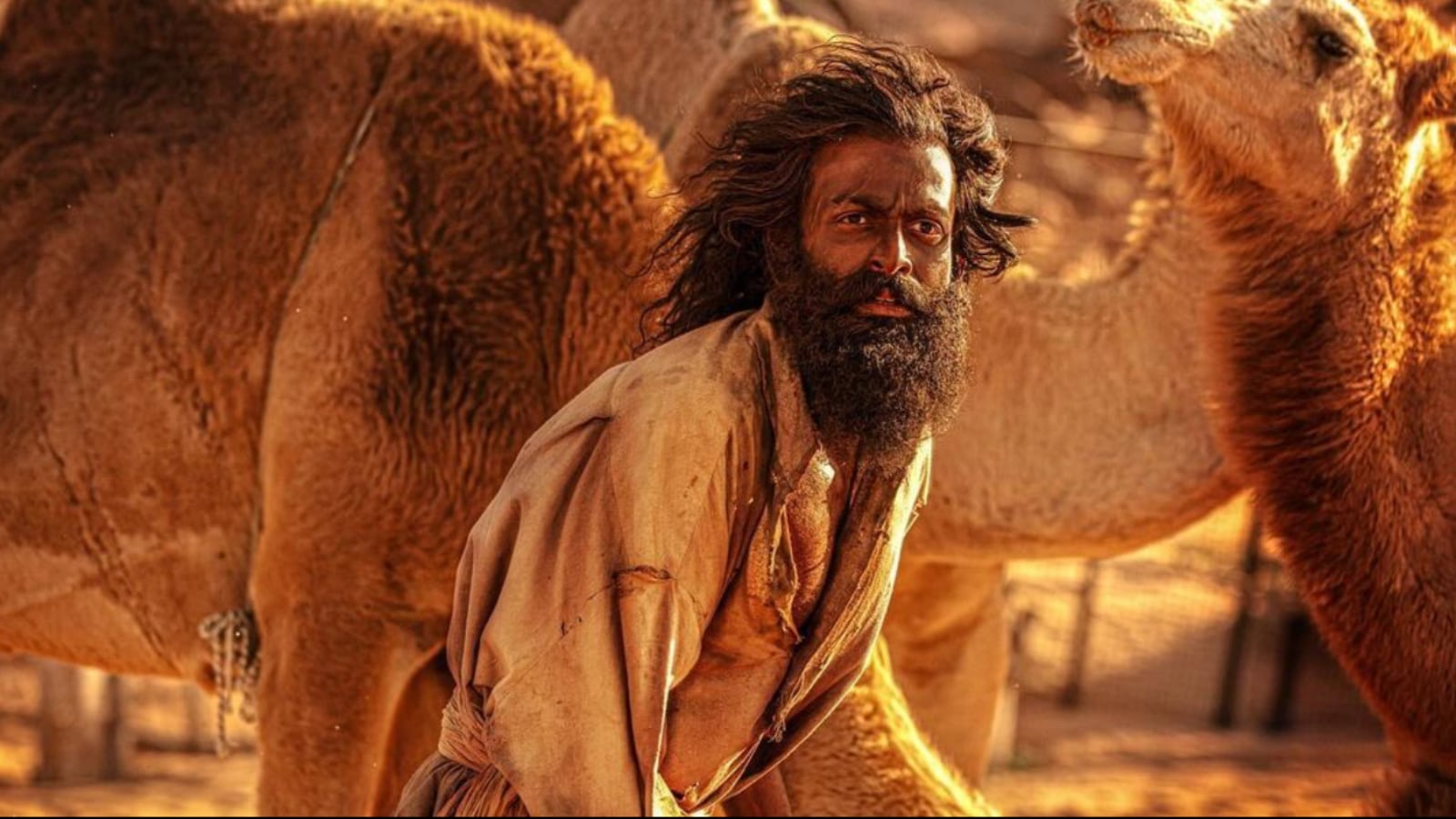
If the current conflicts in the West Asian region are waged with airstrikes and geopolitical manoeuvring, Aadujeevitham, a Malayalam film directed by Blessy, turns our attention to another, less visible war for survival. Adapted from Benyamin’s celebrated semi-biographical novel of the same name, the film tells the gripping story of Najeeb, an Indian migrant worker trapped in modern-day servitude in an unforgiving desert mazrah (cattle farm) of Saudi Arabia. The film follows the protagonist’s gruelling hardships and relentless fight, driven by his sheer endurance, against the conditions of extreme precarity, isolation, and the ebbing tides of hope.
This is a war no less brutal, and for many migrants, the war field extends across worksites, cramped living quarters, and public spaces. Despite the quiet erosion of freedom and dignity, and their frequent deprivation of mobility and rights, migrants persistently negotiate and try to resist asymmetric, exploitative systems through a refusal to just surrender to ‘fate’. This is a war fought with the body and the mind, where fragile acts of resilience, hope, and reminiscing about home become survival strategies and returning to their homelands becomes the ultimate goal. However, many fail in the pursuit; fortunately, Najeeb does not.
From Departure to Despair: The Plot Revealed
The film opens with Najeeb and his friend Hakkim, both first-time migrants from the South Indian state of Kerala, going through immigration checks at a Saudi airport in the early 1990s. Unable to speak Arabic or any language other than Malayalam, they attempt to make themselves understood to an immigration officer in broken English, stating that they had come to Saudi Arabia to work as company helpers. Najeeb, a fifth-class pass who previously worked as a sand miner, decides to try his luck by migrating when a friend offers him a visa, procured through a relative in the Gulf, for 20,000 rupees. To afford it, he borrows from lenders, mortgages his home and his wife’s gold, and leaves for Bombay to meet the agent who will send him to Saudi Arabia for an additional 10,000 rupees commission.
Like Najeeb, countless others migrated to the Gulf, often via Bombay, in search of better-paying jobs and financial stability for their families since the oil boom of the 1970s. While the allure of economic prosperity in the Gulf region and the growing labour demand from rapid, extensive infrastructure development pulled them in, the economic hardships in their home states pushed them to migrate, both as a choice and as a compulsion. Their journeys were financed by debt, each rupee borrowed against the promise of a better tomorrow. Carrying the weight of their dreams and hopes of a lifetime and the ache of separation, they set off for the Gulf, a place known to them through tall tales of earlier pravasis, who had built large multi-storeyed houses back in their villages and acquired other visible markers of success with their “Gulf money.”
Back to the film: as Najeeb and Hakkim waited for hours in the airport for their kafeel (sponsor) to pick them up, the day faded into twilight, casting an ominous shadow over their initial excitement with growing unease. Anxious about their predicament and unable to contact their families to inform them of their ‘safe’ arrival, they fell prey to a stranger whom they mistook for their kafeel. Exploiting their ignorance, desperation, and vulnerability, he seizes their passports and drives them deep into the desert interior. Hakkim was dropped off at an unknown location, leaving Najeeb to face in isolation a grim turn of fate he neither chose nor understands.
The rest of the film unfolds Najeeb’s harsh, slave-like existence in the secluded mazrah, where each day demands a battle against the relentless elements of nature, brutal living and working conditions, and a gradual loss of his sense of self. In rendering his physical and emotional ordeals with searing intimacy, the film masterfully shows that migrants’ experiences are not just passive sufferings, but a war in itself, for the right to decent work and to live with dignity. While some may be inclined to dismiss this as a fictionalised or overstated cinematic narrative, reports by civil society organisations, such as Migrant-Rights.org, FairSquare, or Human Rights Watch, underscore the systemic injustices and the persistent, deeply entrenched precarity that characterise global labour migration regimes.
Labour Migration and the Architecture of Precarity
While early Gulf migrants from India were largely low-skilled, single men, today, people of all ages, genders, religions, classes, and skill levels migrate to the region. Unlike blue-collar workers, high-skilled migrants have greater mobility, job security, legal protections, social benefits, and opportunities for family reunification. While they too endure work-related stress, fear of sudden job loss due to the temporary nature of their employment, the uptrend of labour nationalisation in the Gulf, and disruptions caused by conflicts or pandemics, professionals remain in high demand, and their contributions to host economies are increasingly recognised. However, the plight of blue-collar workers is most represented in academic and policy discourses, as well as in popular culture, given the magnitude of known (and unreported) cases of labour and human rights violations they face at all stages of migration.
For many, migration experiences remain marked by severe hardship shaped by entrenched systemic fault lines, particularly the exploitative kafala system. This visa sponsorship regime binds migrant workers to their sponsors/employers, granting sponsors significant control over their employment, wages, residence, and immigration status. In practice, this often results in the withholding of passports and permits, curtailing migrants’ freedom of movement and choice of work. Women migrant domestic workers are especially vulnerable, frequently reporting long working hours without adequate rest breaks or weekly leave, alongside experiences of gender-based violence, verbal abuse, intimidation, and manipulation, all of which contribute to profound physical and psychological distress.
Attempts to escape such abusive conditions are often criminalised as de jure violations of kafala regulations, leaving migrants vulnerable to arrest (often on charges of theft or absconding), detention, or deportation. When they return home in such circumstances, they are burdened by neck-deep debt and the shame and stigma of failing to achieve the expected financial success in the Gulf.
In response to global criticism that the kafala is modern-day slavery, the Gulf countries have taken steps in recent years to reform it. Yet, various forms of exploitation continue to persist, including contract substitution, forced labour, wage theft, denial of paid leave and healthcare, and workplace harassment. Such conditions are exacerbated by the stark power asymmetries between employers and migrants, general apathy towards migrant needs, limited institutional accountability, and weak enforcement of labour protections.
Besides, any crisis that affects the Gulf, whether a public health emergency like COVID-19 or the ongoing conflict, disproportionately affects migrant workers. For instance, during the pandemic, migrants were often the first to lose jobs without end-of-service compensation or social protection, confined to overcrowded housing that heightened infection risks, and left stranded without wages, healthcare, or the ability to return home. While there are many testimonies of Arab employers treating their employees with kindness and compassion, it is a sad reality that many migrants encounter experiences similar to Najeeb’s.
Correspondingly, despite efforts by the Indian and Gulf governments to curb irregular migration, fraudulent recruitment and travel agencies and their sub-agents take advantage of the legal loopholes to profit from migrant trafficking. The visa agents, often known to and trusted by their victims, dupe those seeking opportunities abroad and ‘export’ them on expensive ‘free’ visas and visiting visas, promising high-paying ‘Gulf jobs.’ It is critical to note that these deceptive recruitment and exploitative labour practices are not limited to the Gulf migration corridor, but they are rampant worldwide, thereby maintaining a global low-cost labour supply chain.
That said, beyond the economies of remittance, migration is also about the lived experiences of migrants and their everyday emotions of joy, despair, alienation, loneliness, anger, and longing for home. Especially in the arid Gulf region, the physical and emotional hardships faced by workers are often exacerbated by hostile climatic and environmental conditions and limited avenues for leisure and social activities. Yet, the psychosocial turmoil experienced by migrants in situations similar to Najeeb’s is often dismissed or normalised by migrants themselves and those around them, contributing to an alarming increase in suicides among Indians in the Gulf. Anxiety, sleep disturbance, depression and associated psychosomatic disorders are widespread, underscoring the urgent need for medical and community-based interventions.
Closing Frames and Afterthoughts
Dehumanised and mistreated by his abusive and exploitative employer, Najeeb was forced into herding goats and camels on the desert farm for years. For him, reminiscing and daydreaming about his homeland’s lush green landscapes, monsoons, and abundant backwaters become only respites from the blazing-hot, eerily still desert surrounding him. The lingering smell of mango pickle from the nearly empty jar he brought from home, and clings to dearly, often transports him to an ‘imagined home’, but it is the unbearableness of the memories of his pregnant wife and ageing mother that ultimately suffocate him. Isolated and braving unimaginable pain and suffering, with his human interactions limited to kafeel and occasional visitors, a deep sense of emptiness has grown in him. After a few failed attempts to escape, he surrendered to his life of bondage, a literal ‘goat life’ and gradually stopped speaking, instead in guttural sounds as if he had metamorphosed into a goat.
However, fate takes a turn when he unexpectedly reunites with his long-lost friend Hakkim and plans their escape with the help of a friend, fuelled by an uncontrollable urge to break free and return home. Walking for days and nights mostly barefoot across the unending desert and fighting many odds and near-death situations, including massive sandstorms, venomous snakes, and dehydration-induced hallucinations, Najeeb finally makes it alive to the city. Now an undocumented migrant, Najeeb, with the help of his community and the authorities, registered for an out-pass.
The 173-minute film Aadujeevitham, released in 2024, is one of the latest additions to the growing body of Indian cinema exploring the profound and complex social and human costs of distress migration. Through powerful imagery and realistic storytelling, the film becomes more than a survival drama; it stands as a searing social commentary on the ‘not-so-isolated’ and often-neglected yet dehumanising experiences of many migrants who leave their country in search of a better livelihood. While the film follows Najeeb’s harrowing journey, the subtext of his family’s ordeals due to his forced disappearance is well comprehensible. Furthermore, shedding light on the structural flaws in the current migration pathways and governance systems in both India and the Gulf states, the film compels critical reflection on the urgent need for rights-based, migrant-centric overseas mobility arrangements. In doing so, Aadujeevitham demonstrates how films can serve as a powerful medium for raising public consciousness about migration and the complex realities that migrants face, which are otherwise often reduced to cherry-picked statistics and occasional media headlines.

Leave a Reply