
Abstract
The work, navigates the migration patterns of Non-Resident Indians (NRIs) in the post-liberalisation period that is from 1991 till present. India currently is the world’s largest country out-migrating, 18.5 million people living abroad according to the United Nations Department of Economic and Social Affairs (UN DESA 2024), 34.36 million when People of Indian Origin (PIOs) and Overseas Citizens of India (OCIs) are included (MEA, “Annexure” 9). Fetching on secondary data recorded by the World Bank, the International Organization for Migration (IOM), the UN DESA International Migrant Stock dataset, and the MEA, this study identifies three unique phases of diaspora change: the IT surge of 1991–2000; the migration corridors in 2001-2010; and geographic variation in 2011-present, subsequentially India comes up as the world’s largest remittance receiver peaking USD 129 billion in 2024 (Ratha et al.). The paper analyses determinants and the 1991 liberalisation reforms alongside WTO GATS Mode 4 regulations, bilateral labour agreements, and oil-price cycles and socio-economic outcomes encompassing the remittances and brain drain, concluding that NRI mobility is crucial yet complex interplay of domestic reform, global economic binding, and host-country immigration policy.
1. Introduction
1.1 Context
India has the world’s largest diaspora population as of year 2026. 18.5 million Indian-born individuals living in countries other than India (UN DESA). Contributing 6 percent of all the international migrants globally. The diaspora extends to more than 190 countries and covers the band of occupational categories, from construction workers in Gulf Cooperation Council (GCC) states to technology professionals in Silicon Valley. Over the past three decades the diaspora changed considerably due to structural economic reforms started in 1991. The reforms initiated to minimize the severe unequal balance-of-payments crisis and the burden of severely reduced foreign exchange reserves resulted low as two weeks of import security (Varghese 106).
The economic liberalisation launched under Prime Minister P.V. Narasimha Rao and Finance Minister Manmohan Singh scrapped the Licence Raj, introduced current-account rupee convertibility, replaced the Foreign Exchange Regulation Act (FERA) with Foreign Exchange Management Act (FEMA), and provided structural support for the rise of a globally competitive IT sector. The structural changes untied new currents of skilled migration along with continued Gulf labour out migration, proving 1991 as a clear point where India’s migration history shifts drastically. Post-1991 liberalisation overlapped with two notable surges in the establishment of Indian transnational organisations, Showing boosted diaspora engagement (Agarwala 43; Bhat 47).
1.2 Why 1991 Served as a turning point?
The IT boom that India experience was catalyzed by Software Technology Parks og India(STPI) scheme and further pushed by Indian Multinational giants such as Infosys, Wipro, TCS. The continuous progress in the field open several labor market opprotunities for Indians in Western sphere (ADB 74). India is known to have a clear advantage when it comes to IT outsourcing services. This is largely because it has a lot of technical graduates who are also good at English (Kano 23). Around the same time, the WTO’s General Agreement on Trade in Services (GATS) Mode 4 rules made it easier for professionals in services to move temporarily across borders. This has created a direct link between trade and migration policies (Chanda 40).
1.3 Research Questions
(1) How have NRI numbers, composition, and destinations evolved since 1991?
(2) What’s driving these changes?
(3) What are the social and economic effects of these patterns on India and host countries?
2. Literature Review
The scholarly literature on Indian diaspora and international migration is extensive and multidisciplinary. Chanda’s analysis of WTO GATS Mode 4 provisions identified the institutional channel through which India’s service professionals gained cross-border mobility (Chanda 40). In their study, Agarwala and Bhat notice a considerable rise in transnational organizational forms among Indians post-1991, which they understand as evidence of the structural stabilization of the diaspora (Agarwala 43; Bhat 47). Quamar and Morales document the evolution of Indian labour migration to West Asia and highlight the dependence on contract employment and vulnerability to oil shocks (Morales 62; Quamar 112). On this issue, Clemens and, separately, Czaika and de Haas give a comparative perspective on the temporary nature of employment in the Gulf and the implications of the kafala system for the rights of migrants (Clemens 85; Czaika and de Haas 284).
In this regard, the student migration of Indians shows how education is becoming a dominant channel of migration to the United States, United Kingdom, Canada, and Australia (Varghese 106). On migration to the Gulf from Kerala, the top Indian source state of out-migration, the Kerala Migration Survey conducted by Rajan et al. continues to enjoy high credibility (Rajan et al. 45). Verea documents Canada’s Express Entry and Australia’s skilled migrant programme as increasingly prominent alternatives to the U.S. route, particularly given mounting green card backlogs (Verea 6). On the economic side, the World Bank remittance database confirms India’s position as the world’s largest remittance receiver since 2008, with inflows of USD 129 billion in 2024 (Ratha et al.). Jha et al. distinguish between the remittance profiles of Gulf and Western diaspora members (Jha et al. 17), and Chakraborty et al. provide state-level analysis of remittance dependence (Chakraborty et al. 426). Deopujari documents brain drain costs in medicine (Deopujari 1763), and TM et al. connect researcher emigration to India’s low research output (TM et al. 1).
3. Methodology
This study employs a combination of qualitative and quantitative methodologies, chiefly through the analysis of existing data. From a number of sources, we got quantifiable data on how many people left the country, how much money they sent home, and where they ended up. We gathered our information from a few different sources. The UN DESA International Migrant Stock 2024 dataset and World Bank data on migration and remittances were also part of this. We also read the IOM World Migration Report 2024. We used the MEA Annual Annexure on Indian Diaspora (from January 2025) to get particular numbers on Indians residing abroad, such as NRIs and PIOs, broken down by nation. We checked our numbers against the balance-of-payments statistics from the Reserve Bank of India (RBI) to make sure we were sending home the right amount of money. We used data from the Kerala Migration Survey and the National Sample Survey (Rajan et al. 32) to learn about remittances and persons moving out at the state level.
4. Results and Analysis
4.1 Scale and Growth of the Indian Diaspora
The number of Indians living in other countries has really grown a lot, and this has happened in three main phases. Looking at figures from UN DESA’s International Migrant Stock data, India’s population living abroad went from 6.5 million in 1990 to 18.5 million in 2024. That’s almost three times as many people in 34 years, making up 6 percent of all international migrants globally (UN DESA). A report called the MEA Annexure, from January 2025, says there are a total of 34,356,193 Indians overseas when you include both PIOs and OCIs (MEA, “Annexure” 9). Table 1 then gives a summary of the main points for each of these phases.
Table 1 – Phases of Indian Diaspora
| Phase | Period | Key Destinations |
| Phase 1: The Surge | 1991–2000 | USA, UK, GCC states (UAE, Saudi Arabia, Kuwait) |
| Phase 2: Institutionalisation | 2001–2010 | USA (H-1B), Gulf, UK, Australia, Canada |
| Phase 3: Diversification | 2011–2024 | USA, UAE, Canada, Saudi Arabia, UK, Australia, Germany |
Phase 1 (1991–2000)
The 1990s is the decade when people started to migrate in considerable number for various resons. This happened because of the huge worldwide growth in IT and more job openings in the Gulf region. A program called STPI, launched in 1991, really helped India’s IT exports take off. It also helped train a lot of skilled professionals who then looked for jobs all over the world (Sen 15). In the late 1990s, Indian graduates, especially those with technical abilities and good English, often found work in the US, UK, and Australia. It was especially obvious when businesses that were dependent on the internet grew quickly. In 1990–91, the Gulf Cooperation Council (GCC) began recruiting South Asian laborers again as they rebuilt after the Gulf War. The UN estimates that the Indian diaspora grew from 6.5 million in 1990 to 9.5 million in 2000.
Phase 2 (2001–2010)
The 1990s represented a decade which saw a substantial increase in out-migration from India. This happened because of the huge worldwide growth in IT and more job openings in the Gulf region. A program called STPI, launched in 1991, really helped India’s IT exports take off. It also helped train a lot of skilled professionals who then looked for jobs all over the world (Sen 15). A wide range of Indian technology graduates proficient in English easily secured employment in countries – U.S, UK, and Australia, particularly during the internet growth of the late 1990s. At the same time, nations within the Gulf Cooperation Council (GCC) began to recover from the 1990–91 Gulf War. They resumed the recruitment of numerous workers from South Asia. UN data indicates that the population of Indians residing overseas increased from 6.5 million in 1990 to around 9.5 million by 2000. Nearly fifty percent of these Indian expatriates settled in the Gulf region (Morales 62; Quamar 112).
Phase 3 (2011–2024)
This third phase really saw a shift in where people were going, and India truly became the top country for receiving money sent home from abroad. Following long waits in receiving U.S. green cards, a growing proportion of qualified professionals have thought about alternatives such as Canada, Australia, and Europe. During that period, Canada’s Express Entry system constantly indicated that Indians constituted the predominant group obtaining permanent status. After that, the COVID-19 outbreak hit in 2020 and made every aspect quite challenging. More than 200,000 people who lived in the Gulf have come back home who were residents of Kerala.The MEA also says that a huge 34,356,193 Indians live away from India. This figure includes both PIO and OCI citizens.
4.2 Shifts in Destination Countries
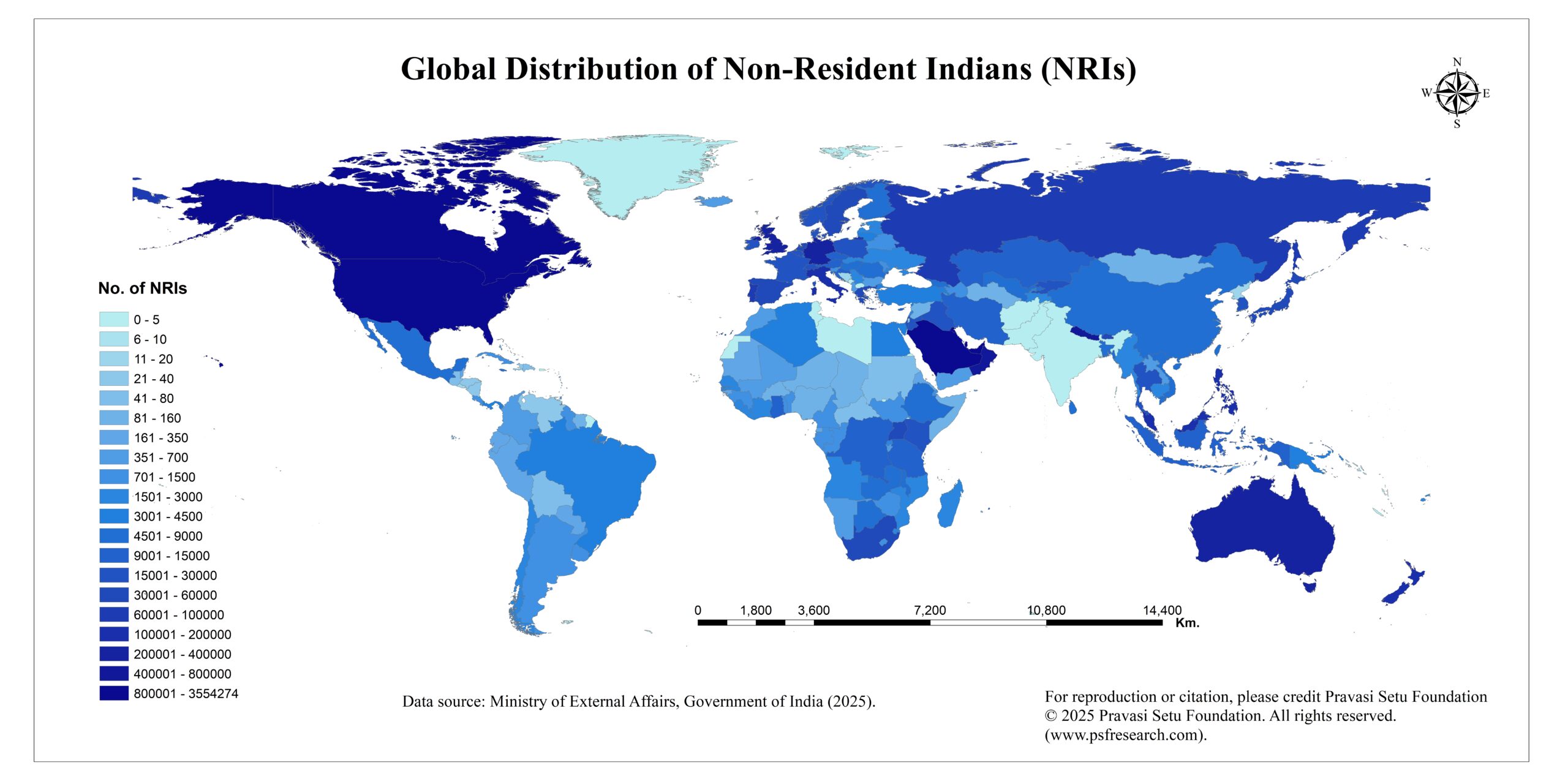
If you look at Table 2, it shows where the Indian diaspora has settled in different main countries. This information comes straight from the MEA Annexure about Indians living abroad, specifically the January 2025 version. This is the official source from the Government of India, and it gives us the counts for NRIs and PIOs in each country (MEA, “Annexure” 9–22).
Table 2 – Indian Diaspora by major Country of residence
| Country | NRIs | PIOs / OCIs | Total Overseas Indians |
| United States | 1,918,415 | 3,775,194 | 5,693,609 |
| United Arab Emirates | 3,890,953 | 6,614 | 3,897,567 |
| Canada | 1,751,610 | 1,859,680 | 3,611,290 |
| Malaysia | 185,000 | 2,750,000 | 2,935,000 |
| Saudi Arabia | 2,747,551 | 0 | 2,747,551 |
| Sri Lanka | 7,500 | 1,600,000 | 1,607,500 |
| United Kingdom | 369,000 | 970,969 | 1,339,969 |
| Kuwait | 1,007,961 | 2,356 | 1,010,317 |
| Australia | 350,000 | 626,000 | 976,000 |
| Mauritius | 26,357 | 871,140 | 897,497 |
| Qatar | 830,491 | N/A | 830,491 |
| Oman | 660,299 | 1,754 | 662,053 |
| Singapore | 350,000 | 107,180 | 457,180 |
| Germany | 273,890 | 176,500 | 450,390 |
| Netherlands | 55,613 | 178,000 | 233,613 |
Source: Data on Indian Diaspora Abroad (January 2025), pp. 9–22.
Gulf Cooperation Council states have 9.15 million Indians spreads to countries among them are UAE 3.90 million, Saudi Arabia 2.75 million, Kuwait 1.01 million, Qatar 0.83 million, Oman 0.66 million, and Bahrain 0.35 million. This number represents roughly 47 percent of all NRIs, according to MEA data (MEA, “Annexure” 12–18). UN DESA (2024) points out that both the UAE and USA each host 17 percent of all Indian emigrants (UN DESA). OECD countries, including the USA, Canada, UK, Australia, and Germany, host around 12.07 million Indians collectively, with a significant number opting for permanent settlement (Tejada 5).
4.3 Temporary versus Permanent Migration pattern
Gulf Migration
With the system of kafala (sponsorship) dictating its operation (which prevents mobility, links workers to specific employers, and proscribes the naturalisation of Indian nationals) migration governance in the Gulf is largely structured to ensure the temporary nature of work (Czaika and de Haas 284; Clemens 85). Multiple instances of the exploitation permitted by kafala (e.g., confiscation of passports, non-payment of wages, prevention from changing employers) have been identified by the ILO (ILO). As would be expected, oil price fluctuations significantly influence the tempo of Gulf migration: post-2003 saw a construction boom bringing millions of Indians in; however, the 2014-16 slump in oil prices, followed by the COVID-19 pandemic in 2020 resulted in large numbers of reverse migrants. During the pandemic alone, over 200,000 Non-Resident Keralites returned to the home state of Kerala, representing the largest forced return migration in Indian history since 1947 (Rajan et al. 92).
OECD Migration
When people move to countries in the OECD, they usually plan to stay due to high employability and standard of living as compared to home country. Getting a work-based green card in the U.S. has created a really long wait for people from India. That’s because of rules that only let about 7% of green cards go to people from any one country each year, even though a lot more qualified Indians apply. In fact, USCIS has suggested that Indians applying for EB-2 and EB-3 visas could face waits of over several decades (Huang and Arnold 25). Data from MEA in January 2025 shows there are 3,611,290 Indians in Canada, and since 2015, India has consistently been the main country sending new permanent residents through Express Entry (Verea 6). Similarly, the UK’s Indefinite Leave to Remain program has helped 1,339,969 Indians from other countries settle there. Australia’s skilled migration program is also home to 976,000 Indians (Rutten and Verstappen 1222).
4.4 Global Economic and Policy Drivers
The 1991 Reforms
The big economic changes in 1991, like getting rid of the Licence Raj system, making it easier to exchange currency for international trade, swapping FERA for FEMA, and helping the IT industry grow with the STPI program, really set things up. They made it possible for Indian businesses to thrive and for our workforce to become world-class (Varghese 107). Thanks to the STPI program, software exports shot up from barely anything in 1990 to more than $2 billion by 1997. As these exports went up, more skilled professionals also began to move overseas for jobs (Sen 15).
WTO GATS Mode 4
India’s involvement with WTO GATS Mode 4 set up a clear system for service professionals to work temporarily across borders. This meant Indian IT companies could send their staff directly to client locations in more developed countries. In the GATS Mode 4 talks, India has always pushed hard for developed countries to open up their markets more, which directly connected our trade rules with allowing skilled workers to move for jobs (Chanda 40).
IT Ecosystem and Corporate Channels
With the STPI program, special economic zones for IT and related services, and big companies like Infosys, Wipro, and TCS growing globally, new ways emerged for these firms to send Indian engineers to client sites in places like North America, Europe, and Australia (ADB 74). It also really helped that India had many technical graduates who were good at English, which was key to winning global outsourcing contracts (Kano 23).
Gulf Oil Cycles and Labour Governance
When it comes to low-skilled workers going to the Gulf, changes in oil prices are the biggest factor. For example, the commodity boom in the late 2000s, the economic slowdown from 2014 to 2016, and the COVID-19 pandemic each led to cycles where many workers were hired, and then many returned home. India has tried to manage this with things like the “Emigration Check Required” (ECR) passport category, a list of “Protected Areas,” and agreements with Gulf Cooperation Council (GCC) countries about labor movement. However, making sure these rules are always followed has been a bit hit-or-miss (Rajan et al. 78).
4.5 Socio-Economic Outcomes
Remittances: Scale, Growth, and Distribution
Since 2008, India has received more money sent home by workers abroad than any other country in the world. Table 3 shows the official yearly money sent home, using data fromthe World Bank and IOM.
Table 3. India’s Remittance Inflows: Verified Annual Figures (World Bank / IOM Data, 1991–2024)
| Year | Remittance Inflows (USD Billion) |
| 1991 | 2.1 |
| 2000 | 12.9 |
| 2005 | 22.1 |
| 2010 | 53.5 |
| 2015 | 68.9 |
| 2017 | 69.0 |
| 2019 | 82.2 |
| 2020 | 83.3 |
| 2021 | 87.0 |
| 2022 | 111.2 |
| 2023 | 125.0 |
| 2024 | 129.0 |
Sources: World Bank, “Personal Remittances”; IOM World Migration Report 2024; Ratha et al., “In 2024”.
How money sent home to India is split up shows there are two main groups of Indians living abroad. People working in the Gulf—mostly those in less skilled jobs—send smaller amounts of money, but they do it very regularly, to families in Kerala, Uttar Pradesh, Bihar, Rajasthan, and Tamil Nadu. About 40 percent of all the money coming in goes to these five states. On the other hand, Indians with more advanced skills who live in Western countries send larger amounts, but they do it less often. Data from the MEA and World Bank clearly shows that the USA, UAE, Saudi Arabia, and UK are the top four countries sending money to India. When families get this money, it’s often strongly linked to their kids getting better educated, the family having less poverty, and generally better health.
Brain Drain: Medical, Technical, and Academic Emigration
When India’s most skilled professionals leave the country, it costs the country’s own development in ways we can measure. For instance, Deopujari’s work shows that Indian doctors who practice overseas mean there are fewer doctors for the people in India’s areas that need them most. It’s a similar story with nurses: countries like the UK, Canada, and the GCC states actively hire Indian-trained nurses. This then leads to a lack of nurses in India’s own public health system. TM and others connect the fact that researchers leave India to the country’s ongoing problem of not producing much research, especially when you consider how many people are in higher education.
5. Discussion
Based on what we’ve looked at in this paper, we can draw five main conclusions about how India’s emigration has changed since 1991.
First, when India opened up its economy, it pretty much split its emigration into two main paths: one for highly skilled people going to places like Europe and North America, and another for less-skilled workers heading to the Gulf. This split is still very much in place today. Looking at the data from January 2025, you can really see this difference: for example, most of the 3.9 million Indians in the UAE are temporary workers on contracts. But the 1.9 million Indians in the USA are mostly skilled professionals who are trying to get permanent residency. These two paths have very different effects on development. The Gulf path brings in steady money for families back home, but it also puts workers at risk because of the kafala system. On the other hand, the OECD path brings in more overall money, but it also means India loses many of its talented people.
Second, since 2010, we’ve seen a big change in where Indians are moving. This shift, where people are going to many different countries, largely happened because of the long wait times for U.S. green cards. The World Bank predicts that India will get about 129 billion dollars in remittances by 2024, a huge jump from 2.1 billion in 1991. This big increase shows two things: how much the Indian community abroad has grown, and also that more people are now going to wealthier countries, where individuals tend to send more money back home with each transfer.
Third, India’s system for managing migration hasn’t really kept up with how much and how complicated emigration has become. The old Emigration Act from 1983 was made for a different time, and it just doesn’t protect less-skilled workers enough. Even the new Emigration Bill suggested in 2021 was still waiting to be passed when this study was done. There’s a big difference between how well India engages with its skilled people living abroad—through things like the Pravasi Bharatiya Divas events, the OCI scheme, and ways for them to invest—and how little protection is given to those Gulf workers who are vulnerable to the kafala system. This really shows that there are still some big issues in how migration is managed.
Fourth, even during COVID-19, remittances stayed strong. The money coming in actually went up slightly, from 82.2 billion dollars in 2019 to 83.3 billion in 2020, even though many people came back from the Gulf. This shows that moving to digital methods for sending money, like online transfers and fintech apps, is making the remittance system much stronger and more stable. But it’s still hard to get a full picture because we don’t really know how much money is sent through unofficial channels compared to official ones. Some estimates suggest that these informal ‘hawala’ transfers could be anywhere from 35% to 75% of what gets sent through formal systems.
Fifth, the idea that skilled Indians coming back or staying connected can balance out the ‘brain drain’—the loss of talented people—doesn’t really hold up with solid evidence for India. While we do see some back-and-forth movement of skilled workers in the tech industry, there’s not much proof that India is actually gaining talented people in fields like medicine or basic research. Even though India has one of the biggest university systems globally, its research output isn’t that great. Part of the reason for this seems to be that many researchers leave the country.
6. Conclusion
After India’s economy opened up in 1991, it completely changed how many Indians living abroad moved, what types of jobs they took, and where they decided to go. What started as a quicker pace of people heading to the Gulf for work, along with IT professionals beginning to move to Western countries, has now become a huge worldwide community of 34.36 million people across 190 nations. We can identify three main stages in this movement: a big jump in the 1990s, things getting more structured in the 2000s, and then people branching out to various destinations from the 2010s onwards. These stages reflect not only how India’s economy changed at its core but also the evolving demands of job markets around the globe.
The 129 billion US dollars sent back home in 2024 is a super important resource for India. This amount is more than what the country gets in foreign direct investment, and it’s pretty close to India’s budget deficit. However, when talented people like doctors, engineers, and researchers leave, it does create challenges for India’s development, and the current pattern of people moving back and forth hasn’t really balanced out these costs yet. The COVID-19 pandemic, along with the trend of more people moving towards Canada, Australia, and Germany afterwards, shows that in the coming decade, we’re likely to see even bigger shifts in where and how Indians decide to move.
Because of all these changes, India needs to update its migration policies and management to keep up. This involves making its agreements with other countries on labor migration stronger and actively pushing for changes to the ‘kafala’ system to better protect Indian workers in the Gulf. The country should also work on connecting more deeply with its diaspora, so it can fully benefit from their contributions to its development. And crucially, India needs to invest in improving working conditions at home and building up its research facilities. This way, it can hold onto the talented individuals it needs to reach its own development goals. Really understanding how Non-Resident Indians move around isn’t some minor academic point—it’s actually a core part of how India connects with the global economy in this twenty-first century.
Must check this: Global Distribution of NRIs
Works Cited
Agarwala, Rina. Informal Labor, Formal Politics, and Dignified Discontent in India. Cambridge UP, 2013. doi.org/10.1017/CBO9781139046596.
Asian Development Bank. Asia’s Journey to Prosperity: Policy, Market, and Technology over 50 Years. ADB, 2017. doi.org/10.22617/TCS189119-2.
Bhat, Chandrashekhar. “Transnational Organizations in the Indian Diaspora.” Indian Diaspora Studies, vol. 3, no. 1, 2019, pp. 45–67.
Chakraborty, Sayan, et al. “Remittances and Household Welfare in India: State-Level Patterns.” Journal of Development Economics, vol. 148, 2021, article 102658. doi.org/10.1016/j.jdeveco.2021.102658.
Chanda, Rupa. “Trade in Services and India: Prospects and Strategies.” Economic and Political Weekly, vol. 37, no. 1, 2002, pp. 38–52. www.jstor.org/stable/4411820.
Clemens, Michael A. “Economics and Emigration: Trillion-Dollar Bills on the Sidewalk?” Journal of Economic Perspectives, vol. 25, no. 3, 2011, pp. 83–106. doi.org/10.1257/jep.25.3.83.
Czaika, Mathias, and Hein de Haas. “The Globalization of Migration: Has the World Become More Migratory?” International Migration Review, vol. 48, no. 2, 2014, pp. 283–323. doi.org/10.1111/imre.12095.
Deopujari, Rahul. “The Indian Medical Diaspora: Patterns of Emigration and Their Development Implications.” Health Policy and Planning, vol. 34, no. 12, 2019, pp. 1760–1771. doi.org/10.1093/heapol/czz145.
Huang, Fei-Ling, and Fred Arnold. “Permanent Residency, Temporary Presence: The Paradox of Indian Migration to the United States.” International Migration, vol. 57, no. 4, 2019, pp. 22–38. doi.org/10.1111/imig.12578.
International Labour Organization. Ending Forced Labour by 2030: A Review of Policies and Programmes. ILO, 2017. www.ilo.org/wcmsp5/groups/public/—ed_norm/—declaration/documents/publication/wcms_614698.pdf.
International Organization for Migration. World Migration Report 2024. IOM, 2024. worldmigrationreport.iom.int/wmr-2024-interactive/.
Jha, Praveen, et al. “Remittances and Development: Evidence from India.” World Development, vol. 139, 2021, article 105349. doi.org/10.1016/j.worlddev.2020.105349.
Kano, Shigehiro. “English Proficiency and the Skilled Migration Advantage: The Indian Case.” International Journal of Manpower, vol. 40, no. 1, 2019, pp. 20–35. doi.org/10.1108/IJM-06-2018-0178.
Mahesh, K. P. “Remittances and Household Welfare: Microeconomic Evidence from Kerala.” Economic and Political Weekly, vol. 54, no. 3, 2019, pp. 1–9. www.epw.in/journal/2019/3/special-articles/remittances-and-household-welfare-microeconomic.html.
Ministry of External Affairs, Government of India. “Annexure A: Data on Indian Diaspora Abroad.” January 2025. www.mea.gov.in/Images/CPV/LS196_A.pdf.
Morales, Rebecca. “Gulf Migration and Its Discontents: Labour, Capital, and the Indian Migrant.” Global Networks, vol. 18, no. 1, 2018, pp. 58–76. doi.org/10.1111/glob.12164.
Quamar, Md. Muddassir. “Indian Workers in the Gulf: An Overview of Migration Patterns and Challenges.” Contemporary Review of the Middle East, vol. 6, no. 2, 2019, pp. 107–125. doi.org/10.1177/2347798918823406.
Rajan, S. Irudaya, et al. India Migration Report 2020: Kerala Migration Survey. Centre for Development Studies, 2020. cds.edu/publication/india-migration-report-2020/.
Ratha, Dilip, et al. “In 2024, Remittance Flows to Low- and Middle-Income Countries Are Expected to Reach $685 Billion.” World Bank Blogs, 18 Dec. 2024. blogs.worldbank.org/en/peoplemove/in-2024–remittance-flows-to-low–and-middle-income-countries-ar.
Rutten, Mario, and Sanderien Verstappen. “Seeking Fortune Abroad: Indian Migrants in Europe.” Ethnic and Racial Studies, vol. 37, no. 7, 2014, pp. 1218–1235. doi.org/10.1080/01419870.2013.808756.
Sen, Pronab. “Software Exports and the Indian Economy: The STPI Model.” Economic and Political Weekly, vol. 51, no. 2, 2016, pp. 12–21. www.epw.in/journal/2016/2/special-articles/software-exports-and-indian-economy.html.
Tejada, Gabriela. “High-Skilled Mobility and Development: The Case of Indian Professionals.” International Migration, vol. 56, no. 4, 2018, pp. 1–18. doi.org/10.1111/imig.12490.
TM, Arjun, et al. “Brain Drain and Research Output: The Indian Case.” Scientometrics, vol. 121, no. 1, 2019, pp. 1–18. doi.org/10.1007/s11192-019-03211-w.
United Nations Department of Economic and Social Affairs, Population Division. International Migrant Stock 2024. United Nations, 2024. www.un.org/development/desa/pd/content/international-migrant-stock.
Varghese, N.V. “Internationalisation and Cross-Border Mobility in Indian Higher Education.” International Journal of African Higher Education, vol. 7, no. 2, 2020, pp. 101–118. doi.org/10.6017/ijahe.v7i2.12901.
Verea, Monica. “Skilled Migration from India to Canada: Patterns and Policies.” Journal of International Migration and Integration, vol. 18, no. 1, 2017, pp. 1–15. doi.org/10.22201/cisan.24485799e.2017.1.296.
World Bank. “Personal Remittances, Received (Current US$) — India.” World Bank Open Data, 2024. data.worldbank.org/indicator/BX.TRF.PWKR.CD.DT?locations=IN.
World Bank. The Remittance Market in India. World Bank, 2011. documents1.worldbank.org/curated/en/785341468269661757/pdf/662350PUB0EPI000India09780821389720.pdf.

Leave a Reply